
This is the 4th instalment of #deanehistory. Back to the Second World War today, but whilst in the 2nd instalment we looked at the very end, this is the very beginning.
Captain Sigismund Payne Best was a monocle sporting British intelligence officer in both world wars.
The aim was to humiliate the Brits, paint us as manipulating / abusing Dutch neutrality, & provide a pretext for saying Dutch were violating their own neutrality (claims not without some merit).
(If after a Brit who writes well about concentration camps, Colin Rushton’s “Spectator in Hell” about his time in Auschwitz is utterly haunting.)
More from Education


Dear @Ofstednews
*Re: Teachers have passed the test the Government have failed*
My letter in response to @GavinWilliamson's request for parents to complain about online provision of learning during global pandemic. It might appeal to parents & #EduTwitter alike. THREAD⬇️
I would like to echo the recent recommendation of my MP, who I understand has education as one of their priorities.
They lead with religious and political faith, and I'd like you to lend from their methods of applying faith over fact, if you could.
You see, I have faith in schools communicating clearly, consistently and safely as the facts have demonstrated they can. Unlike the cabinet.
Schools have acknowledged the fear and confusion communities have suffered when this government has failed to deliver clear and consistent messages that lend to 'common sense'.
This, despite the fact their 'common sense' pleas for the contradicting that of their own dangerous behaviour.
*Re: Teachers have passed the test the Government have failed*
My letter in response to @GavinWilliamson's request for parents to complain about online provision of learning during global pandemic. It might appeal to parents & #EduTwitter alike. THREAD⬇️
I would like to echo the recent recommendation of my MP, who I understand has education as one of their priorities.
They lead with religious and political faith, and I'd like you to lend from their methods of applying faith over fact, if you could.
You see, I have faith in schools communicating clearly, consistently and safely as the facts have demonstrated they can. Unlike the cabinet.
Priti Patel announces even more deaths than I was expecting: "Three hundred thousand, thirty four, nine hundred and seventy four thousand"
— Parody Boris Johnson (@BorisJohnson_MP) April 11, 2020
That's almost twelvty ten squidillion.#COVID19 #pritipatel pic.twitter.com/Jf7a5E7BfI
Schools have acknowledged the fear and confusion communities have suffered when this government has failed to deliver clear and consistent messages that lend to 'common sense'.
This, despite the fact their 'common sense' pleas for the contradicting that of their own dangerous behaviour.


This seems like a positive base from which to #BuildBackBetter
https://t.co/OwpgNh8mEu
https://t.co/7eOi1Bv3bM
https://t.co/GhxVgLuWJE
https://t.co/ymHp910wrC
Hearing laughter &banter from lessons in the background every day. Yesterday at end of \u201c school\u201d she rushed out for snack, had to be quick as she wanted to join peer zoom doing art... her pals are thinking of doing afterschool yoga/ book club/ gardening, low/no cost ideas
— Ruth knight (@ruth_rmknig) January 29, 2021
https://t.co/OwpgNh8mEu
Helped prepare my teenagers for online life postschoolc. My daughter engaged with a health professional on teams this week with no input from me. They are well prepared for workplaces where online learning and e-learning are increasingly the norm. Life skills
— Sughra Nazir \U0001f499 (@Care_excellence) January 29, 2021
https://t.co/7eOi1Bv3bM
I have reconnected with my children as we have never had this time together before. We have had time to talk without the hustle and bustle of work, car journeys etc. No hassling over uniform washing has been a bonus too. \U0001f600
— Sughra Nazir \U0001f499 (@Care_excellence) January 29, 2021
https://t.co/GhxVgLuWJE
Prompted to try to have a day of positive talk about our children and young people today.
— Little Hoppy Saul \U0001f499#SafeEdForAll (@HoppySaul) January 29, 2021
Let\u2019s stop the alarmist headlines of LOST LEARNING
DAMAGE OF SCHOOL \u2018CLOSURES\u2019
Let\u2019s look at the opportunities and positives of temporary remote education & hope for a long-term strategy https://t.co/ODBqdZzSw2
https://t.co/ymHp910wrC
Like I say, I\u2019m a shy student and I always have been! I\u2019ve loved not having that pressure on top of me and I agree that it\u2019s helped us flourish!
— Hear Our Voices (@HearTheStudent) January 29, 2021
You May Also Like






@EricTopol @NBA @StephenKissler @yhgrad B.1.1.7 reveals clearly that SARS-CoV-2 is reverting to its original pre-outbreak condition, i.e. adapted to transgenic hACE2 mice (either Baric's BALB/c ones or others used at WIV labs during chimeric bat coronavirus experiments aimed at developing a pan betacoronavirus vaccine)
@NBA @StephenKissler @yhgrad 1. From Day 1, SARS-COV-2 was very well adapted to humans .....and transgenic hACE2 Mice
@NBA @StephenKissler @yhgrad 2. High Probability of serial passaging in Transgenic Mice expressing hACE2 in genesis of SARS-COV-2
@NBA @StephenKissler @yhgrad B.1.1.7 has an unusually large number of genetic changes, ... found to date in mouse-adapted SARS-CoV2 and is also seen in ferret infections.
https://t.co/9Z4oJmkcKj

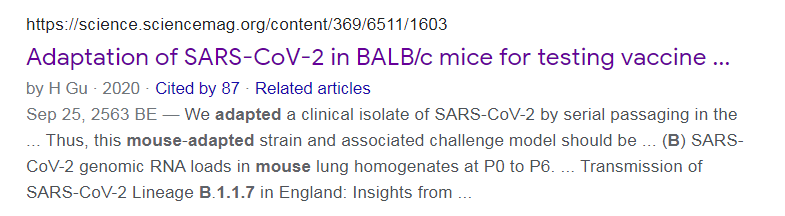
@NBA @StephenKissler @yhgrad We adapted a clinical isolate of SARS-CoV-2 by serial passaging in the ... Thus, this mouse-adapted strain and associated challenge model should be ... (B) SARS-CoV-2 genomic RNA loads in mouse lung homogenates at P0 to P6.
https://t.co/I90OOCJg7o
@NBA @StephenKissler @yhgrad 1. From Day 1, SARS-COV-2 was very well adapted to humans .....and transgenic hACE2 Mice
1. From Day 1, SARS-COV-2 was very well adapted to humans .....and transgenic hACE2 Mice
— Billy Bostickson \U0001f3f4\U0001f441&\U0001f441 \U0001f193 (@BillyBostickson) January 30, 2021
"we generated a mouse model expressing hACE2 by using CRISPR/Cas9 knockin technology. In comparison with wild-type C57BL/6 mice, both young & aged hACE2 mice sustained high viral loads... pic.twitter.com/j94XtSkscj
@NBA @StephenKissler @yhgrad 2. High Probability of serial passaging in Transgenic Mice expressing hACE2 in genesis of SARS-COV-2
1. High Probability of serial passaging in Transgenic Mice expressing hACE2 in genesis of SARS-COV-2!
— Billy Bostickson \U0001f3f4\U0001f441&\U0001f441 \U0001f193 (@BillyBostickson) January 2, 2021
2 papers:
Human\u2013viral molecular mimicryhttps://t.co/irfH0Zgrve
Molecular Mimicryhttps://t.co/yLQoUtfS6s https://t.co/lsCv2iMEQz
@NBA @StephenKissler @yhgrad B.1.1.7 has an unusually large number of genetic changes, ... found to date in mouse-adapted SARS-CoV2 and is also seen in ferret infections.
https://t.co/9Z4oJmkcKj
@NBA @StephenKissler @yhgrad We adapted a clinical isolate of SARS-CoV-2 by serial passaging in the ... Thus, this mouse-adapted strain and associated challenge model should be ... (B) SARS-CoV-2 genomic RNA loads in mouse lung homogenates at P0 to P6.
https://t.co/I90OOCJg7o