Let's understand FII and DII flows (or institutional flows) in India with data. A short thread🧵.

1/n

2/n

Market cap of listed universe: ~INR 180 TN (lakh crore)
Top 100 companies by market cap: 146 TN (~80%)
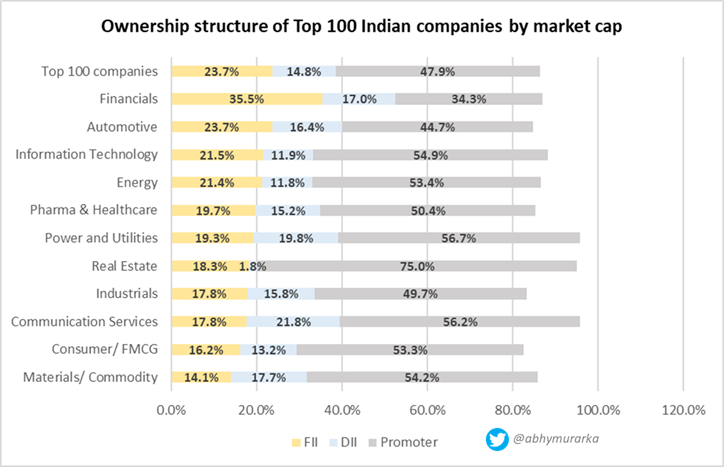
Ownership for Top 100 (FII/DII/ Prom): 24%/15%/48%
Highest FII share: Banking & Financials (36%)
Lowest FII share: Materials & commodities (14%)

Sector wise ownership 👇
3/n

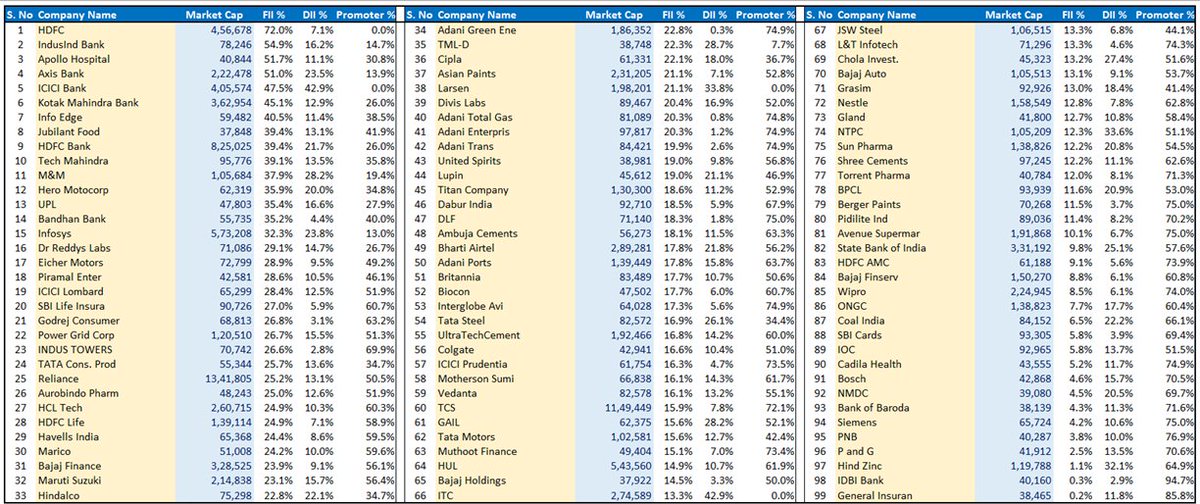
Ownership structure of Top 100 companies at December 2020 is shared below (sorted in descending order of FII). Notice that companies with high FII holding are more susceptible to direction of FII flows.

List sorted by market cap here: https://t.co/wVUgGOMMEn
4/n

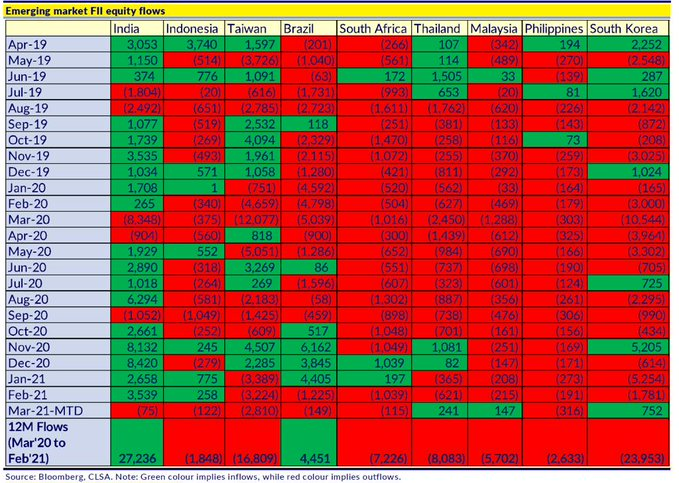
Over last 2 years and especially post the March 20 crash, India has been the cynosure of FIIs emerging market play. We are seeing the first sign of break now in March given macro cues.

Note: March data till 14th (Source: CLSA)
5/n

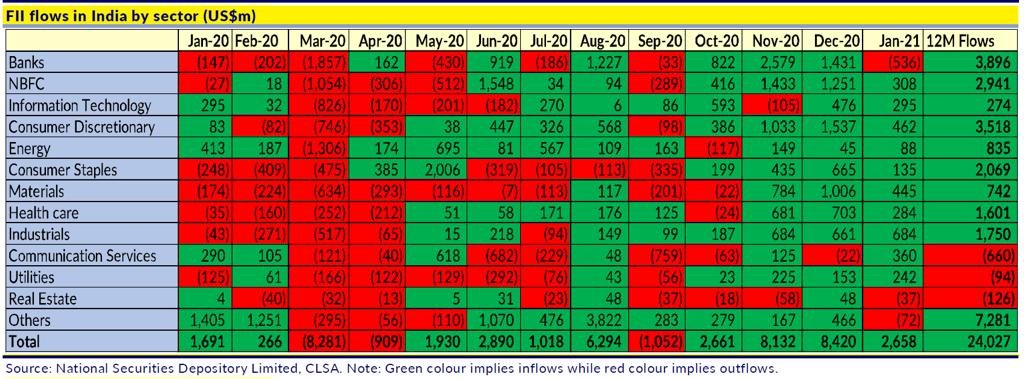
Here is how the FII flows in India stack up across sectors. Largest flows in Banks followed by Consumer discretionary. (Source: CLSA)
6/n
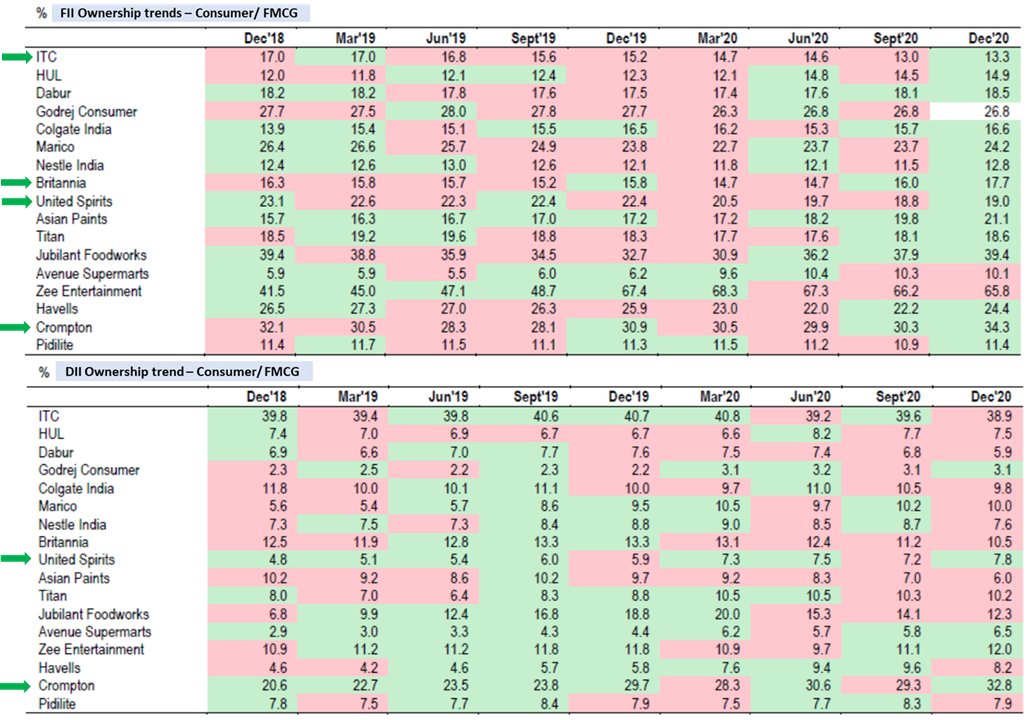
Let me take your attention back to Tweet 2. Consumer & FMCG had the second lowest FII allocation. There are signs of change there.

Check FII holding across key FMCG/ Consumer companies over 2 years. See that change in Dec quarter? Marked out few names. One for the ITC bulls.
7/n

So who are these FIIs?

Large FIIs are mainly Sovereign Wealth funds, ETFs with total global assets in trillions of dollars. Emerging markets are approx. 10% allocation. Thus a small allocation change for India means huge inflows in $ terms.

List of largest FIIs in India👇
8/n

Trivia: LIC, the largest DII, holds market value of INR 7.46 lakh crores (~4.2% of overall market cap of India). Equivalent of holdings of Top 5 FIIs in India.

Working on some data on small and midcap holdings of FIIs and increases therein. More on that later.

/End
Now this has taken some time and effort over the weekend. Show some love and RT if this helped.
Also, happy to take any questions around this topic of FII/ DII. Think I understand a bit after this exercise. Shoot.

You May Also Like

1/12

RT-PCR corona (test) scam

Symptomatic people are tested for one and only one respiratory virus. This means that other acute respiratory infections are reclassified as


2/12

It is tested exquisitely with a hypersensitive non-specific RT-PCR test / Ct >35 (>30 is nonsense, >35 is madness), without considering Ct and clinical context. This means that more acute respiratory infections are reclassified as


3/12

The Drosten RT-PCR test is fabricated in a way that each country and laboratory perform it differently at too high Ct and that the high rate of false positives increases massively due to cross-reaction with other (corona) viruses in the "flu


4/12

Even asymptomatic, previously called healthy, people are tested (en masse) in this way, although there is no epidemiologically relevant asymptomatic transmission. This means that even healthy people are declared as COVID


5/12

Deaths within 28 days after a positive RT-PCR test from whatever cause are designated as deaths WITH COVID. This means that other causes of death are reclassified as
"I really want to break into Product Management"

make products.

"If only someone would tell me how I can get a startup to notice me."

Make Products.

"I guess it's impossible and I'll never break into the industry."

MAKE PRODUCTS.

Courtesy of @edbrisson's wonderful thread on breaking into comics –
https://t.co/TgNblNSCBj – here is why the same applies to Product Management, too.


There is no better way of learning the craft of product, or proving your potential to employers, than just doing it.

You do not need anybody's permission. We don't have diplomas, nor doctorates. We can barely agree on a single standard of what a Product Manager is supposed to do.

But – there is at least one blindingly obvious industry consensus – a Product Manager makes Products.

And they don't need to be kept at the exact right temperature, given endless resource, or carefully protected in order to do this.

They find their own way.