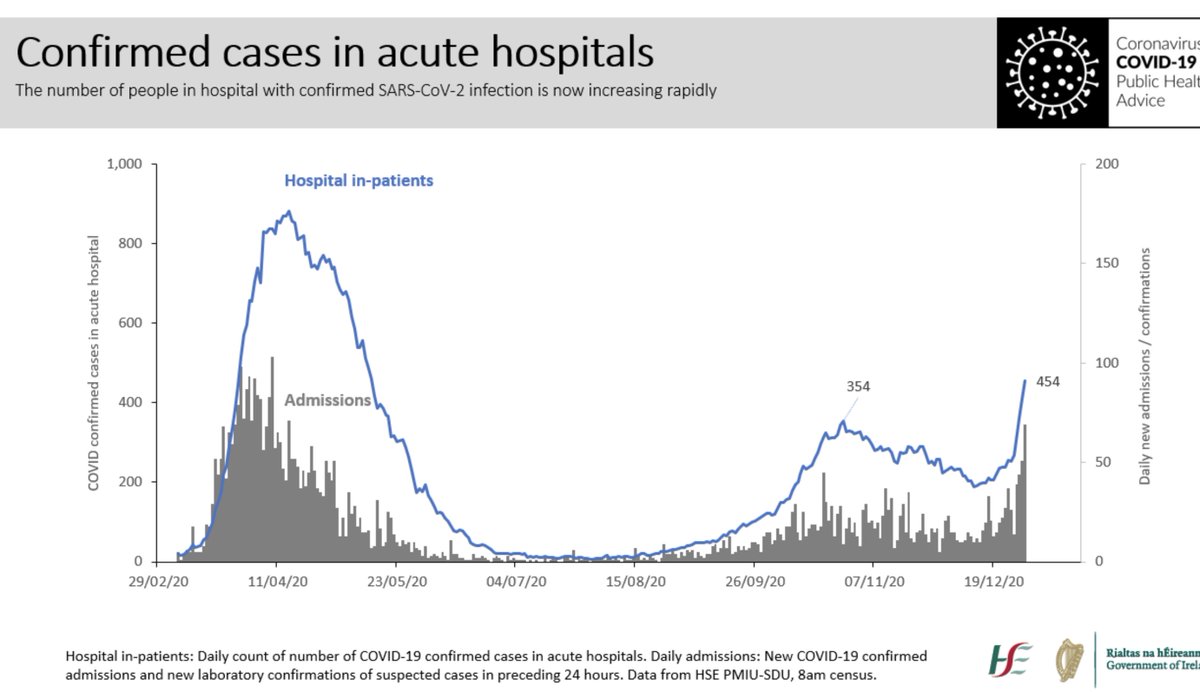
Thread contd: Gap was 4,000 yesterday. Now it's much bigger again.
The system wasn't designed to handle the influx of testing, Prof Nolan said he's accounted for it in models.
This means confirmed cases are not representative. It's worse than it looks, if looking at just cases.
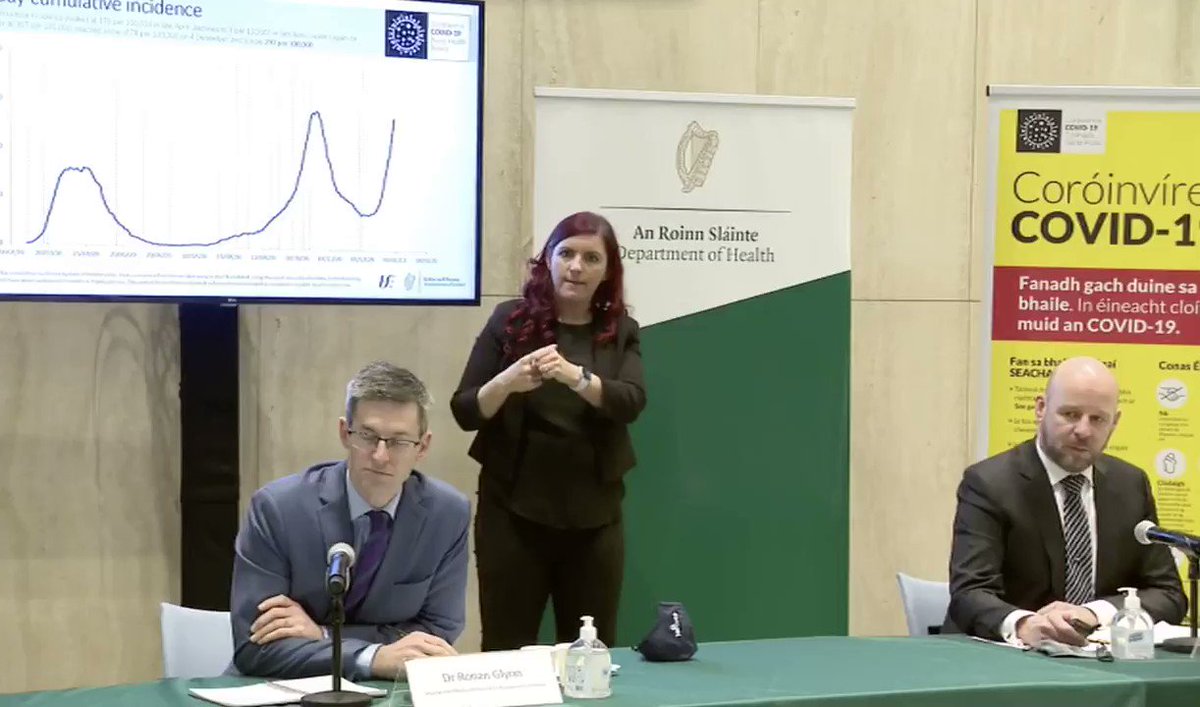
The ESRI provides health capacity modelling. If we get R back below 1 very soon, we'll be looking at 700 to 1000 people in hospital with Covid at the one time in January.
Early pandemic peak was 880.
https://t.co/Ay2RsAtMaR
Last time we peaked like that the health system was essentially closed to nearly all but Covid, the aim is avoid needing to do that.
That's one thing, but as they haven't been tested, we won't in any sense be tracking *their* contacts.
https://t.co/wunyr99AOa
2021 will be brighter for sure. But firstly we need to get the spread of the virus back under control. Positivity rates yesterday at 22% with some centres reaching 50%. It's quite rampant & high risk. But we can turn this around again. Let's do it. @HSELive #COVID19
— Paul Reid (@paulreiddublin) January 1, 2021
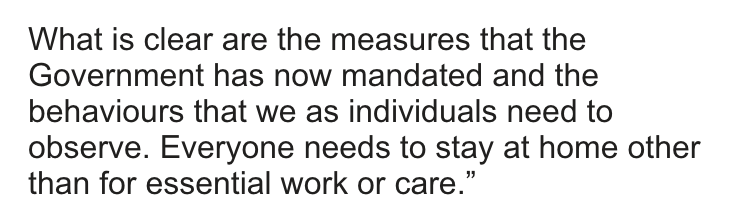
Press release today, Dr Holohan, the message isn't complex:
Hospitalisations and ICU figures are most relevant for next period.
There is no indication it makes people sicker than any other version, and scientists are confident the vaccines will still work with it.
Hopefully that's brought both you who read this far up to date.
Mega thread on seismic few days of the pandemic in Ireland.
— Mark_Coughlan (@Mark_Coughlan) January 1, 2021
\U0001f4cdThe govt implemented level five.
\U0001f4cdMore info about the UK variant.
\U0001f4cdAnd NPHET held one of the most important briefings in months on New Years Eve.
What's happened and where does it leave us now?
Further testing this week of #SARSCoV2 samples dating from #December 23rd to 29th has detected 9 additional #UKvariant cases in #Ireland. This brings the total number of cases identified @nvrlucdireland to 16 (of 169 tested to date) 1/2 https://t.co/gBEy0VjXO7
— Cillian De Gascun (@CillianDeGascun) January 1, 2021
You May Also Like
Week 1 highlights: getting shortlisted for YC W2019🤞, acquiring a premium domain💰, meeting Substack's @hamishmckenzie and Stripe CEO @patrickc 🤩
2/ So what is Brew?
brew / bru : / to make (beer, coffee etc.) / verb: begin to develop 🌱
A place for you to enjoy premium content while supporting your favorite creators. Sort of like a ‘Consumer-facing Patreon’ cc @jackconte
(we’re still working on the pitch)
3/ So, why be so transparent? Two words: launch strategy.
jk 😅 a) I loooove doing something consistently for a long period of time b) limited downside and infinite upside (feedback, accountability, reach).
cc @altimor, @pmarca
4/ https://t.co/GOQJ7LjQ2t domain 🍻
It started with a cold email. Guess what? He was using BuyMeACoffee on his blog, and was excited to hear about what we're building next. Within 2w, we signed the deal at @Escrowcom's SF office. You’re a pleasure to work with @MichaelCyger!
5/ @ycombinator's invite for the in-person interview arrived that evening. Quite a day!
Thanks @patio11 for the thoughtful feedback on our YC application, and @gabhubert for your directions on positioning the product — set the tone for our pitch!
This New York Times feature shows China with a Gini Index of less than 30, which would make it more equal than Canada, France, or the Netherlands. https://t.co/g3Sv6DZTDE
That's weird. Income inequality in China is legendary.
Let's check this number.
2/The New York Times cites the World Bank's recent report, "Fair Progress? Economic Mobility across Generations Around the World".
The report is available here:
3/The World Bank report has a graph in which it appears to show the same value for China's Gini - under 0.3.
The graph cites the World Development Indicators as its source for the income inequality data.
4/The World Development Indicators are available at the World Bank's website.
Here's the Gini index: https://t.co/MvylQzpX6A
It looks as if the latest estimate for China's Gini is 42.2.
That estimate is from 2012.
5/A Gini of 42.2 would put China in the same neighborhood as the U.S., whose Gini was estimated at 41 in 2013.
I can't find the <30 number anywhere. The only other estimate in the tables for China is from 2008, when it was estimated at 42.8.