A few years ago, researchers
@NJCummins @GregoryClarkUCD tracked how the descendants of rich people who died between 1858-1887 got on.
Britain has since gotten more equal. But 5 generations later, those families who were rich in Victorian Britain were still rich in the 2000s!
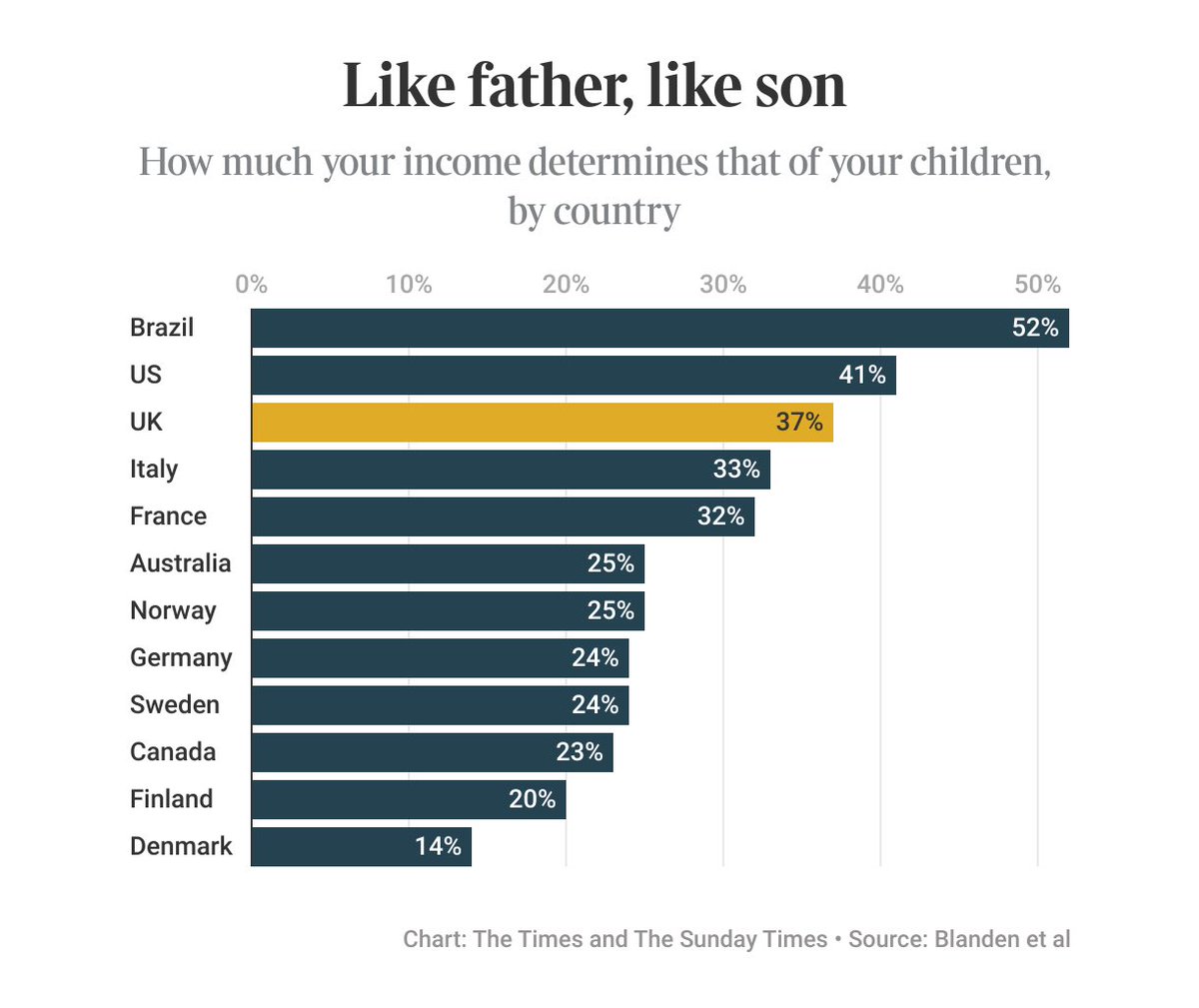
It's therefore not surprising that the link between your parents' income and yours is strong in Britain, at least compared with other countries
In the Nordic countries, where wealth is distributed more evenly, it's harder to predict what you'll earn by looking at your parents
British families have always been good at passing down wealth.
But today, it matters more, even if millennials won't inherit until they're 61.
Young people are much less wealthy than their parents were at the same age..
How did this happen? Three things stand out..
💰 Final salary pension schemes - many of which are now closed - allowed baby boomers to accumulate huge sums of wealth
📈 Stock market performance since the 1980s
🏡 The third is property. Baby boomers bought much earlier than Millennials did.
This meant they were able to benefit from house price growth for longer…
… and there was *a lot* of house price growth since baby boomers have bought their homes.
British homes have soared in price more than any other G7 nation, thanks partly to tight planning rules
For property purchases in Greater London, the average first-time buyer deposit is now a whopping £125,000
Most people who do buy in the capital, therefore, are turning to their wealthier parents...
The bank of Mum and Dad lends
£7.4bn a year to property purchases, making it the tenth-largest lender in Britain.
In fact, we are very unusual in our gift-giving: 20% of 🇬🇧 under-35s have received a substantial gift, vs 2% of those in 🇺🇸
The trouble is, this isn't really evening out inter-generational inequality.
Research from
@ThelFS shows that people on higher incomes are much more likely to receive cash from their family
Actually, as Lord Willets
@resfoundation says, inheritance is much more egalitarian than gift giving, namely because home ownership is so high among pensioners…
More on what this means in tomorrow's Sunday Times
https://t.co/8PVzDjDw7y