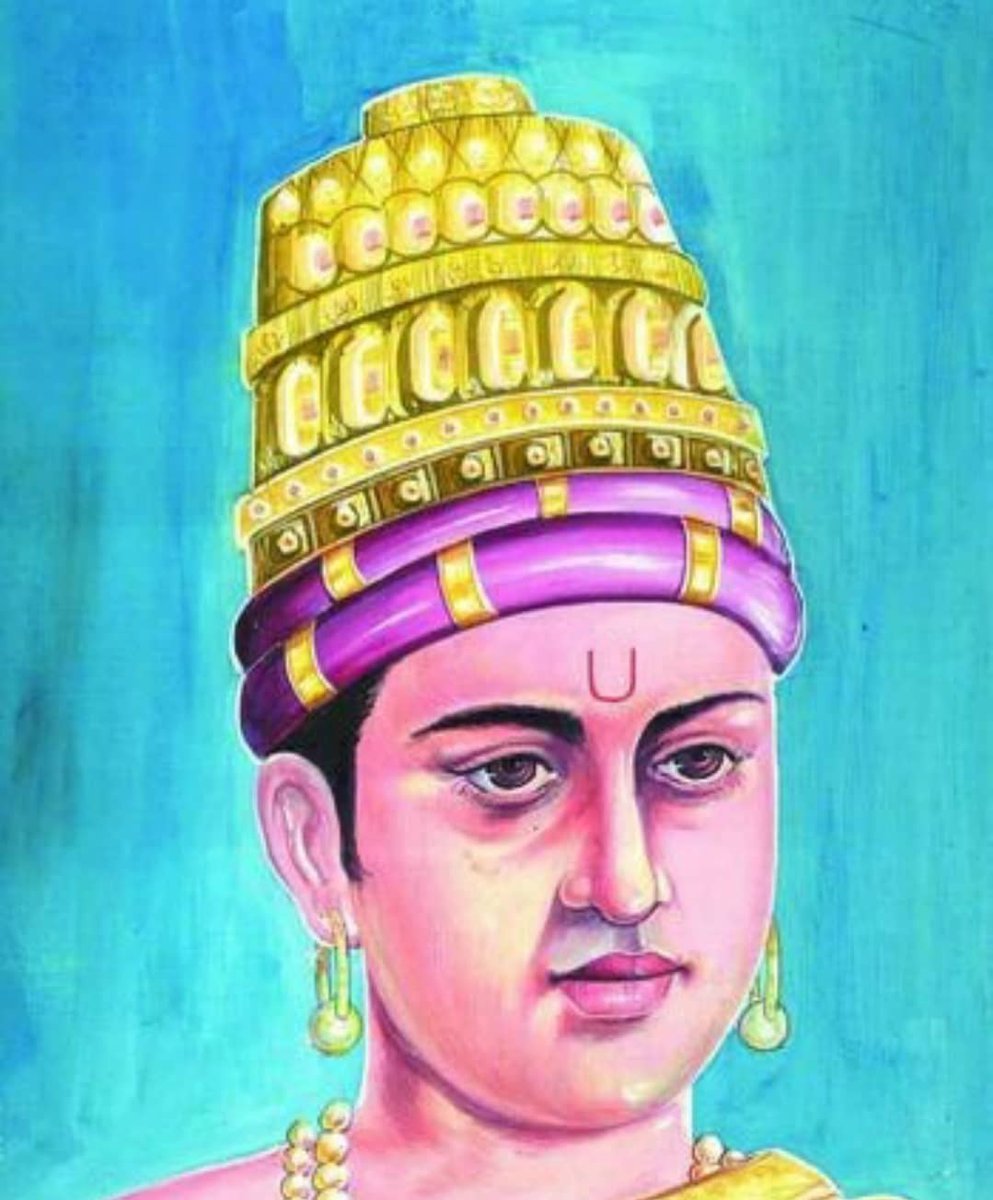
Dakshinapatheshwara Pulakeshi

After the death of Kirtivarman, his son Pulakesin II was too young to rule, so his uncle Mangalesa, held sway as regent. But when Pulakesi came of age, Mangalesa did not hand over the kingdom to his nephew and wanted to grab it permanently.

Thereupon, Pulakesin II gathered the army, defeated & killed his uncle in the battle & proclaimed himself king in 609 CE.

He emerged as the greatest king of the Chalukyas. His accession to the throne in the year 609 CE, marks the beginning of an important epoch in the history.
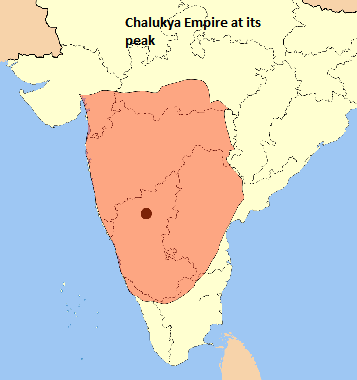
The Chalukyas who remained until then as a local power, confined to Karnataka and Southern Maharashtra, spread over the whole of the Deccan and became paramount sovereigns of the entire peninsula to the South of Vindhyas.

His Aihole inscription narrates his victorious campaigns
and of his great qualities. These included victories against the Kadambas of Banavasi, Alupas and Gangas of Mysore. Dhurvinita the Ganga ruler accepted his overlord ship and even gave his daughter in marriage to Pulakesin II, and she became the mother of Vikramaditya I.
The Latas, Malwas and Gurjaras also offered their submission to him because of their fear of Harshavardhana of Kanauj. After this Pulakesin II defeated the rulers of Kosala, vishnukundins, Kalinga, Pistapura and the Banas of Rayalaseema too.
His greatest achievement was his victory over Harsha on the banks of river Narmada in 630 CE. Thus the river Narmada became a border line between the two powerful empires.
This fact has been recorded in the Aihole Prasasti and also in the writings of Hieun Tsang.
The Chinese, Hiuen Tsang paid a visit to the Chalukya kingdom and was highly impressed by the power and efficiency of the administration of Pulakesin II. Hiuen Tsang's description is quite useful in knowing the social and economic conditions of the Chalukyas of Badami.
The present day Maharashtra, West coast, East coast of Andhra and Gujarat were included in his empire.

Pulakesin's first expedition against the Pallava kingdom, which was then ruled by Mahendravarman I was a complete success & he annexed the northern part of the Pallava kingdom.
He again invaded the Pallavas, but the Pallavas now under Narasimhavarman I, defeated and killed Pulakesin II and captured Badami.

Please Follow @CliosChronicles for more historical content : )
All the images are just for representation purpose only.

Info source: IGNTU eContent (by DrJanardhanaB)

More from All

You May Also Like

The UN just voted to condemn Israel 9 times, and the rest of the world 0.

View the resolutions and voting results here:

The resolution titled "The occupied Syrian Golan," which condemns Israel for "repressive measures" against Syrian citizens in the Golan Heights, was adopted by a vote of 151 - 2 - 14.

Israel and the U.S. voted 'No'
https://t.co/HoO7oz0dwr


The resolution titled "Israeli practices affecting the human rights of the Palestinian people..." was adopted by a vote of 153 - 6 - 9.

Australia, Canada, Israel, Marshall Islands, Micronesia, and the U.S. voted 'No' https://t.co/1Ntpi7Vqab


The resolution titled "Israeli settlements in the Occupied Palestinian Territory, including East Jerusalem, and the occupied Syrian Golan" was adopted by a vote of 153 – 5 – 10.

Canada, Israel, Marshall Islands, Micronesia, and the U.S. voted 'No'
https://t.co/REumYgyRuF


The resolution titled "Applicability of the Geneva Convention... to the
Occupied Palestinian Territory..." was adopted by a vote of 154 - 5 - 8.

Canada, Israel, Marshall Islands, Micronesia, and the U.S. voted 'No'
https://t.co/xDAeS9K1kW
I'm going to do two history threads on Ethiopia, one on its ancient history, one on its modern story (1800 to today). 🇪🇹

I'll begin with the ancient history ... and it goes way back. Because modern humans - and before that, the ancestors of humans - almost certainly originated in Ethiopia. 🇪🇹 (sub-thread):


The first likely historical reference to Ethiopia is ancient Egyptian records of trade expeditions to the "Land of Punt" in search of gold, ebony, ivory, incense, and wild animals, starting in c 2500 BC 🇪🇹


Ethiopians themselves believe that the Queen of Sheba, who visited Israel's King Solomon in the Bible (c 950 BC), came from Ethiopia (not Yemen, as others believe). Here she is meeting Solomon in a stain-glassed window in Addis Ababa's Holy Trinity Church. 🇪🇹


References to the Queen of Sheba are everywhere in Ethiopia. The national airline's frequent flier miles are even called "ShebaMiles". 🇪🇹