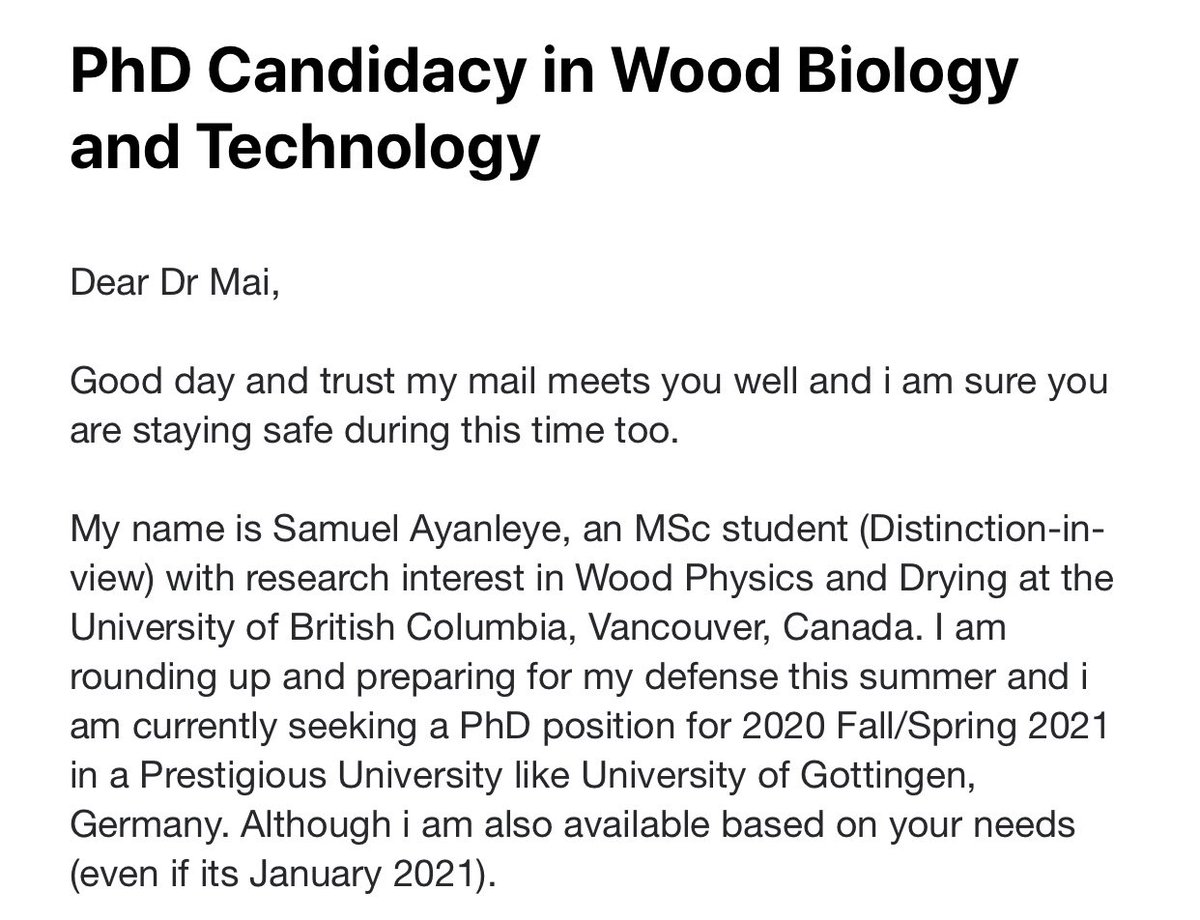
I have been sending emails to supervisors since I was a 1st year MSc student
@ubcforestry @UBC and I can say I have at least 70% success rate (positive response) and if you want to know the steps; then you have it here.
2/n
1. Use catchy subjects: I know some people still think it doesn’t matter how they write the subjects of their emails but will tell you, it matters. Should I call it negligence when you don’t even have a subject when writing a professor that receives about 300 emails per 3/n
day? (because my MSc supervisor at UBC receives about 300 emails per day). You need something that will catch their attention. I know there is no one way answer to this BUT you can use something like “Statement of Research Interest”, “MSc/PhD Candidacy in Wood Drying”
4/n
or write a subject based on the advertised position. You just want them to open that email and read.
2. Research Experience/Skills: I have noticed that most of the profs like it when you talk about your experience/skills working on several projects in that field, laboratory 5/n
experience? using certain equipments? Data analysis? publishing academic articles? Collaborations? Communication (scientific presentations) to mention but few. You need to talk about these things to assess your fit for a Graduate program. After this, you can then match the
6/n
experience/skills with their current projects, how will those help you in the MSc and PhD project? will they make you successful in Graduate school?Do you have something to offer based on them? Is it possible to complete projects for them based on your skills and expertise ?
7/n
If you have anything extra to add, you can BUT don’t be wordy (you don’t want to bore them right ?).
3. Specific Lab Interest: The most important thing to talk about here is doing your background research very well that you have a good idea of what the lab is all about
8/n
Supervisors interest? Current projects? Publications ? Here, you can talk about why you are interested in that lab/project, how it fits into your own research interests and long term career plans. You just need to structure your write-up in a way that it is not convoluted and
9/n
confusing. From the attached images, you can check how I put all these things together for PhD Position in Wood science. You must not follow the exact style but adapt it to your use. As a note, I got a YES from that professor who is like the Father of Wood Modification
10/n
in Europe.
4. Talk about your achievements: You need to let the professor know you are qualified to be in his lab. Talk about your overall achievements; grades? publications? conference attended? academic presentations? research collaborations? among others.
11/n
Some of them will later check you out on Research gate and google scholar. They might be impressed and want to give you a chance. Don’t sound too proud but let them know you have an interesting profile they can work it and MOST IMPORTANTLY
12/n
that you have something to offer.
5. Structure: You can have the statement of research interest in MS WORD (to be attached), then add few details in the body of the email. Also, don’t forget to attach your well written CV and transcripts (some want to see the courses you
13/n
have taken in previous degree (S). You can also have the statement of RI in the body of the email (well written) and attach other documents. They both work for people, although I use the 1st method because I think some wants a conviction before they open the attached files
14/n
N.B: For an advertised position, you should talk about how you can contribute to the project advertised based on your past research experience, skills and expertise. Tell them you are also available for further conversations about the project through informal and formal
15/n
meetings. I may not have covered everything but I am sure you will be good following these tips (all tips based on my personal experience). I wish you all the best in your pursuits.