In 1937, a trucker got frustrated waiting for his cargo to be unloaded. He later sold his company for $1.1 billion.

Here’s the story of how Malcom McLean made a billion dollars and which startup could be following in his footsteps. (Inspired by our episode with @laurabehrenswu)

In the early 1950s, the shipping industry was a dying business.

New York’s docks were handling half as much domestic cargo in the early 1950s as they had been in the depressed 1930s.

In thirty years, no one had invested significant money in coastal shipping.
Why?

As McLean found out, loading ships was difficult and slow.

A truck or train would deliver items to the port. Each item was unloaded separately, recorded, and carried to storage.

When a ship was ready, each item was taken from storage, counted again, and hauled on-board.
The cost of this labor was significant. As one expert at the time explained:

“A four-thousand-mile voyage for a shipment might consume 50 percent of its costs in covering just the two ten-mile movements through two ports.”
Yet, despite the industry’s issues, it felt little pressure to change.

Foreigners were barred from operating domestically. Cartels ran international routes. And gov. subsidies eased the pain of labor costs.

Reshaping the industry needed an outsider.

Enter Malcolm McLean.
In 1953, McLean owned one of the largest trucking companies in America.

But he worried that domestic shipping lines would undercut his business. Highway traffic was getting worse and shipping costs were falling as the government gave away war-surplus ships for next to nothing.
His memory of Thanksgiving 1937 resurfaced.

Why not bypass traffic by driving truck trailers onto ships?

Ships would then move trailers between North Carolina, New York City, and Rhode Island, circumventing traffic jams at a time when expressways were few and far between.
After some thought, he reconsidered.

The wheels beneath each trailer would waste precious space. Pondering that problem, McLean came up with a more radical idea.

Leave the wheels and chassis, load the container. That would reduce the space each trailer needed by one-third.
But to make that happen, McLean needed to buy and convert old WWII tankers.

The Interstate Commission said no. He couldn't own both a shipping and trucking company.

McLean chose shipping.

In 1955, he made $6 million ($60m today) on the sale of McLean Trucking.
One year and no small amount of problems later, McLean’s vision sailed into reality.

On April 26, 1956, 100 dignitaries watched a purpose-built crane place a container on the Ideal-X every seven minutes. The ship was loaded in less than eight hours and set sail the same day.
For McLean, Ideal-X’s real triumph came when the costs were tallied.

Loading loose cargo on a medium-size cargo ship cost $5.83 per ton in 1956. McLean’s experts pegged the cost of loading the Ideal-X at $0.15 per ton.

With numbers like that, the container had a future.
And so it proved.

McLean wasn’t the first to suggest containerization. But he was the first to understand that the future of shipping required not just a metal box but an entirely new way of handling freight.

Today, the US shipping industry alone is worth $700bn.
McLean built a billion-dollar business by taking a problem he experienced and solving it for everyone.

Laura Behrens Wu, this week’s FFG guest, is doing the same. She’s making shipping easier in the internet age.

McLean 2.0? Listen to find out:

https://t.co/vP8POjAEfb
Both stories beg this question for aspiring entrepreneurs:

If you’re struggling for business ideas, what problem do you face that you’re sure other people struggle with too?

Start there. Solve that problem. As Laura shows, you may find it’s a huge market.
If you want to learn more about Malcom McLean, read Marc Levinson’s excellent book, ‘The Box’.

It pairs well with @patrick_oshag and @LauraBehrensWu's conversation about Shippo and how to build a digital business in the physical world of shipping.

https://t.co/zCZWTiFOsj

More from History

Folks who don't know history just tweet whatever they want.

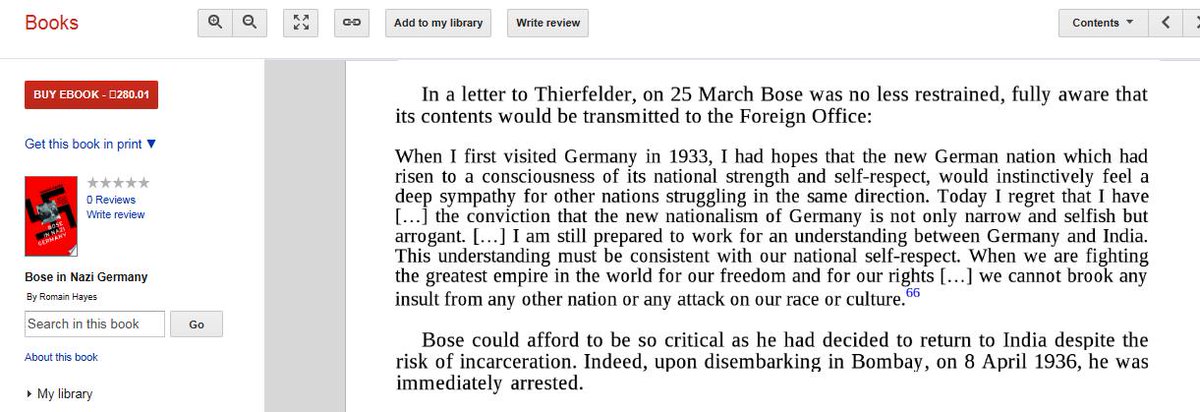
On Feb 1935, Bose attacked the Nazis as he was angry as Indians were described as Sub-Humans in Mein Kampf. The British arrested Bose in April 1936, because he insulted the Nazis.

#Thread


The West at this point had a soft spot for the Nazis. France, Great Britain, Netherlands, Poland all gave the Nazi Salute during the 1936 Olympics in Berlin.

Even during the Spanish Civil War (1936 - 1939), the Western powers observed neutrality as the Fascists rose in Spain.


In 1937, Hitler told British Foreign Secretary Lord Halifax that one of his fav movies was ‘The Lives of a Bengal Lancer’. Why?

‘The Lives of a Bengal Lancer’ depicted a handful of "superior race" Brits holding sway over an entire Indian subcontinent (Sub-Humans).

"Shoot Gandhi. If necessary, shoot more Congress Leaders (Nehru & Bose)."

- Hitler to Lord Halifax, Britain's Foreign Secretary

This statement by Hitler in 1937 angered many pro-Leftist leaders of the INC including Bose.

Bose reached London in Jan 1938, and he met many leaders of the British Labour Party including Attlee.

1938 & 1939 were two huge years for the Indian National Congress. As i always say, the 10-year phase from 1938 - 1948 shaped modern India and it began in 1938 Haripura session.

You May Also Like

॥ॐ॥
अस्य श्री गायत्री ध्यान श्लोक:
(gAyatri dhyAna shlOka)
• This shloka to meditate personified form of वेदमाता गायत्री was given by Bhagwaan Brahma to Sage yAgnavalkya (याज्ञवल्क्य).

• 14th shloka of गायत्री कवचम् which is taken from वशिष्ठ संहिता, goes as follows..


• मुक्ता-विद्रुम-हेम-नील धवलच्छायैर्मुखस्त्रीक्षणै:।
muktA vidruma hEma nIla dhavalachhAyaiH mukhaistrlkShaNaiH.

• युक्तामिन्दुकला-निबद्धमुकुटां तत्वार्थवर्णात्मिकाम्॥
yuktAmindukalA nibaddha makutAm tatvArtha varNAtmikam.

• गायत्रीं वरदाभयाङ्कुश कशां शुभ्रं कपालं गदाम्।
gAyatrIm vardAbhayANkusha kashAm shubhram kapAlam gadAm.

• शंखं चक्रमथारविन्दयुगलं हस्तैर्वहन्ती भजै॥
shankham chakramathArvinda yugalam hastairvahantIm bhajE.

This shloka describes the form of वेदमाता गायत्री.

• It says, "She has five faces which shine with the colours of a Pearl 'मुक्ता', Coral 'विद्रुम', Gold 'हेम्', Sapphire 'नील्', & a Diamond 'धवलम्'.

• These five faces are symbolic of the five primordial elements called पञ्चमहाभूत:' which makes up the entire existence.

• These are the elements of SPACE, FIRE, WIND, EARTH & WATER.

• All these five faces shine with three eyes 'त्रिक्षणै:'.
A brief analysis and comparison of the CSS for Twitter's PWA vs Twitter's legacy desktop website. The difference is dramatic and I'll touch on some reasons why.

Legacy site *downloads* ~630 KB CSS per theme and writing direction.

6,769 rules
9,252 selectors
16.7k declarations
3,370 unique declarations
44 media queries
36 unique colors
50 unique background colors
46 unique font sizes
39 unique z-indices

https://t.co/qyl4Bt1i5x


PWA *incrementally generates* ~30 KB CSS that handles all themes and writing directions.

735 rules
740 selectors
757 declarations
730 unique declarations
0 media queries
11 unique colors
32 unique background colors
15 unique font sizes
7 unique z-indices

https://t.co/w7oNG5KUkJ


The legacy site's CSS is what happens when hundreds of people directly write CSS over many years. Specificity wars, redundancy, a house of cards that can't be fixed. The result is extremely inefficient and error-prone styling that punishes users and developers.

The PWA's CSS is generated on-demand by a JS framework that manages styles and outputs "atomic CSS". The framework can enforce strict constraints and perform optimisations, which is why the CSS is so much smaller and safer. Style conflicts and unbounded CSS growth are avoided.