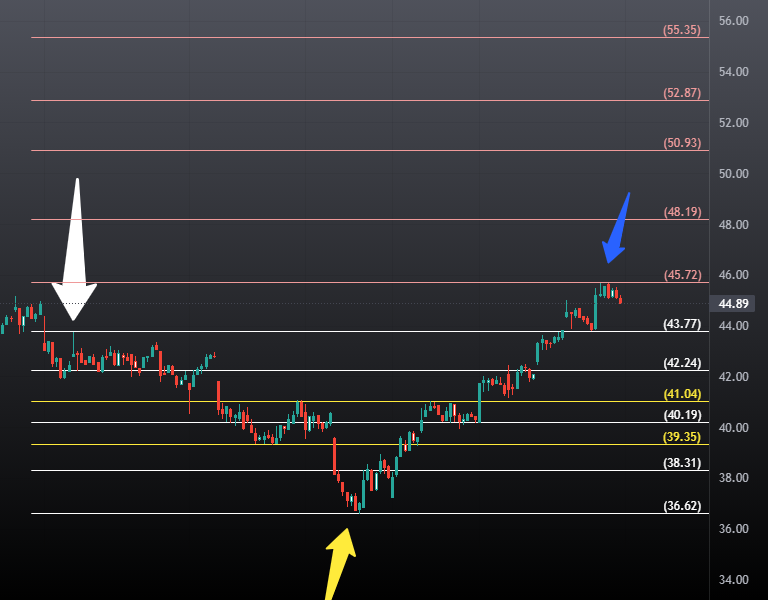
A process requires an edge which is simply a statistical advantage you have over other players. A strong psychological state can be considered a bonus edge.
A COMPLETE BREAKDOWN OF MY MOMENTUM DAY TRADING PROCESS.
[THREAD]
A process requires an edge which is simply a statistical advantage you have over other players. A strong psychological state can be considered a bonus edge.
1) Knowledge and idea generation
2) Method and trade execution
3) Risk management and mindset
Each element is necessary and it builds a solid foundation in your trading process.
These factors make up the trading trinity.
In PM, I look for:
- Top gainers (40%+)
- Notable volume on gappers
- News or catalysts (to justify gap)
- Float (<50M)
- Market cap (<500M)
- Range (check daily)
- Price (<25)
- Stock personality (check daily)
- Filings (cash on hand and offering potential)
- https://t.co/dGrDjwtOR8
- https://t.co/Vc256oZCre
- https://t.co/AFrA2ebGr6
- https://t.co/N9nDmqz54E
- https://t.co/0aEt36amzx
- https://t.co/K5b5oercFQ
- https://t.co/VogPh4QNHM
- https://t.co/OoMHVH19CX
I hone in on my top 2.
Also, I have any names that have had momentum and held trend in the prior days as back burner watches since they may see continuation.
I want to identify:
- Prior ranges (since I believe stocks will trade in ranges until they breakout/down)
- Key levels from the daily
- PML and PMH
Also, I take note of the trend and the 50 and 200 SMA.
INDICATORS:
- 9 EMA = Red
- 20 EMA = Light Blue
- 50 SMA = Yellow
- 200 SMA = Green
- VWAP = Purple
- Volume Bars
TIME FRAMES:
- 5 Minute
- 1 Minute
- 1 Day
I prefer to dip buy most of the time because breakout trades require a certain market condition.
I try add as close to major key levels as possible for low risk/high reward.
When it comes down to a channel line or key level. I look to see if price respects that level for an entry with risk just beneath.
I don’t breakout add unless the market is hot. I would rather for a breakout and re-test and get my adds there.
I flick between the 1m and 5m and I mainly watch candle bodies.
Seasonal strategies are simply strategies that are high probability given the current market conditions.
*I go through and explain some strategies in my pinned tweet.
I constantly assess sentiment and I always ask myself: “Who’s in control and who’s stuck?”.
This helps me better understand the price action.
I love asymmetrical bets where risk/reward and probability is skewed heavily in my favor.
I have a max pain of 10% on a trade and I will risk <2.5% of my account on a trade.
You can calculate position size by:
Max risk / (Entry price - Stop price) = Position size
I believe these levels to be potential pivot points so I’m really strict at cutting my losses because if I carry on holding then price is likely to flush.
I don’t hold bags!
Either I will:
1) Scale most (50%+) on the first target and move my stop to entry
2) Let the stock work and only scale out small amounts (~10%) at key resistances and ride the trend based on the 20 EMA on the 5m
However, I take note of runners that remain strong and AH movers depending on their action and their close.
I will chart these names when market closes. I keep them on back burner watch the next day.
It’s what I find consistency, repeatability and profitability in.
It works for me but it may not work for you.
You can take this thread as a guideline and adapt it to fit your way of trading.
Ideally, I want an ADR% of 10+ because I’m interested in explosive momentum moves.
Also, you always want to keep an eye on volume. You don’t want volume to fall off a cliff for a trade you’re in.
Keep things simple and be able to do them time and time again with ease.
There’s no need to make things complex and sophisticated when they don’t need to be.
It’s better to have something straightforward where you just need to execute well.
In many ways, my strategy is inspired and derived from their own.
More from Tradingthread
Due Diligence Thread 🚨👇
In this thread I will be revealing to you guys my step by step process on how I do my due diligence on any ticker along with the process of how I find good setups and what resources and websites do I use to do it.
Step 1: Finding Good Chart Setups (continued)
Attached below is my personal finviz screener settings which I use to look at charts and how I
change some of the settings to my own preferences.
Site Reference: https://t.co/liI2ktnHhz
PS: Sometimes I don't even select any pattern
My favorite bullish chart setups that I personally look out for initiating swing positions:
1-) Falling Wedge Pattern
2-) Ascending Triangle Pattern
3-) Fish Hook / Oversold Bounce Pattern
4-) Channel Up Pattern
5-) Descending Triangle Breakout Pattern ( Towards Upside)
Step 2: Checking for Offerings
Once I have found a good chart, with a high risk reward ratio, the immediate first thing that I
do is to look out for any signs of upcoming offering. Since I don’t want to get caught in
offerings , these are the two things that I lookout for.
Step 2: Checking for Offerings (continued)
1-) Firstly, I look for whether the company had made any recent offerings in the last two months, if yes then there are less chances of new offerings.
In this thread I will be revealing to you guys my step by step process on how I do my due diligence on any ticker along with the process of how I find good setups and what resources and websites do I use to do it.
Step 1: Finding Good Chart Setups (continued)
Attached below is my personal finviz screener settings which I use to look at charts and how I
change some of the settings to my own preferences.
Site Reference: https://t.co/liI2ktnHhz
PS: Sometimes I don't even select any pattern
My favorite bullish chart setups that I personally look out for initiating swing positions:
1-) Falling Wedge Pattern
2-) Ascending Triangle Pattern
3-) Fish Hook / Oversold Bounce Pattern
4-) Channel Up Pattern
5-) Descending Triangle Breakout Pattern ( Towards Upside)
Step 2: Checking for Offerings
Once I have found a good chart, with a high risk reward ratio, the immediate first thing that I
do is to look out for any signs of upcoming offering. Since I don’t want to get caught in
offerings , these are the two things that I lookout for.
Step 2: Checking for Offerings (continued)
1-) Firstly, I look for whether the company had made any recent offerings in the last two months, if yes then there are less chances of new offerings.
Friends here we go 🗝️
12 solid videos each 1 HR long teaching you all I know on #Options and day trading 🚀
This is my gift to the world ❤️
All of your questions have been answered here 👇👇👇
Help me with a❤️so we can share the TRUTH with the
TradingWarz FREE Indicators TOS
Holy Grail by Rich
https://t.co/yi7xeIsSTX
Inside Power by Rich
https://t.co/J6J8wOMRj6
Doubles by Rich
https://t.co/Tb6RyFjBTd
Outside Power by Rich
https://t.co/Wpr9OlCjid
Leave a ❤️ to help me out
12 solid videos each 1 HR long teaching you all I know on #Options and day trading 🚀
This is my gift to the world ❤️
All of your questions have been answered here 👇👇👇
Help me with a❤️so we can share the TRUTH with the
TradingWarz FREE Indicators TOS
Holy Grail by Rich
https://t.co/yi7xeIsSTX
Inside Power by Rich
https://t.co/J6J8wOMRj6
Doubles by Rich
https://t.co/Tb6RyFjBTd
Outside Power by Rich
https://t.co/Wpr9OlCjid
Leave a ❤️ to help me out
You May Also Like
THREAD: 12 Things Everyone Should Know About IQ
1. IQ is one of the most heritable psychological traits – that is, individual differences in IQ are strongly associated with individual differences in genes (at least in fairly typical modern environments). https://t.co/3XxzW9bxLE
2. The heritability of IQ *increases* from childhood to adulthood. Meanwhile, the effect of the shared environment largely fades away. In other words, when it comes to IQ, nature becomes more important as we get older, nurture less. https://t.co/UqtS1lpw3n
3. IQ scores have been increasing for the last century or so, a phenomenon known as the Flynn effect. https://t.co/sCZvCst3hw (N ≈ 4 million)
(Note that the Flynn effect shows that IQ isn't 100% genetic; it doesn't show that it's 100% environmental.)
4. IQ predicts many important real world outcomes.
For example, though far from perfect, IQ is the single-best predictor of job performance we have – much better than Emotional Intelligence, the Big Five, Grit, etc. https://t.co/rKUgKDAAVx https://t.co/DWbVI8QSU3
5. Higher IQ is associated with a lower risk of death from most causes, including cardiovascular disease, respiratory disease, most forms of cancer, homicide, suicide, and accident. https://t.co/PJjGNyeQRA (N = 728,160)
1. IQ is one of the most heritable psychological traits – that is, individual differences in IQ are strongly associated with individual differences in genes (at least in fairly typical modern environments). https://t.co/3XxzW9bxLE
2. The heritability of IQ *increases* from childhood to adulthood. Meanwhile, the effect of the shared environment largely fades away. In other words, when it comes to IQ, nature becomes more important as we get older, nurture less. https://t.co/UqtS1lpw3n
3. IQ scores have been increasing for the last century or so, a phenomenon known as the Flynn effect. https://t.co/sCZvCst3hw (N ≈ 4 million)
(Note that the Flynn effect shows that IQ isn't 100% genetic; it doesn't show that it's 100% environmental.)
4. IQ predicts many important real world outcomes.
For example, though far from perfect, IQ is the single-best predictor of job performance we have – much better than Emotional Intelligence, the Big Five, Grit, etc. https://t.co/rKUgKDAAVx https://t.co/DWbVI8QSU3
5. Higher IQ is associated with a lower risk of death from most causes, including cardiovascular disease, respiratory disease, most forms of cancer, homicide, suicide, and accident. https://t.co/PJjGNyeQRA (N = 728,160)