
A generation of consumers became more risk averse, business investment & productivity slumped, and a large cohort of workers witnessed real declines in nominal incomes. 2/
This chart is the clearest representation of the immense damage that emanated from the GFC on the US economy.
In the ~60 years following WWII, US real GDP seemed to grow at ~3% trend like clockwork.
2008 marked the end of this trend, with growth downshifting to ~2% since. 1/

A generation of consumers became more risk averse, business investment & productivity slumped, and a large cohort of workers witnessed real declines in nominal incomes. 2/
The Fed's own estimate of R* now sits at 2.5%, down nearly 200 bps from its estimate in 2012. 3/

I don't think this is as far fetched as conventional wisdom makes it out to be. 4/
Think of the difference between someone who lived through the great depression versus someone who survived WWII. The latter was far more risk seeking than the former. 5/
When in history have we witnessed a ~10% decline in nominal GDP and a coincident 12% INCREASE in nominal income in the same quarter?! Never... 6/

At the beginning of 2020, household debt as a percentage of disposable income was at its lowest levels in ~20 years. 7/

This sounds trite, but the pandemic is a reminder that life is short. There is little point in waiting to start a business. And with HH B/S's healthy, there is no time like the present. 8/
US business applications have surged this year following years of stagnant growth. 9/


More from Trading

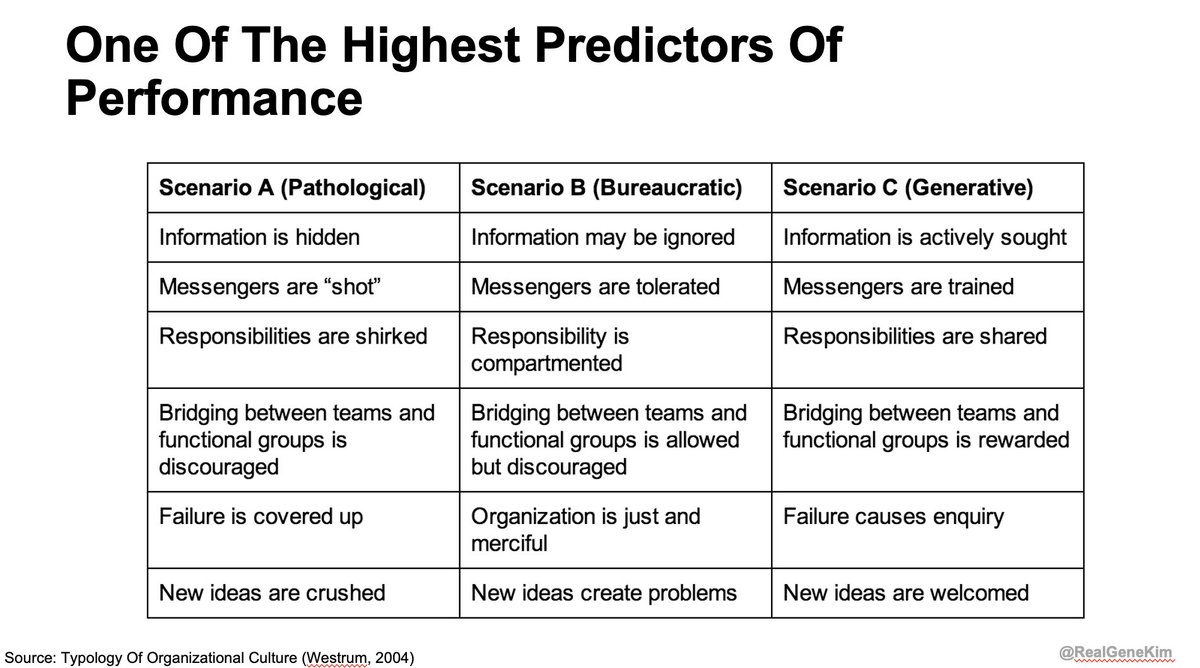
Many of you have seen the famous Westrum Organizational Typology model, so prominently featured in State of DevOps Research, Accelerate, DevOps Handbook, etc.
This model was created Dr. Ron Westrum, a widely-cited sociologist who studied the impact of culture on safety
Thanks to Dr. @nicolefv, I was able to interview him for an upcoming episode of the Idealcast! 🤯
It was a very heady experience, and while preparing to interview him, I was startled to discover how much work he's done in healthcare, aviation, spaceflight, but also innovation.
I've read 4+ of his papers, so I thought I was familiar with his work. (Here's one paper: https://t.co/7X00O67VgS)
I was startled to learn he has also studied in depth what enables innovation. He wrote a wonderful book "Sidewinder: Creative Missile Development at China Lake"

Dr. Westrum writes about China Lake Research Labs: "its design and structure had one purpose: to foster technical creativity. It did; China Lake operated far outside the normal envelope... Sidewinder & others were "impossible" accomplishments,
I love this book because it describes traits of organizations that routinely create and maintain greatness: US space program (Mercury, Gemini, Apollo), US Naval Reactors, Toyota, Team of Teams, Tesla, the tech giants (Amazon, Google, Netflix, Google)
This model was created Dr. Ron Westrum, a widely-cited sociologist who studied the impact of culture on safety
Thanks to Dr. @nicolefv, I was able to interview him for an upcoming episode of the Idealcast! 🤯
It was a very heady experience, and while preparing to interview him, I was startled to discover how much work he's done in healthcare, aviation, spaceflight, but also innovation.
I've read 4+ of his papers, so I thought I was familiar with his work. (Here's one paper: https://t.co/7X00O67VgS)
I was startled to learn he has also studied in depth what enables innovation. He wrote a wonderful book "Sidewinder: Creative Missile Development at China Lake"
Dr. Westrum writes about China Lake Research Labs: "its design and structure had one purpose: to foster technical creativity. It did; China Lake operated far outside the normal envelope... Sidewinder & others were "impossible" accomplishments,
I love this book because it describes traits of organizations that routinely create and maintain greatness: US space program (Mercury, Gemini, Apollo), US Naval Reactors, Toyota, Team of Teams, Tesla, the tech giants (Amazon, Google, Netflix, Google)


FREE MINI STOCK MBA
If you wish to learn abt trading,psychology,options,business etc
You can go through this thread.
Other than this I do post videos on my YT channel : -Abhishek Kar & Tradiostation
-Intraday views on FREE telegram : Abhishek Kar Official
RT will be appreciated
1. Threads to learn Options
https://t.co/wabkek43I8
2. https://t.co/OIDenHKdWN
3. Some core rules to investing
https://t.co/37d1pygp7P
4.Summing up 2020 Trading lessons
https://t.co/jSUb1lSGbQ
5.Effects of margin change on
6. Exciting story about a trader who destroyed a Bank
https://t.co/CsEEhIsD3q
7. Some Thought Provoking facts about stock markets
https://t.co/IjxpX5Wx24
8. A dose on Trading and investing
9. Top 5 resources to learn everything about stocks
https://t.co/6KnIySBGIG
10. Some Pro Tips on Trading
https://t.co/EiSGikt7jv
11. Wisdom on stuffs you should not do
https://t.co/bI2dH0XTSS
12. Reasons why you are losing the
13. The DARK side of stock market
https://t.co/qsteGcbquI
14. Stocks where you should NOT invest
https://t.co/2tD5q0K3UQ
15. Lessons from MILLIONAIRE trader
https://t.co/Pec6LmUtGa
16. Lessons from my
If you wish to learn abt trading,psychology,options,business etc
You can go through this thread.
Other than this I do post videos on my YT channel : -Abhishek Kar & Tradiostation
-Intraday views on FREE telegram : Abhishek Kar Official
RT will be appreciated
1. Threads to learn Options
https://t.co/wabkek43I8
2. https://t.co/OIDenHKdWN
3. Some core rules to investing
https://t.co/37d1pygp7P
4.Summing up 2020 Trading lessons
https://t.co/jSUb1lSGbQ
5.Effects of margin change on
\U0001d413\U0001d421\U0001d42b\U0001d41e\U0001d41a\U0001d41d \U0001d41f\U0001d428\U0001d42b \U0001d40e\U0001d429\U0001d42d\U0001d422\U0001d428\U0001d427\U0001d42c
— Abhishek Kar (@Abhishekkar_) December 29, 2020
The entire thread will have some quick pointers on options trading. These bullet points are based on experience and learning and even if you are completely new,will help you to build some perspective. So,lets go :
6. Exciting story about a trader who destroyed a Bank
https://t.co/CsEEhIsD3q
7. Some Thought Provoking facts about stock markets
https://t.co/IjxpX5Wx24
8. A dose on Trading and investing
\U0001d413\U0001d42b\U0001d41a\U0001d41d\U0001d41e\U0001d42b \U0001d430\U0001d421\U0001d428 \U0001d41d\U0001d41e\U0001d42c\U0001d42d\U0001d42b\U0001d428\U0001d432\U0001d41e\U0001d41d \U0001d401\U0001d41a\U0001d42b\U0001d422\U0001d427\U0001d420\U0001d42c \U0001d401\U0001d41a\U0001d427\U0001d424
— Abhishek Kar (@Abhishekkar_) October 11, 2020
This thread is about the trader who with his reckless trading destroyed the entire Barings bank. In case you would like to read more such informative threads,do not forget to retweet and share as acts as encouragement
9. Top 5 resources to learn everything about stocks
https://t.co/6KnIySBGIG
10. Some Pro Tips on Trading
https://t.co/EiSGikt7jv
11. Wisdom on stuffs you should not do
https://t.co/bI2dH0XTSS
12. Reasons why you are losing the
\U0001d5e7\U0001d5db\U0001d5d8 \U0001d5e7\U0001d5e2\U0001d5e3 \U0001d7f1 \U0001d5e7\U0001d5db\U0001d5e5\U0001d5d8\U0001d5d4\U0001d5d7
— Abhishek Kar (@Abhishekkar_) July 21, 2020
The following thread will have top 5 for everything you need in the world of stock market and as learner who wants to REALLY grow. Make sure you #retweet the thread and let it reach the maximum number of people as sharing is caring.
13. The DARK side of stock market
https://t.co/qsteGcbquI
14. Stocks where you should NOT invest
https://t.co/2tD5q0K3UQ
15. Lessons from MILLIONAIRE trader
https://t.co/Pec6LmUtGa
16. Lessons from my
\U0001d5e7\U0001d5db\U0001d5d8 \U0001d5d7\U0001d5d4\U0001d5e5\U0001d5de \U0001d5e6\U0001d5dc\U0001d5d7\U0001d5d8 \U0001d5e2\U0001d5d9 \U0001d5e6\U0001d5e7\U0001d5e2\U0001d5d6\U0001d5de \U0001d5e7\U0001d5e5\U0001d5d4\U0001d5d7\U0001d5dc\U0001d5e1\U0001d5da
— Abhishek Kar (@Abhishekkar_) July 6, 2020
In the following thread you will understand a few dark truths about stock trading as a profession.
Sadly everyone touches the only green side but there has to be a balance. Don't forget to #retweet for wider reach.


You May Also Like











A THREAD ON @SarangSood
Decoded his way of analysis/logics for everyone to easily understand.
Have covered:
1. Analysis of volatility, how to foresee/signs.
2. Workbook
3. When to sell options
4. Diff category of days
5. How movement of option prices tell us what will happen
1. Keeps following volatility super closely.
Makes 7-8 different strategies to give him a sense of what's going on.
Whichever gives highest profit he trades in.
2. Theta falls when market moves.
Falls where market is headed towards not on our original position.
3. If you're an options seller then sell only when volatility is dropping, there is a high probability of you making the right trade and getting profit as a result
He believes in a market operator, if market mover sells volatility Sarang Sir joins him.
4. Theta decay vs Fall in vega
Sell when Vega is falling rather than for theta decay. You won't be trapped and higher probability of making profit.
Decoded his way of analysis/logics for everyone to easily understand.
Have covered:
1. Analysis of volatility, how to foresee/signs.
2. Workbook
3. When to sell options
4. Diff category of days
5. How movement of option prices tell us what will happen
1. Keeps following volatility super closely.
Makes 7-8 different strategies to give him a sense of what's going on.
Whichever gives highest profit he trades in.
I am quite different from your style. I follow the market's volatility very closely. I have mock positions in 7-8 different strategies which allows me to stay connected. Whichever gives best profit is usually the one i trade in.
— Sarang Sood (@SarangSood) August 13, 2019
2. Theta falls when market moves.
Falls where market is headed towards not on our original position.
Anilji most of the time these days Theta only falls when market moves. So the Theta actually falls where market has moved to, not where our position was in the first place. By shifting we can come close to capturing the Theta fall but not always.
— Sarang Sood (@SarangSood) June 24, 2019
3. If you're an options seller then sell only when volatility is dropping, there is a high probability of you making the right trade and getting profit as a result
He believes in a market operator, if market mover sells volatility Sarang Sir joins him.
This week has been great so far. The main aim is to be in the right side of the volatility, rest the market will reward.
— Sarang Sood (@SarangSood) July 3, 2019
4. Theta decay vs Fall in vega
Sell when Vega is falling rather than for theta decay. You won't be trapped and higher probability of making profit.
There is a difference between theta decay & fall in vega. Decay is certain but there is no guaranteed profit as delta moves can increase cost. Fall in vega on the other hand is backed by a powerful force that sells options and gives handsome returns. Our job is to identify them.
— Sarang Sood (@SarangSood) February 12, 2020