(the stripe report is here: https://t.co/SbyZDarWr9)
Developer productivity, y'all. It is a three TRILLION dollar opportunity, per the stripe report.
Eng managers and directors, we have got to stop asking for "more headcount" and start treating this like the systems problem that it is. https://t.co/XJ0CkFdgiO
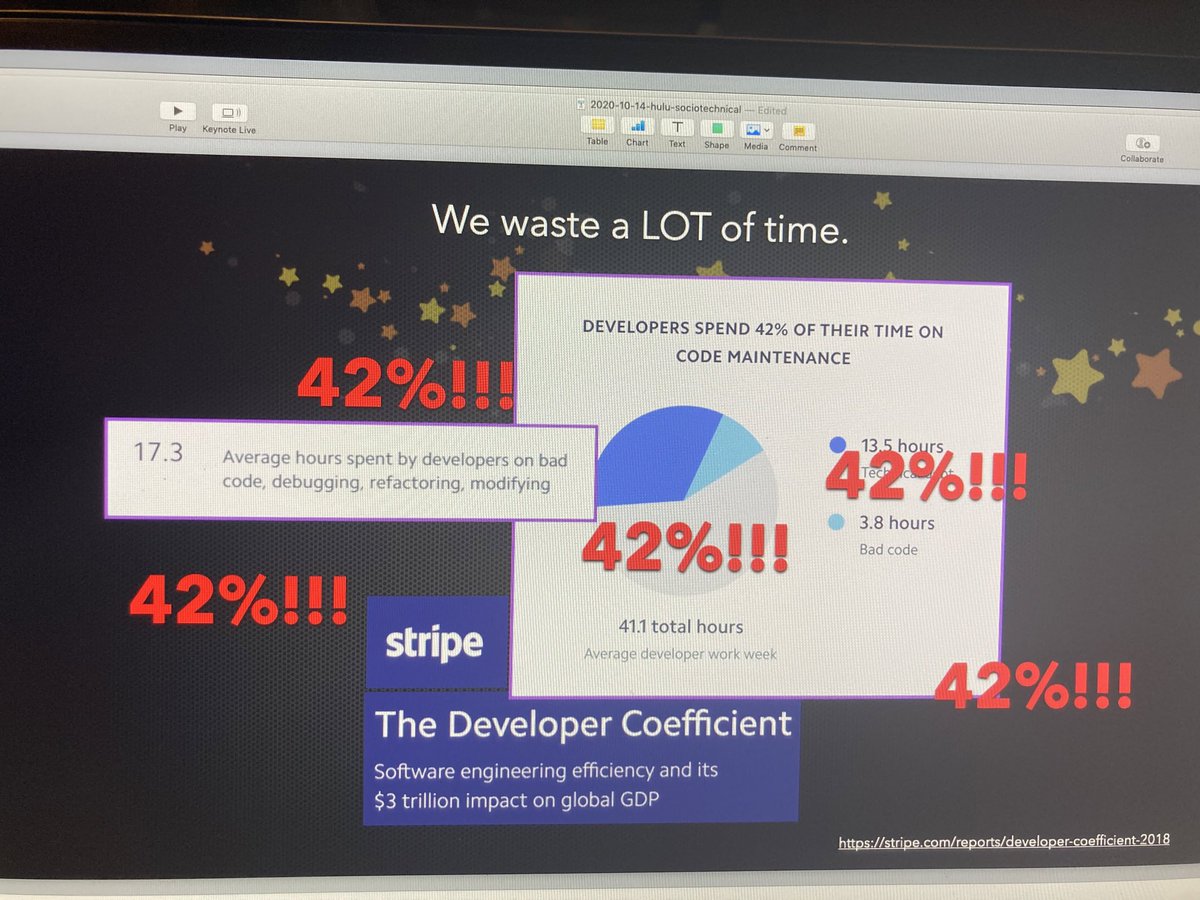
When people often have to spend weeks just to get a local development environment up, there is a lot to improve. \U0001f641
— Daniel Schildt (@autiomaa) December 20, 2020
(the stripe report is here: https://t.co/SbyZDarWr9)
By my calculations, that would reclaim 3 engineers worth of capacity given a team of just 17-18 people.
But also, we are wasting a fuck load of people's valuable time and energy, all because we refuse to improve our pipeline and fulfill the real promise of Continuous Delivery.
But it's not. It's the brutal grind of detangling stupid problems that should never have existed, repeatedly, with your eyes taped closed.
It's getting woken up in the middle of the night. It's flappy pages. For deprecated code.
And let us be clear: this is a fucking management problem. The fact that developer productivity is not high on every VP, director, and manager 2021 goals is a management failure.
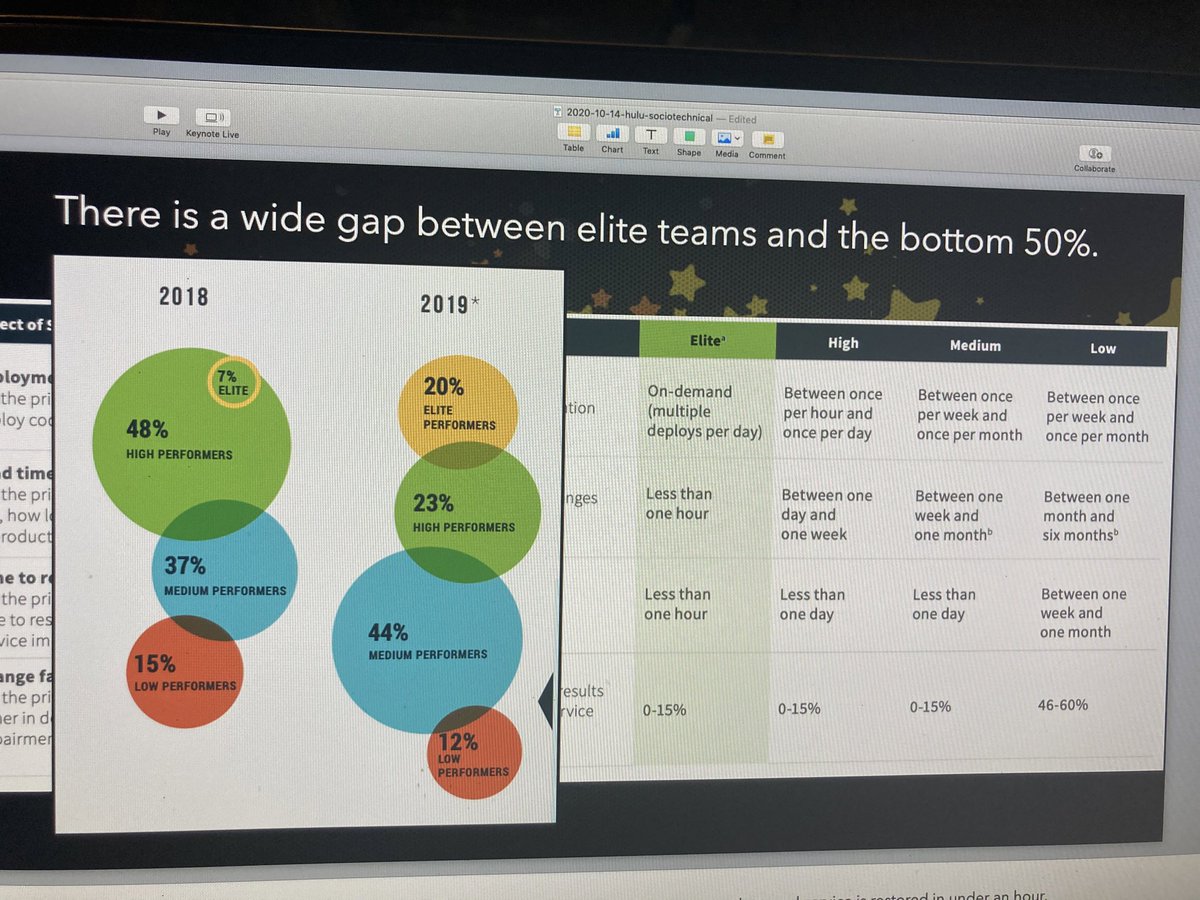
You've seen this graph, right? (The yellow bubble is the "elite" teams.)
Then they tend to that shit, and don't let it drift.
I am sure there are exceptions, but increasingly I see this as a manager/director/VP eng problem.
Hear me out. I don't have it out for y'all; I've known some stellar nontech EMs.
That's a hard line for an EM to take with upper management (none of whom may have read or care about DORA reports or Accelerate).
EMs who don't have that personal grounded knowledge? Nah. I can't imagine going out on this limb based on hearsay. I sure wouldn't.
Anyone who walls you off with people OR tech isn't acting in your interest long term.
Moral of the story? (Morals?)
If you are an engineer, set yourself a goal that 2020 is the last year you leak time working for a place without observability and CD. Find one or help your job become one, but don't get left behind.
(If you *don't* know...catch up I guess)
The power to change the lives of engineers and teams around the world *dramatically* for the better rests primarily with you.
You span worlds. You have the moral authority of the doer and the influence.
But what is the point of power and influence if you don't haul it out when a mountain needs moving?
This fucking mountain, lol. Burn it to the grond. 😈
More from Software





The Great Software Stagnation is real, but we have to understand it to fight it. The CAUSE of the TGSS is not "teh interwebs". The cause is the "direct manipulation" paradigm : the "worst idea in computer science" \1
Progress in CS comes from discovering ever more abstract and expressive languages to tell the computer to do something. But replacing "tell the computer to do something in language" with "do it yourself using these gestures" halts that progress. \2
Stagnation started in the 1970s after the first GUIs were invented. Every genre of software that gives users a "friendly" GUI interface, effectively freezes progress at that level of abstraction / expressivity. Because we can never abandon old direct manipulation metaphors \3
The 1990s were simply the point when most people in the world finally got access to a personal computer with a GUI. So that's where we see most of the ideas frozen. \4
It's no surprise that the improvements @jonathoda cites, that are still taking place are improvements in textual representation : \5
The Great Software\xa0Stagnation https://t.co/A6peSPERaU
— Jonathan Edwards (@jonathoda) January 1, 2021
Progress in CS comes from discovering ever more abstract and expressive languages to tell the computer to do something. But replacing "tell the computer to do something in language" with "do it yourself using these gestures" halts that progress. \2
Stagnation started in the 1970s after the first GUIs were invented. Every genre of software that gives users a "friendly" GUI interface, effectively freezes progress at that level of abstraction / expressivity. Because we can never abandon old direct manipulation metaphors \3
The 1990s were simply the point when most people in the world finally got access to a personal computer with a GUI. So that's where we see most of the ideas frozen. \4
It's no surprise that the improvements @jonathoda cites, that are still taking place are improvements in textual representation : \5


Software architecture is in crisis, and the way to fix it is a hefty dose of anarchy.

Some lay the blame for this on @boicy with the whole microservices thing.
(Admittedly, @nicolefv, @jezhumble and @realgenekim didn’t help when they statistically proved that he might have been onto something with all that de-coupling and team-alignment…)
However I don’t blame him at all.
I think he saved us; bringing us back to the path of value-delivery and independent services, but now with added independent teams.

But one thing is clear. Microservices need more architecture, not less (as do other forms of #Accelerate-style software organisation).
(See https://t.co/B2hWmXhIqe if you need convincing)
I mean, all those pesky slices we need to carve up our monoliths (or were they big balls of mud?) That’s a significant amount of work right there…

Some lay the blame for this on @boicy with the whole microservices thing.
(Admittedly, @nicolefv, @jezhumble and @realgenekim didn’t help when they statistically proved that he might have been onto something with all that de-coupling and team-alignment…)
However I don’t blame him at all.
I think he saved us; bringing us back to the path of value-delivery and independent services, but now with added independent teams.
But one thing is clear. Microservices need more architecture, not less (as do other forms of #Accelerate-style software organisation).
(See https://t.co/B2hWmXhIqe if you need convincing)
I mean, all those pesky slices we need to carve up our monoliths (or were they big balls of mud?) That’s a significant amount of work right there…
You May Also Like


The first area to focus on is diversity. This has become a dogma in the tech world, and despite the fact that tech is one of the most meritocratic industries in the world, there are constant efforts to promote diversity at the expense of fairness, merit and competency. Examples:
USC's Interactive Media & Games Division cancels all-star panel that included top-tier game developers who were invited to share their experiences with students. Why? Because there were no women on the
ElectronConf is a conf which chooses presenters based on blind auditions; the identity, gender, and race of the speaker is not known to the selection team. The results of that merit-based approach was an all-male panel. So they cancelled the conference.
Apple's head of diversity (a black woman) got in trouble for promoting a vision of diversity that is at odds with contemporary progressive dogma. (She left the company shortly after this
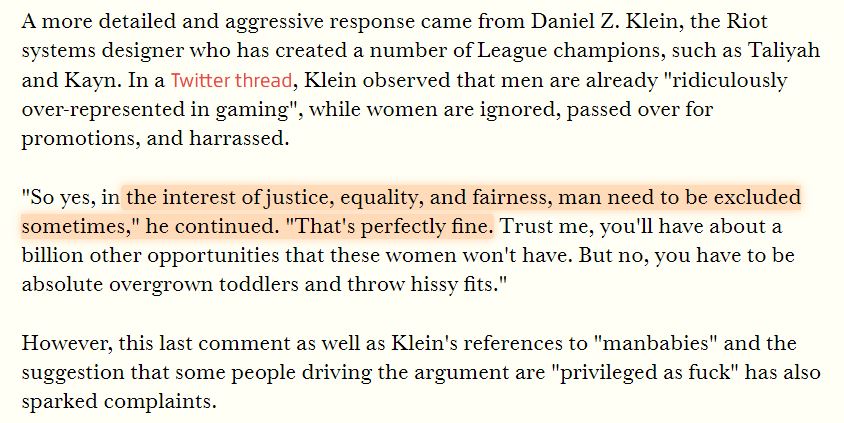
Also in the name of diversity, there is unabashed discrimination against men (especially white men) in tech, in both hiring policies and in other arenas. One such example is this, a developer workshop that specifically excluded men: https://t.co/N0SkH4hR35
USC's Interactive Media & Games Division cancels all-star panel that included top-tier game developers who were invited to share their experiences with students. Why? Because there were no women on the
ElectronConf is a conf which chooses presenters based on blind auditions; the identity, gender, and race of the speaker is not known to the selection team. The results of that merit-based approach was an all-male panel. So they cancelled the conference.
Apple's head of diversity (a black woman) got in trouble for promoting a vision of diversity that is at odds with contemporary progressive dogma. (She left the company shortly after this
Also in the name of diversity, there is unabashed discrimination against men (especially white men) in tech, in both hiring policies and in other arenas. One such example is this, a developer workshop that specifically excluded men: https://t.co/N0SkH4hR35