New research on the history of legal #prostitution in Germany focussing on the murders of women in the sex trade by @manuelaschon and Anna Hoheide. I am proud to have helped with translating this work that shines a light into the darkest corners.


More from Society





Two things can be true at once:
1. There is an issue with hostility some academics have faced on some issues
2. Another academic who himself uses threats of legal action to bully colleagues into silence is not a good faith champion of the free speech cause
I have kept quiet about Matthew's recent outpourings on here but as my estwhile co-author has now seen fit to portray me as an enabler of oppression I think I have a right to reply. So I will.
I consider Matthew to be a colleague and a friend, and we had a longstanding agreement not to engage in disputes on twitter. I disagree with much in the article @UOzkirimli wrote on his research in @openDemocracy but I strongly support his right to express such critical views
I therefore find it outrageous that Matthew saw fit to bully @openDemocracy with legal threats, seeking it seems to stifle criticism of his own work. Such behaviour is simply wrong, and completely inconsistent with an academic commitment to free speech.
I am not embroiling myself in the various other cases Matt lists because, unlike him, I think attention to the detail matters and I don't have time to research each of these cases in detail.
1. There is an issue with hostility some academics have faced on some issues
2. Another academic who himself uses threats of legal action to bully colleagues into silence is not a good faith champion of the free speech cause
How about Selina Todd, Kathleen Stock, Jo Phoenix, Rachel Ara, Sarah Honeychurch, Michele Moore, Nina Power, Joanna Williams, Jenny Murray, Julia Gasper ...
— Matt Goodwin (@GoodwinMJ) February 17, 2021
Or is it only Eric you pop at?
Are they all making it up too Rob?
Are they "beyond parody"? https://t.co/drQssTD0OL
I have kept quiet about Matthew's recent outpourings on here but as my estwhile co-author has now seen fit to portray me as an enabler of oppression I think I have a right to reply. So I will.
I consider Matthew to be a colleague and a friend, and we had a longstanding agreement not to engage in disputes on twitter. I disagree with much in the article @UOzkirimli wrote on his research in @openDemocracy but I strongly support his right to express such critical views
I therefore find it outrageous that Matthew saw fit to bully @openDemocracy with legal threats, seeking it seems to stifle criticism of his own work. Such behaviour is simply wrong, and completely inconsistent with an academic commitment to free speech.
I am not embroiling myself in the various other cases Matt lists because, unlike him, I think attention to the detail matters and I don't have time to research each of these cases in detail.

You May Also Like


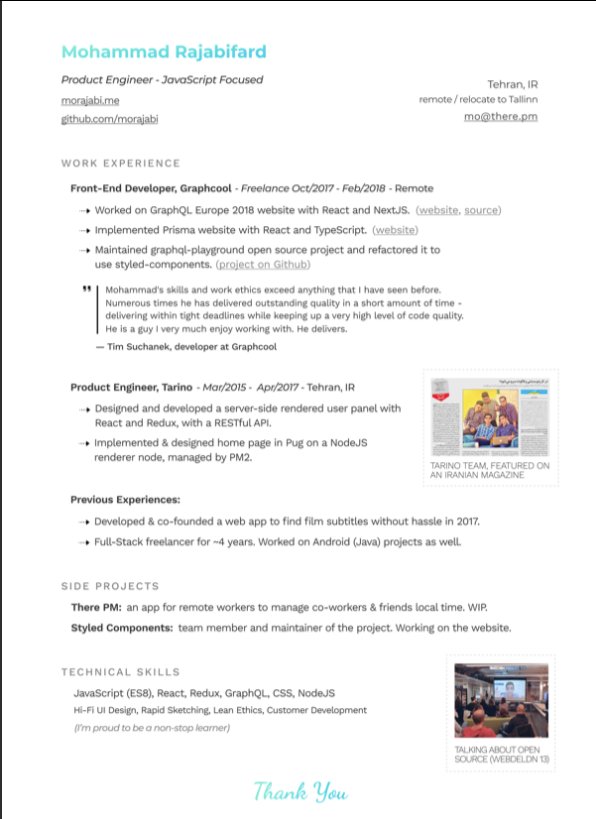
👨💻 Last resume I sent to a startup one year ago, sharing with you to get ideas:
- Forget what you don't have, make your strength bold
- Pick one work experience and explain what you did in detail w/ bullet points
- Write it towards the role you apply
- Give social proof
/thread
"But I got no work experience..."
Make a open source lib, make a small side project for yourself, do freelance work, ask friends to work with them, no friends? Find friends on Github, and Twitter.
Bonus points:
- Show you care about the company: I used the company's brand font and gradient for in the resume for my name and "Thank You" note.
- Don't list 15 things and libraries you worked with, pick the most related ones to the role you're applying.
-🙅♂️"copy cover letter"
"I got no firends, no work"
One practical way is to reach out to conferences and offer to make their website for free. But make sure to do it good. You'll get:
- a project for portfolio
- new friends
- work experience
- learnt new stuff
- new thing for Twitter bio
If you don't even have the skills yet, why not try your chance for @LambdaSchool? No? @freeCodeCamp. Still not? Pick something from here and learn https://t.co/7NPS1zbLTi
You'll feel very overwhelmed, no escape, just acknowledge it and keep pushing.
- Forget what you don't have, make your strength bold
- Pick one work experience and explain what you did in detail w/ bullet points
- Write it towards the role you apply
- Give social proof
/thread
"But I got no work experience..."
Make a open source lib, make a small side project for yourself, do freelance work, ask friends to work with them, no friends? Find friends on Github, and Twitter.
Bonus points:
- Show you care about the company: I used the company's brand font and gradient for in the resume for my name and "Thank You" note.
- Don't list 15 things and libraries you worked with, pick the most related ones to the role you're applying.
-🙅♂️"copy cover letter"
"I got no firends, no work"
One practical way is to reach out to conferences and offer to make their website for free. But make sure to do it good. You'll get:
- a project for portfolio
- new friends
- work experience
- learnt new stuff
- new thing for Twitter bio
If you don't even have the skills yet, why not try your chance for @LambdaSchool? No? @freeCodeCamp. Still not? Pick something from here and learn https://t.co/7NPS1zbLTi
You'll feel very overwhelmed, no escape, just acknowledge it and keep pushing.