
"I sought the Lord, and he answered me and delivered me from all my fears, except coronavirus. Those who look to him are radiant, and their faces shall never be ashamed, though they shall be covered.” Psalm 34:4–5. COVID trans.
More from Society

So, as the #MegaMillions jackpot reaches a record $1.6B and #Powerball reaches $620M, here's my advice about how to spend the money in a way that will truly set you, your children and their kids up for life.
Ready?
Create a private foundation and give it all away. 1/
Let's stipulate first that lottery winners often have a hard time. Being publicly identified makes you a target for "friends" and "family" who want your money, as well as for non-family grifters and con men. 2/
The stress can be damaging, even deadly, and Uncle Sam takes his huge cut. Plus, having a big pool of disposable income can be irresistible to people not accustomed to managing wealth. https://t.co/fiHsuJyZwz 3/
Meanwhile, the private foundation is as close as we come to Downton Abbey and the landed aristocracy in this country. It's a largely untaxed pot of money that grows significantly over time, and those who control them tend to entrench their own privileges and those of their kin. 4
Here's how it works for a big lotto winner:
1. Win the prize.
2. Announce that you are donating it to the YOUR NAME HERE Family Foundation.
3. Receive massive plaudits in the press. You will be a folk hero for this decision.
4. Appoint only trusted friends/family to board. 5/


Hi @officestudents @EHRC @EHRCChair @KishwerFalkner @RJHilsenrath @trussliz @GEOgovuk
The Equality and Diversity section of your job application has 'gender' in what appears to be a list of the protected characteristics under the Equality Act 2010.
However...
1/15
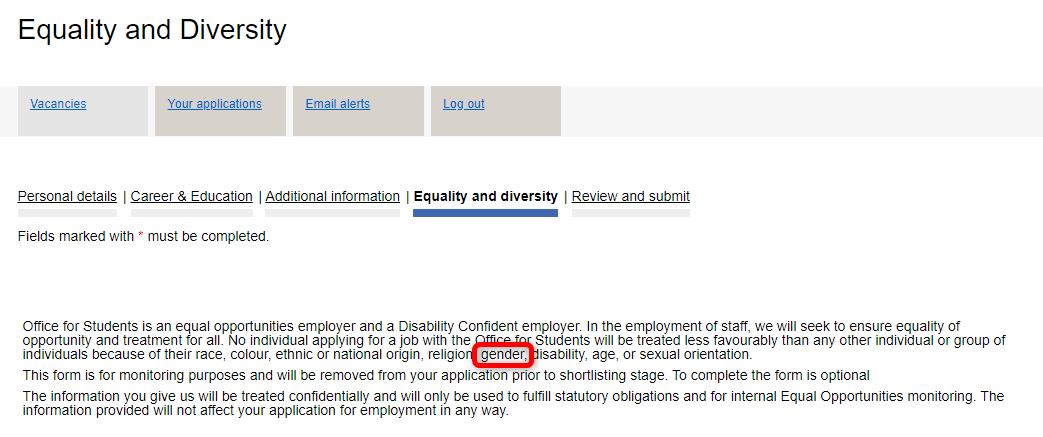
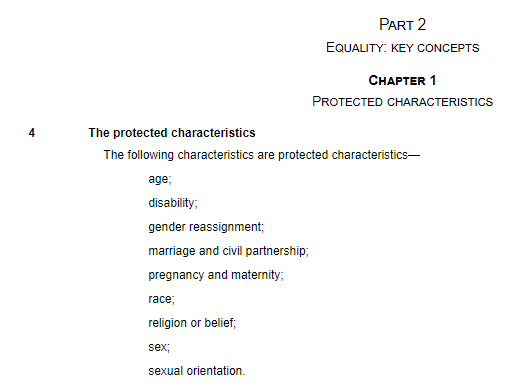
However, 'gender' is not a protected characteristic under the Equality Act 2010 and is not defined in the Act.
https://t.co/qisFhCiV1u
Sex is the protected characteristic under the Act, but that is not on your list.
2/15
You then ask for the 'gender' of the applicant with options:
Male
Female.
3/15

Again, 'gender' is not a protected characteristic under the Equality Act 2010 and is not defined in the Act.
https://t.co/qisFhCiV1u
4/15
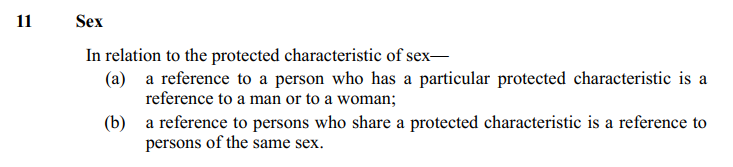
Sex is the protected characteristic and the only two possible options for sex are 'Female' and 'Male' as defined in the Act and consistent with biology, but you don't ask for that.
https://t.co/CEJ0gkr6nF
'Gender' is not a synonym for sex.
5/15
The Equality and Diversity section of your job application has 'gender' in what appears to be a list of the protected characteristics under the Equality Act 2010.
However...
1/15
However, 'gender' is not a protected characteristic under the Equality Act 2010 and is not defined in the Act.
https://t.co/qisFhCiV1u
Sex is the protected characteristic under the Act, but that is not on your list.
2/15
You then ask for the 'gender' of the applicant with options:
Male
Female.
3/15
Again, 'gender' is not a protected characteristic under the Equality Act 2010 and is not defined in the Act.
https://t.co/qisFhCiV1u
4/15
Sex is the protected characteristic and the only two possible options for sex are 'Female' and 'Male' as defined in the Act and consistent with biology, but you don't ask for that.
https://t.co/CEJ0gkr6nF
'Gender' is not a synonym for sex.
5/15

You May Also Like

I just finished Eric Adler's The Battle of the Classics, and wanted to say something about Joel Christiansen's review linked below. I am not sure what motivates the review (I speculate a bit below), but it gives a very misleading impression of the book. 1/x
The meat of the criticism is that the history Adler gives is insufficiently critical. Adler describes a few figures who had a great influence on how the modern US university was formed. It's certainly critical: it focuses on the social Darwinism of these figures. 2/x
Other insinuations and suggestions in the review seem wildly off the mark, distorted, or inappropriate-- for example, that the book is clickbaity (it is scholarly) or conservative (hardly) or connected to the events at the Capitol (give me a break). 3/x
The core question: in what sense is classics inherently racist? Classics is old. On Adler's account, it begins in ancient Rome and is revived in the Renaissance. Slavery (Christiansen's primary concern) is also very old. Let's say classics is an education for slaveowners. 4/x
It's worth remembering that literacy itself is elite throughout most of this history. Literacy is, then, also the education of slaveowners. We can honor oral and musical traditions without denying that literacy is, generally, good. 5/x
As someone\u2019s who\u2019s read the book, this review strikes me as tremendously unfair. It mostly faults Adler for not writing the book the reviewer wishes he had! https://t.co/pqpt5Ziivj
— Teresa M. Bejan (@tmbejan) January 12, 2021
The meat of the criticism is that the history Adler gives is insufficiently critical. Adler describes a few figures who had a great influence on how the modern US university was formed. It's certainly critical: it focuses on the social Darwinism of these figures. 2/x
Other insinuations and suggestions in the review seem wildly off the mark, distorted, or inappropriate-- for example, that the book is clickbaity (it is scholarly) or conservative (hardly) or connected to the events at the Capitol (give me a break). 3/x
The core question: in what sense is classics inherently racist? Classics is old. On Adler's account, it begins in ancient Rome and is revived in the Renaissance. Slavery (Christiansen's primary concern) is also very old. Let's say classics is an education for slaveowners. 4/x
It's worth remembering that literacy itself is elite throughout most of this history. Literacy is, then, also the education of slaveowners. We can honor oral and musical traditions without denying that literacy is, generally, good. 5/x










I’m torn on how to approach the idea of luck. I’m the first to admit that I am one of the luckiest people on the planet. To be born into a prosperous American family in 1960 with smart parents is to start life on third base. The odds against my very existence are astronomical.
I’ve always felt that the luckiest people I know had a talent for recognizing circumstances, not of their own making, that were conducive to a favorable outcome and their ability to quickly take advantage of them.
In other words, dumb luck was just that, it required no awareness on the person’s part, whereas “smart” luck involved awareness followed by action before the circumstances changed.
So, was I “lucky” to be born when I was—nothing I had any control over—and that I came of age just as huge databases and computers were advancing to the point where I could use those tools to write “What Works on Wall Street?” Absolutely.
Was I lucky to start my stock market investments near the peak of interest rates which allowed me to spend the majority of my adult life in a falling rate environment? Yup.
Ironies of Luck https://t.co/5BPWGbAxFi
— Morgan Housel (@morganhousel) March 14, 2018
"Luck is the flip side of risk. They are mirrored cousins, driven by the same thing: You are one person in a 7 billion player game, and the accidental impact of other people\u2019s actions can be more consequential than your own."
I’ve always felt that the luckiest people I know had a talent for recognizing circumstances, not of their own making, that were conducive to a favorable outcome and their ability to quickly take advantage of them.
In other words, dumb luck was just that, it required no awareness on the person’s part, whereas “smart” luck involved awareness followed by action before the circumstances changed.
So, was I “lucky” to be born when I was—nothing I had any control over—and that I came of age just as huge databases and computers were advancing to the point where I could use those tools to write “What Works on Wall Street?” Absolutely.
Was I lucky to start my stock market investments near the peak of interest rates which allowed me to spend the majority of my adult life in a falling rate environment? Yup.