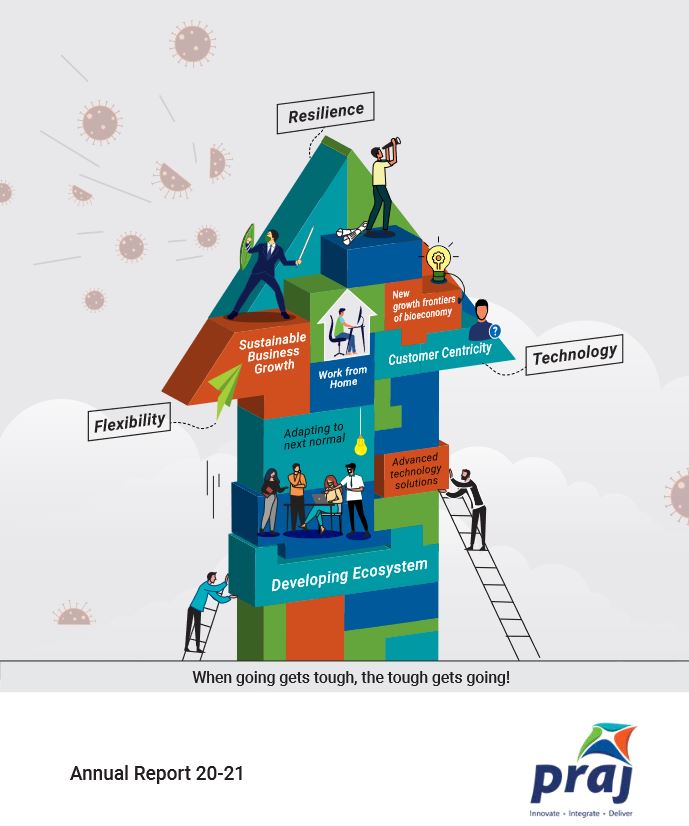
AR20-21 Notes
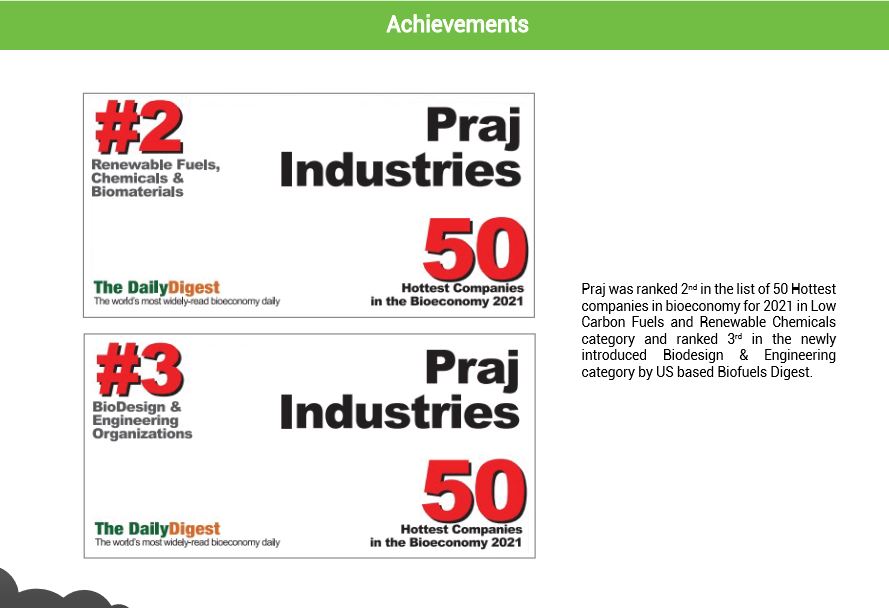
Praj Industries
India’s Leader in Bio-Fuel Technology
Put on your helmets & Enjoy the ride 🙂
Retweet for wider reach 🙏
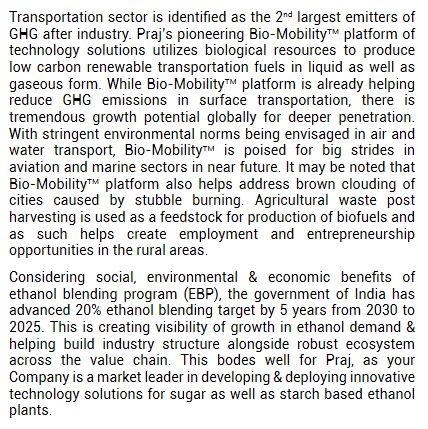
~Ethanol Demand to rise from Govt push for 20% ethanol blending by 2025
~Launched BioPrism tech portfolio for producing bio-based Renewable Materials
~Identified growth areas like Bioplastics, Lignin products, specialty
chemicals, & others
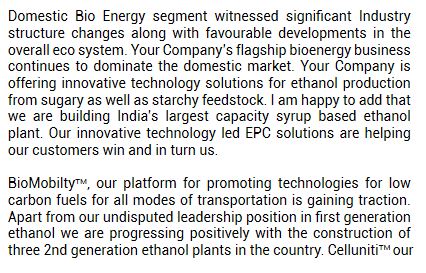
~Praj continues to dominate the bioenergy sector in India
~Engg Business saw good unique opportunities
~Delivered Solutions as part of critical vaccine supply chain
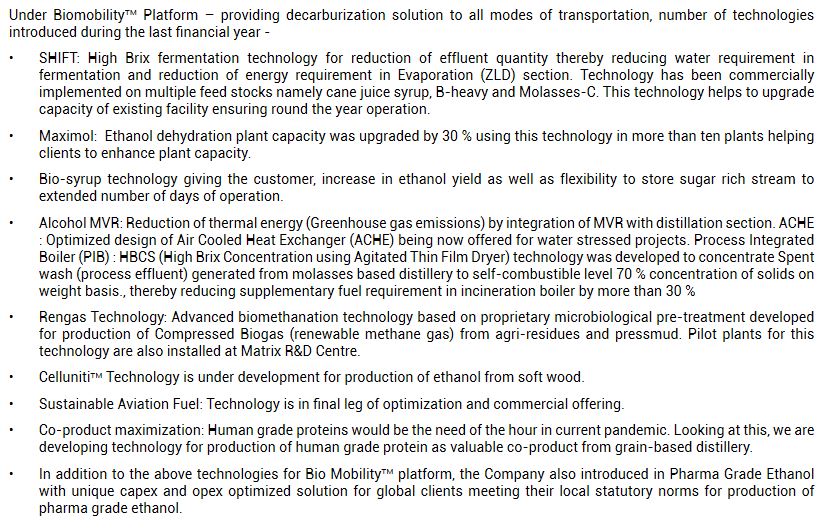
~Reduced water requirement
~Enhanced plant capacity
~Increased ethanol yield
~Reduction in emissions
~Pharma Grade Ethanol
~Production of Compressed Biogas from agri-residues and pressmud

~Gained 5 Indian & 6 Foreign Patents in FY21
~Bagged awards for innovation and waste management

1st Gen Ethanol Domestic:
~Govt push to create opportunity for new 10 bn liters PA capacity
~Good traction for B-heavy molasses and sugar syrup based ethanol plants
1st Gen Ethanol International
~Traction for Pharma grade Ethanol
~Demand up for biofuels
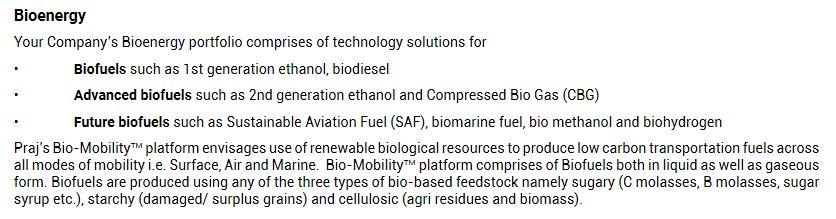
2nd Gen Ethanol
~Has 3 orders for advanced biofuel refineries in India
~Expect demand from North Europe
Compressed BioGas
~Expecting setup of 5000 CBG plants in next 5 years
Others
~Developed process for making Isobutanol
~Scaling up SAF in India

~CPES got orders from a US-based Industrial Gases Company
~Slowdown in domestic Brewery Segment
~Got repeat orders for Zero Liquid Discharge Solutions
~HiPurity to see demand rise from pharma & personal care segments
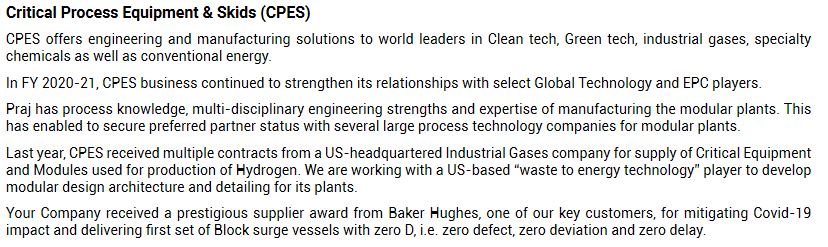
~Joined with Institute Of Chemical Technology, Mumbai (ICT) for process development and reactor design research
~Produced breakthrough in making “Bio-bitumen” based on Lignin
~Filed for over 300 patents to date
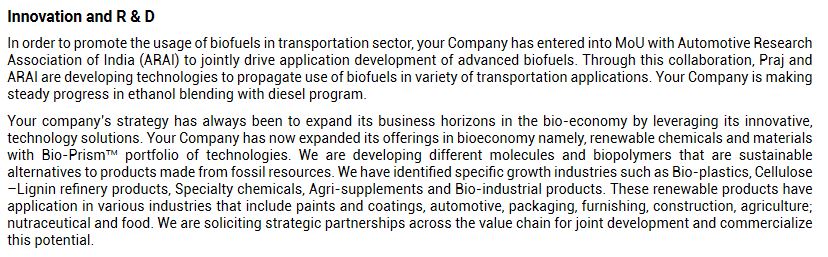
~Ethanol demand to rise for blending
~CBG opportunity to rise
~Bioenergy to become mainstream due to focus on sustainability

More from SmartSyncServices.com








More from Praj


#praj
Some interesting pointers to understand few misunderstood stuff revolving around Ethanol and all the verticals Praj Industries is into. All of these were answered by Mr. Shishir Joshipura of Praj Industries.
— swapnilkabra (@caswapnilkabra) August 26, 2021
Do retweet for maximum reach. \U0001f447\U0001f9f5
You May Also Like

Tip from the Monkey
Pangolins, September 2019 and PLA are the key to this mystery
Stay Tuned!

1. Yang
2. A jacobin capuchin dangling a flagellin pangolin on a javelin while playing a mandolin and strangling a mannequin on a paladin's palanquin, said Saladin
More to come tomorrow!

3. Yigang Tong
https://t.co/CYtqYorhzH
Archived: https://t.co/ncz5ruwE2W
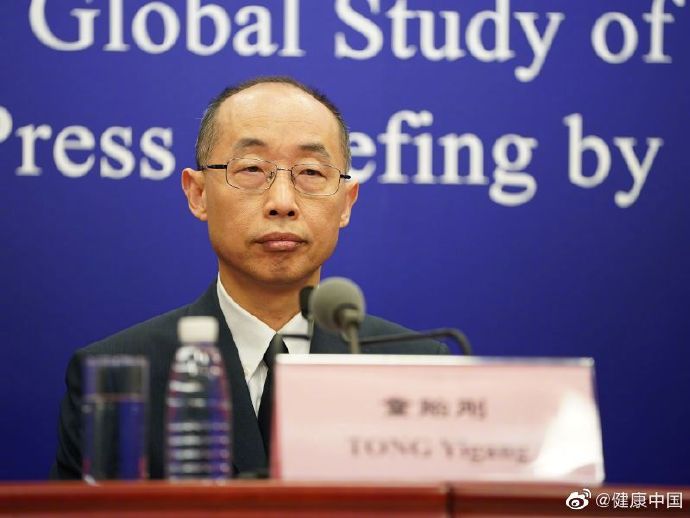
4. YT Interview
Some bats & pangolins carry viruses related with SARS-CoV-2, found in SE Asia and in Yunnan, & the pangolins carrying SARS-CoV-2 related viruses were smuggled from SE Asia, so there is a possibility that SARS-CoV-2 were coming from
Pangolins, September 2019 and PLA are the key to this mystery
Stay Tuned!
1. Yang
Meet Yang Ruifu, CCP's biological weapons expert https://t.co/JjB9TLEO95 via @Gnews202064
— Billy Bostickson \U0001f3f4\U0001f441&\U0001f441 \U0001f193 (@BillyBostickson) October 11, 2020
Interesting expose of China's top bioweapons expert who oversaw fake pangolin research
Paper 1: https://t.co/TrXESKLYmJ
Paper 2:https://t.co/9LSJTNCn3l
Pangolinhttps://t.co/2FUAzWyOcv pic.twitter.com/I2QMXgnkBJ
2. A jacobin capuchin dangling a flagellin pangolin on a javelin while playing a mandolin and strangling a mannequin on a paladin's palanquin, said Saladin
More to come tomorrow!
3. Yigang Tong
https://t.co/CYtqYorhzH
Archived: https://t.co/ncz5ruwE2W
4. YT Interview
Some bats & pangolins carry viruses related with SARS-CoV-2, found in SE Asia and in Yunnan, & the pangolins carrying SARS-CoV-2 related viruses were smuggled from SE Asia, so there is a possibility that SARS-CoV-2 were coming from



Ivor Cummins has been wrong (or lying) almost entirely throughout this pandemic and got paid handsomly for it.
He has been wrong (or lying) so often that it will be nearly impossible for me to track every grift, lie, deceit, manipulation he has pulled. I will use...

... other sources who have been trying to shine on light on this grifter (as I have tried to do, time and again:
Example #1: "Still not seeing Sweden signal versus Denmark really"... There it was (Images attached).
19 to 80 is an over 300% difference.
Tweet: https://t.co/36FnYnsRT9

Example #2 - "Yes, I'm comparing the Noridcs / No, you cannot compare the Nordics."
I wonder why...
Tweets: https://t.co/XLfoX4rpck / https://t.co/vjE1ctLU5x

Example #3 - "I'm only looking at what makes the data fit in my favour" a.k.a moving the goalposts.
Tweets: https://t.co/vcDpTu3qyj / https://t.co/CA3N6hC2Lq

He has been wrong (or lying) so often that it will be nearly impossible for me to track every grift, lie, deceit, manipulation he has pulled. I will use...
... other sources who have been trying to shine on light on this grifter (as I have tried to do, time and again:
Ivor Cummins BE (Chem) is a former R&D Manager at HP (sourcre: https://t.co/Wbf5scf7gn), turned Content Creator/Podcast Host/YouTube personality. (Call it what you will.)
— Steve (@braidedmanga) November 17, 2020
Example #1: "Still not seeing Sweden signal versus Denmark really"... There it was (Images attached).
19 to 80 is an over 300% difference.
Tweet: https://t.co/36FnYnsRT9
Example #2 - "Yes, I'm comparing the Noridcs / No, you cannot compare the Nordics."
I wonder why...
Tweets: https://t.co/XLfoX4rpck / https://t.co/vjE1ctLU5x
Example #3 - "I'm only looking at what makes the data fit in my favour" a.k.a moving the goalposts.
Tweets: https://t.co/vcDpTu3qyj / https://t.co/CA3N6hC2Lq