Categories Politics


I\u2019m sorry it\u2019s just insane that Democrats are like, \u201cwe won everything and our opening position on relief is $1.9T\u201d and Republicans are like, \u201cwe lost and our opening position is $600B,\u201d and the media will be like, \u201cDemocrats say they want unity but reject this bipartisan deal.\u201d
— Meredith Shiner (@meredithshiner) January 31, 2021
First, party/policy mandates from elections are far from self-executing in our system. Work on mandates from Dahl to Ellis and Kirk on the history of the mandate to mine on its role in post-Nixon politics, to Peterson Grossback and Stimson all emphasize that this link is... 2/
Created deliberately and isn't always persuasive. Others have to convinced that the election meant a particular thing for it to work in a legislative context. I theorized in the immediate period of after the 2020 election that this was part of why Repubs signed on to ...3/
Trump's demonstrably false fraud nonsense - it derailed an emerging mandate news cycle. Winners of elections get what they get - institutional control - but can't expect much beyond that unless the perception of an election mandate takes hold. And it didn't. 4/
Let's turn to the legislation element of this. There's just an asymmetry in terms of passing a relief bill. Republicans are presumably less motivated to get some kind of deal passed. Democrats are more likely to want to do *something.* 5/

As Akiva notes, the legal question is going to boil down to something known as "actual malice."
That's a tricky concept for nonlawyers (and often for lawyers) so an explainer might help.
So Dominion sued Rudy for defamation. How are they ever going to allege actual malice? https://t.co/p8d3flDkGm
— Akiva Cohen (@AkivaMCohen) January 25, 2021
What I'm going to do with this thread is a bit different from normal - I'm going to start by explaining the underlying law so that you can see why lawyers are a little skeptical of the odds of success, and only look at the complaint after that.
So let's start with the most basic basics:
If you want to win a defamation case, you have to prove:
(1) that defendant made a false and defamatory statement about you;
(2) to a third party without privilege;
(3) with the required degree of fault;
(4) causing you to suffer damage.
For Dominion's defamation cases, proving 1 and 4 is easy. 2 is, in the case of the lawyers they're suing, slightly more complex but not hard. And 3 - degree of fault - is really really hard to prove.
A false statement of fact that is defamatory is a slam dunk element here - all the fraud allegations against dominion are totally banana-pants. They are also allegations which are clearly going to harm Dominion's reputation.


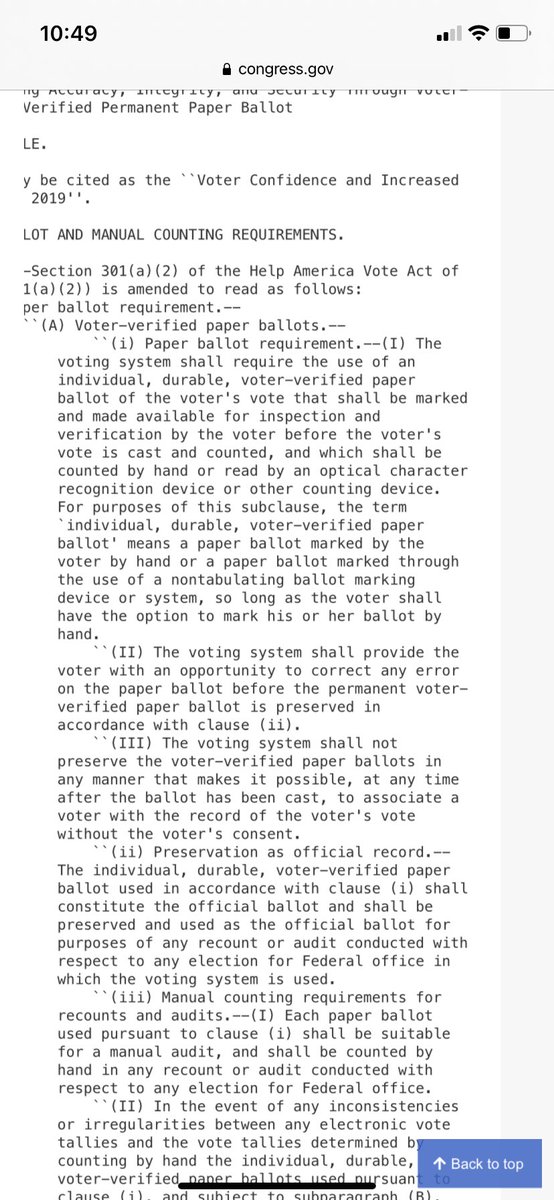
Even HR1 did not require that jurisdictions give all voters the option to mark their ballots by hand AT THE POLLS. The House has not even warned the public about the dangers of new touchscreen ballot marking devices. Pls do that NOW. TY.
— Jennifer Cohn \u270d\U0001f3fb \U0001f4e2 (@jennycohn1) April 24, 2019
Expert Report: https://t.co/I2EWvFIQEH pic.twitter.com/euekDq65mr
I have not looked at other aspects of HR1. It addresses more than election security. The #SAFEAct shld be the starting point for election security reform in my opinion. 2/
HR1 requires that all voters have the option to mark their ballots by hand. But it does not specify that, for jurisdictions with in person voting, the hand marked (pen & paper) option must be available for in person voting (vs it only being an option w/ vote by mail). 3/
HR1 may still be a good start. But it does not go nearly far enough on election security. Here are my suggestions for election security. Maybe these could be addressed in a later bill, but we shld keep them on our radar. 4/ https://t.co/mNdHrvwHcN
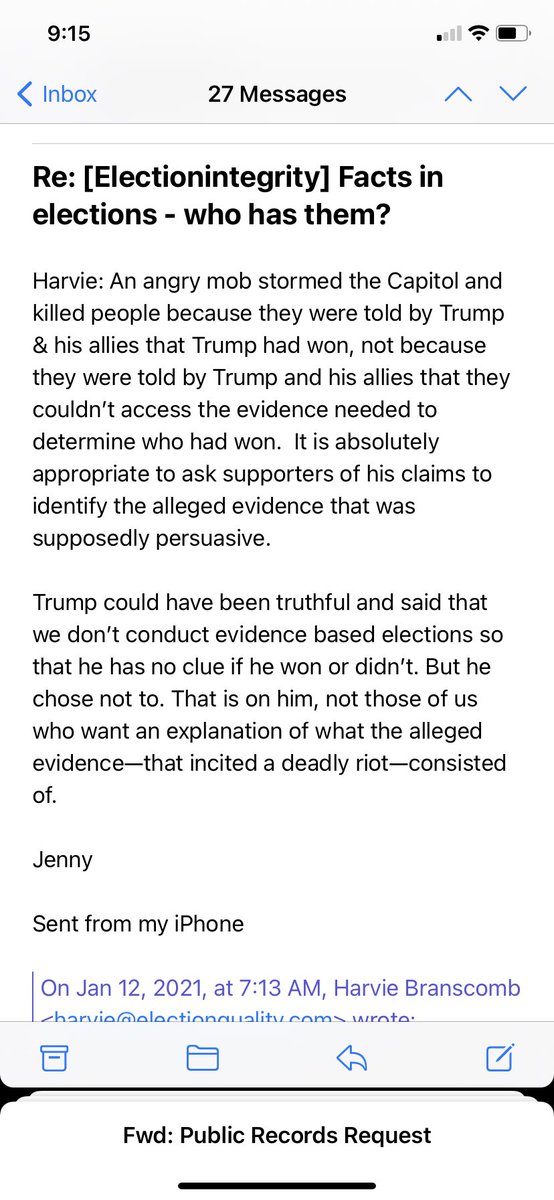
The key section is 1502. IMO, it shld add the following. “For jurisdictions that offer in person voting, the option to mark a paper ballot by hand must be offered at the in-person polling location; giving this option only for vote by mail won’t suffice for such jurisdictions.” 5/
Oh myyyyyyyyyy
— Mike Dunford (@questauthority) January 25, 2021
Good morning, followers of frivolous election-related litigation - new filings in Seditionists v 117th Congress et al. (aka in re Gondor)
I've really got to get stuff done, but there's time for a really quick overview.
As far as I can tell from the docket, this is the FOURTH attempt in a week to get a TRO; the question the judge will ask if they ever figure out how to get the judge's attention will be "couldn't you have served by now;" and this whole thing is a
The memorandum in support of this one is 9 pages, and should go pretty quick.
But they still haven't figured out widow/orphan issues.
https://t.co/l7EDatDudy

It appears that the opening of this particular filing is going to proceed on the theme of "we are big mad at @SollenbergerRC" which is totally something relevant when you are asking a District Court to temporarily annihilate the US Government on an ex parte basis.

Also, if they didn't want their case to be known as "in re Gondor" they really shouldn't have gone with the (non-literary) "Gondor has no king" quote.