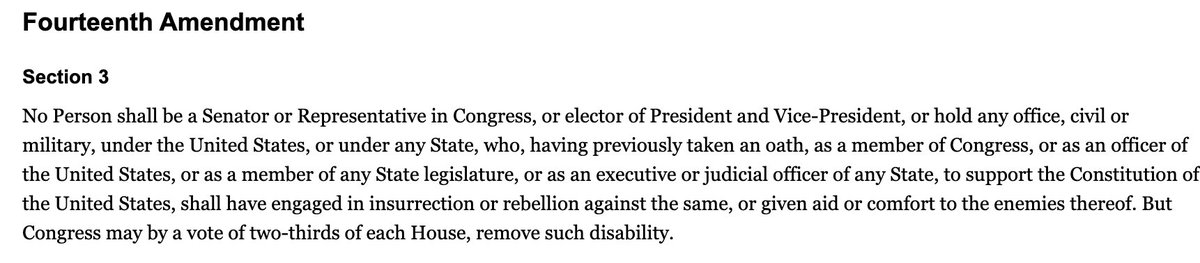
This would be a complement, not a substitute, for impeachment.
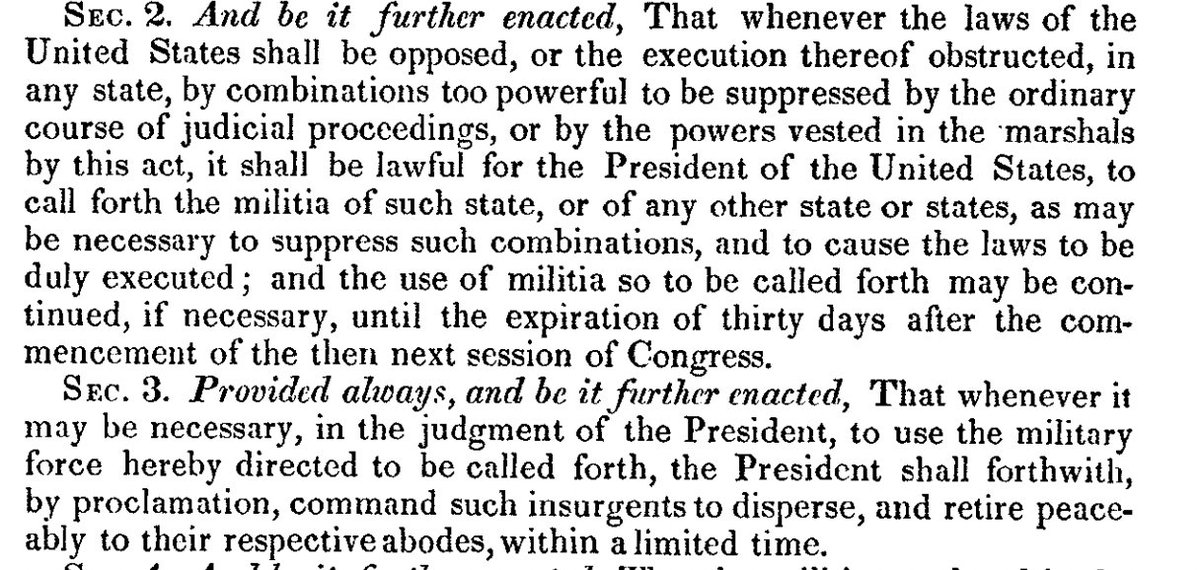
In the NY Times today, I argue w/ @brianbeutler that a Civil War amendment to the Constitution--barring those who've "engaged in insurrection" from holding office--authorizes a broader response, one that goes beyond impeachment and beyond Trump
This would be a complement, not a substitute, for impeachment.
https://t.co/z3mpfQid2e
https://t.co/6vZA5f7nfD


More from Politics


Funny, before the election I recall lefties muttering the caravan must have been a Trump setup because it made the open borders crowd look so bad. Why would the pro-migrant crowd engineer a crisis that played into Trump's hands? THIS is why. THESE are the "optics" they wanted.
This media manipulation effort was inspired by the success of the "kids in cages" freakout, a 100% Stalinist propaganda drive that required people to forget about Obama putting migrant children in cells. It worked, so now they want pics of Trump "gassing children on the border."
There's a heavy air of Pallywood around the whole thing as well. If the Palestinians can stage huge theatrical performances of victimhood with the willing cooperation of Western media, why shouldn't the migrant caravan organizers expect the same?
It's business as usual for Anarchy, Inc. - the worldwide shredding of national sovereignty to increase the power of transnational organizations and left-wing ideology. Many in the media are true believers. Others just cannot resist the narrative of "change" and "social justice."
The product sold by Anarchy, Inc. is victimhood. It always boils down to the same formula: once the existing order can be painted as oppressors and children as their victims, chaos wins and order loses. Look at the lefties shrieking in unison about "Trump gassing children" today.
Funny there are those who think these migrant caravans were a FANTASTIC idea that's going to take the immigration issue away from you.
— Brian Cates (@drawandstrike) November 26, 2018
Like several weeks watching a rampaging horde storm the fences & throw rocks at our border patrol agents & getting gassed = great optics!
This media manipulation effort was inspired by the success of the "kids in cages" freakout, a 100% Stalinist propaganda drive that required people to forget about Obama putting migrant children in cells. It worked, so now they want pics of Trump "gassing children on the border."
There's a heavy air of Pallywood around the whole thing as well. If the Palestinians can stage huge theatrical performances of victimhood with the willing cooperation of Western media, why shouldn't the migrant caravan organizers expect the same?
It's business as usual for Anarchy, Inc. - the worldwide shredding of national sovereignty to increase the power of transnational organizations and left-wing ideology. Many in the media are true believers. Others just cannot resist the narrative of "change" and "social justice."
The product sold by Anarchy, Inc. is victimhood. It always boils down to the same formula: once the existing order can be painted as oppressors and children as their victims, chaos wins and order loses. Look at the lefties shrieking in unison about "Trump gassing children" today.


This idea - that elections should translate into policy - is not wrong at all. But political science can help explain why it's not working this way. There are three main explanations: 1. mandates are constructed, not automatic, 2. party asymmetry, 3. partisan conpetition 1/
First, party/policy mandates from elections are far from self-executing in our system. Work on mandates from Dahl to Ellis and Kirk on the history of the mandate to mine on its role in post-Nixon politics, to Peterson Grossback and Stimson all emphasize that this link is... 2/
Created deliberately and isn't always persuasive. Others have to convinced that the election meant a particular thing for it to work in a legislative context. I theorized in the immediate period of after the 2020 election that this was part of why Repubs signed on to ...3/
Trump's demonstrably false fraud nonsense - it derailed an emerging mandate news cycle. Winners of elections get what they get - institutional control - but can't expect much beyond that unless the perception of an election mandate takes hold. And it didn't. 4/
Let's turn to the legislation element of this. There's just an asymmetry in terms of passing a relief bill. Republicans are presumably less motivated to get some kind of deal passed. Democrats are more likely to want to do *something.* 5/
I\u2019m sorry it\u2019s just insane that Democrats are like, \u201cwe won everything and our opening position on relief is $1.9T\u201d and Republicans are like, \u201cwe lost and our opening position is $600B,\u201d and the media will be like, \u201cDemocrats say they want unity but reject this bipartisan deal.\u201d
— Meredith Shiner (@meredithshiner) January 31, 2021
First, party/policy mandates from elections are far from self-executing in our system. Work on mandates from Dahl to Ellis and Kirk on the history of the mandate to mine on its role in post-Nixon politics, to Peterson Grossback and Stimson all emphasize that this link is... 2/
Created deliberately and isn't always persuasive. Others have to convinced that the election meant a particular thing for it to work in a legislative context. I theorized in the immediate period of after the 2020 election that this was part of why Repubs signed on to ...3/
Trump's demonstrably false fraud nonsense - it derailed an emerging mandate news cycle. Winners of elections get what they get - institutional control - but can't expect much beyond that unless the perception of an election mandate takes hold. And it didn't. 4/
Let's turn to the legislation element of this. There's just an asymmetry in terms of passing a relief bill. Republicans are presumably less motivated to get some kind of deal passed. Democrats are more likely to want to do *something.* 5/

How the CIA gets the media to lie to you
https://t.co/vsTrS43Fft

https://t.co/rUTYg42PYH
https://t.co/1r0MbPv8wG
War on democracy - installing US-puppet dictators in Latin America in order to control their economies
#Guatemala #Arbenz #RedScare
Propaganda, "harmless bombing" and a CIA terror campaign

CIA war on Nicaragua
https://t.co/vsTrS43Fft
#OTD 73 years ago, CIA was born after President Truman signed the National Security Act of 1947.
— CIA (@CIA) September 18, 2020
\xa0
Separated into five directorates, the Agency collects, analyze and disseminates intelligence to top U.S. officials.
\xa0
Learn more about today's #CIA: https://t.co/diMVOoC3jT pic.twitter.com/ljoTxBYbAc
https://t.co/rUTYg42PYH
War is being pushed upon us by 'news'
— Maria \u23f3 (@ml_1maria) April 21, 2018
Journalists are bribed to write pro-American and anti-Russian
Bribed to lie, betray, manipulate & push for war #CIA #propaganda
Dr Udo Ulfkottehttps://t.co/MsPh5vOwTW pic.twitter.com/Z5GVEzSKBd
https://t.co/1r0MbPv8wG
Former CIA agent and whistleblower Phillip Agee explains that the USA wages economic war against socialists nations because it is threatened by a successful example of an alternative economic system. 1/ pic.twitter.com/NUpdpxnYgw
— \U0001d482\U0001d48d\U0001d48a\U0001d484\U0001d48a\U0001d482 (@alicia_dl_1) July 23, 2020
War on democracy - installing US-puppet dictators in Latin America in order to control their economies
#Guatemala #Arbenz #RedScare
Propaganda, "harmless bombing" and a CIA terror campaign
CIA war on Nicaragua
CIA operation in Nicaragua
— Maria \u23f3 (@ml_1maria) July 19, 2020
Destabilisation program: rip apart the social and economic fabric - make the people suffer as much as you can, until the country plunges into chaos, until at some point you can step in and impose your choice of government on that country. pic.twitter.com/dlxoMZX6xw