
Pricing freelancing projects.
Everything I've learned.
A thread.
- Hourly billing
- Daily billing
- Retainers
- Fixed-pricing
- Value-based pricing
Understand their pros and cons.
Understand your circumstances.
Understand the project.
Choose appropriately.
If you need to use it to get started,
Stop using it as soon as you can.
- Estimating every small task?
- Filling out timesheets?
- Sending tons of invoices?
- Having to justify every time you go "over"?
Avoid hourly billing.
1 day = 8 hours
Or
1 day = 1 day
Always use the latter.
The former robs you of your autonomy.
When billing by the day,
Max out at selling 4 days per week to clients.
Give yourself time to grow your own business.
Nothing else.
It's a rolling engagement for a reason.
Day rate can't come with a guarantee of completion.
- The scarcity of your time (availability)
- What you've done before (credibility)
- The project price itself
If you can't write a proposal without research then you need a pre-project.
Discovery work has value and should come at a price.
Client 1: Day rate
Client 2: Fixed priced project
Client 3: Ongoing retainer
Use the strategy that fits the work best.
Freelancer: "I'm happy to do the work for this price".
Client: "I'm happy to pay this price for the work completing".
1. Get a deposit
2. Get a fixed scope
3. To reduce the price you must reduce the scope
4. Don't use estimated days x day rate = price
5. Add a minimum 20% contingency
6. Price high enough to make a profit after you've paid yourself
You are guaranteeing completion.
Going back to the table for more money at this stage leaves a bad taste.
And a prospect who cares can't understand why,
Your positioning is off.
Price tells it's own story, but it needs back up from credibility.
Be aware of this when making offers.
But you should still research your client when using other strategies.
How valuable will you be to them?
Your client's average lead value = £500
You estimate that your work will get them 100 leads in year 1.
That's £50,00 of value.
You give a price for your work based on a % of that figure.
If you can show the value, you can justify the price.
It's billing hourly for less money.
If it's most risky for the client to work with you the price will be lower
Price mirrors risk.
It'll probably happen during the project.
Add 20%.
You May Also Like









@EricTopol @NBA @StephenKissler @yhgrad B.1.1.7 reveals clearly that SARS-CoV-2 is reverting to its original pre-outbreak condition, i.e. adapted to transgenic hACE2 mice (either Baric's BALB/c ones or others used at WIV labs during chimeric bat coronavirus experiments aimed at developing a pan betacoronavirus vaccine)
@NBA @StephenKissler @yhgrad 1. From Day 1, SARS-COV-2 was very well adapted to humans .....and transgenic hACE2 Mice
@NBA @StephenKissler @yhgrad 2. High Probability of serial passaging in Transgenic Mice expressing hACE2 in genesis of SARS-COV-2
@NBA @StephenKissler @yhgrad B.1.1.7 has an unusually large number of genetic changes, ... found to date in mouse-adapted SARS-CoV2 and is also seen in ferret infections.
https://t.co/9Z4oJmkcKj

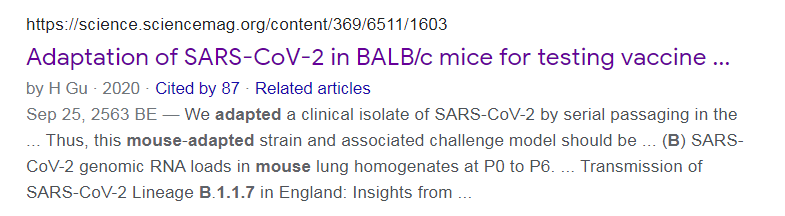
@NBA @StephenKissler @yhgrad We adapted a clinical isolate of SARS-CoV-2 by serial passaging in the ... Thus, this mouse-adapted strain and associated challenge model should be ... (B) SARS-CoV-2 genomic RNA loads in mouse lung homogenates at P0 to P6.
https://t.co/I90OOCJg7o
@NBA @StephenKissler @yhgrad 1. From Day 1, SARS-COV-2 was very well adapted to humans .....and transgenic hACE2 Mice
1. From Day 1, SARS-COV-2 was very well adapted to humans .....and transgenic hACE2 Mice
— Billy Bostickson \U0001f3f4\U0001f441&\U0001f441 \U0001f193 (@BillyBostickson) January 30, 2021
"we generated a mouse model expressing hACE2 by using CRISPR/Cas9 knockin technology. In comparison with wild-type C57BL/6 mice, both young & aged hACE2 mice sustained high viral loads... pic.twitter.com/j94XtSkscj
@NBA @StephenKissler @yhgrad 2. High Probability of serial passaging in Transgenic Mice expressing hACE2 in genesis of SARS-COV-2
1. High Probability of serial passaging in Transgenic Mice expressing hACE2 in genesis of SARS-COV-2!
— Billy Bostickson \U0001f3f4\U0001f441&\U0001f441 \U0001f193 (@BillyBostickson) January 2, 2021
2 papers:
Human\u2013viral molecular mimicryhttps://t.co/irfH0Zgrve
Molecular Mimicryhttps://t.co/yLQoUtfS6s https://t.co/lsCv2iMEQz
@NBA @StephenKissler @yhgrad B.1.1.7 has an unusually large number of genetic changes, ... found to date in mouse-adapted SARS-CoV2 and is also seen in ferret infections.
https://t.co/9Z4oJmkcKj
@NBA @StephenKissler @yhgrad We adapted a clinical isolate of SARS-CoV-2 by serial passaging in the ... Thus, this mouse-adapted strain and associated challenge model should be ... (B) SARS-CoV-2 genomic RNA loads in mouse lung homogenates at P0 to P6.
https://t.co/I90OOCJg7o


