1/ Thoughts on Disney's Analyst Day.

Obviously a longtime Disney D2C bull; I was astounded, shocked by slate's quality, range, volume.

This is Disney going beyond a digital "Vault" plus originals. It is saying all of your favorite stories, more,

2/ Not just a stronger Disney+, but one that hugely raises the tablestakes of competition, growth, press coverage, notability.

Paramount+ plans new Star Trek year round. Feels quaint now. Peacock will have a Jurassic Park + Fast series eventually. Cool.

https://t.co/yaH4k4L1GA
3/ In "Content, Cars, and Comparisons in the 'Streaming Wars'", I wrote about how Disney $1B in content spend gets several billion of equivalent spend through its resonance

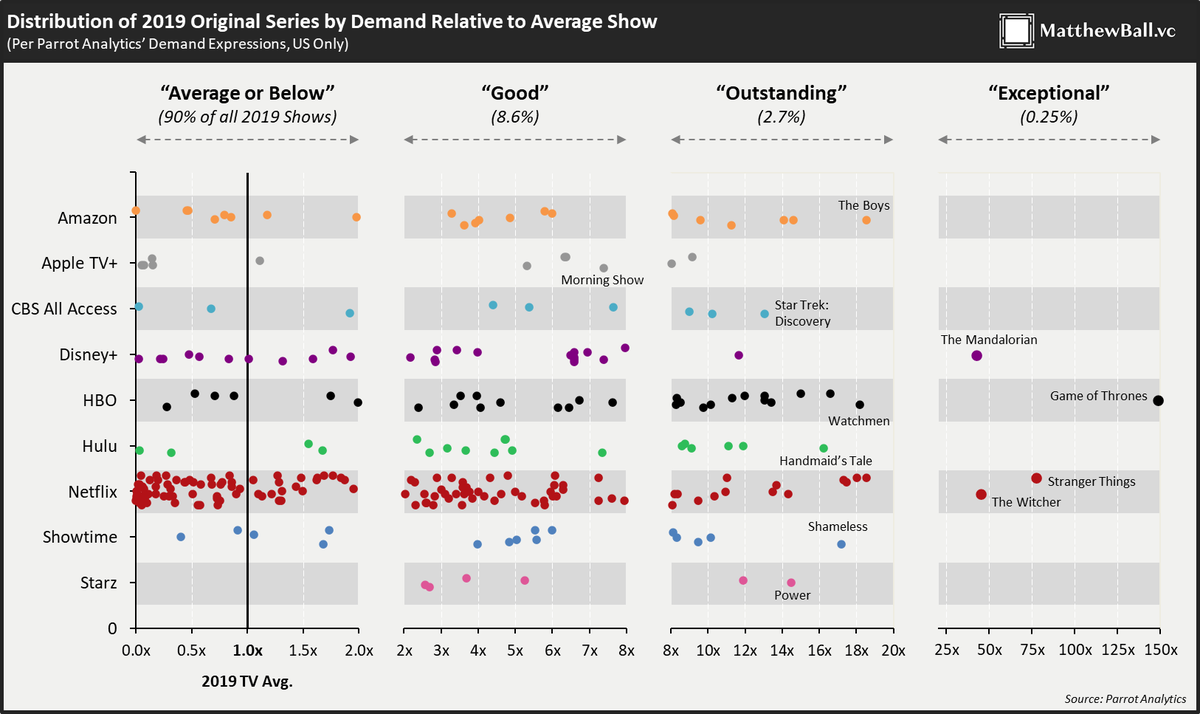
Mando was a top 5 show per @ParrotAnalytics in 2019. Disney thinks it can have 10 "Top 5s" a year.
4/ Trade talk can be misleading, but it takes only a cursory look at Twitter, the most popular shows of the past decade (Walking Dead, Thrones, Mando, Stranger Things), Disney's dominance at the box office (8 of top 10 in 2019) and wonder how to beat this

https://t.co/t8l0tQvuu1
5/ Roadmap doesn't just suck oxygen out of streaming wars (as Netflix did from 2014-18), it will enable Disney+ to rapidly grow its price

If I pay $54 a year to use Disney+ for 2 months, what happens when it's year-round?

Worth $15 month in 2023.

https://t.co/wyLkyzfqi8
6/ Disney obviously sandbagged its original 60-90MM estimate, but elevating this forecast to 230-260MM on the same time horizon, one year in, has to be the largest elevation at a company of this size... ever?
7/ Disney spoke about how much more popular Disney+ was with households without kids. That's key.

At the same time, half of those I know with kids... had set-up iPads for their kids to watch a four hour corporate event... out of enthusiasm for Disney+. That's unreplicable
8/ This is an impossibly great company. And still surprised.

From Oct 2019:
Disney, IP, and "Returns to Marginal Affinity"
https://t.co/8Rapc2gHi4
https://t.co/KDwt3Lh2c9
9/ Also important is to note the extraordinary talent Disney was able to attract despite (1) Capped backends; (2) IP constraints; (3) Disney+ centric distribution.

Darren Aronofsky making Disney+ docuseries? Patty Jenkins doing Star Wars? Amy Adams doing an Enchanted 2?

More from Economy

The International Monetary Fund (IMF) is analyzing damage due to COVID and projecting further severe consequences if current policies persist. They state “despite involving short term economic costs, lockdowns may lead to faster economic recovery by containing the virus”

1/


Note: This report doesn’t do a dynamic analysis that makes things much clearer, but it does a thoughtful statistical analysis based upon increasingly available data.

https://t.co/5Xmt8y7lCL

A few more quotes:

2/


“The analysis also finds that lockdowns are powerful instruments to reduce infections, especially when they are introduced early in a country’s epidemic and when they are sufficiently stringent.”

3/


“lockdowns become progressively more effective in reducing COVID-19 cases when they become sufficiently stringent. Mild lockdowns appear instead ineffective at curbing infections.”

4/

“The results suggest that to achieve a given reduction in infections, policymakers may want to opt for stringent lockdowns over a shorter period rather than prolonged mild lockdowns...

5/
1/ Trend Factor: Any Economic Gains from Using Information over Investment Horizons? (Han, Zhou, Zhu)

"A trend factor using multiple time lengths outperforms ST reversal, momentum, and LT reversal, which are based on the three price trends separately."

https://t.co/udkvsdw2Lz


2/ This resembles combining multiple measures of ST reversal, momentum, and LT reversal (forecasts determined by walking forward rather than using signs from the full sample).

Unlike normal moving average signals, these are *cross-sectional.* More below:
https://t.co/wkIFLg9jtK


3/ Unsurprisingly, the Trend factor formed by this approach outperforms benchmarks in terms of both Sharpe ratio and tail metrics. It's combining momentum with two factors that are negatively correlated to it AND using multiple specifications.

More here:
https://t.co/x8Tloz3iyL


4/ "Average return and volatility of the trend factor are both higher in recession periods. However, the Sharpe ratio is virtually the same.

"Interestingly, all of the factors still have positive average returns.

"Momentum experiences the greatest increase in volatility."


5/ "In terms of maximum drawdown and the Calmar ratio, the trend factor performs the best.

"The trend factor is correlated with the short-term reversal factor (35%), long-term reversal factor (14%), and the market (20%) but is virtually uncorrelated with the momentum factor."

You May Also Like

A brief analysis and comparison of the CSS for Twitter's PWA vs Twitter's legacy desktop website. The difference is dramatic and I'll touch on some reasons why.

Legacy site *downloads* ~630 KB CSS per theme and writing direction.

6,769 rules
9,252 selectors
16.7k declarations
3,370 unique declarations
44 media queries
36 unique colors
50 unique background colors
46 unique font sizes
39 unique z-indices

https://t.co/qyl4Bt1i5x


PWA *incrementally generates* ~30 KB CSS that handles all themes and writing directions.

735 rules
740 selectors
757 declarations
730 unique declarations
0 media queries
11 unique colors
32 unique background colors
15 unique font sizes
7 unique z-indices

https://t.co/w7oNG5KUkJ


The legacy site's CSS is what happens when hundreds of people directly write CSS over many years. Specificity wars, redundancy, a house of cards that can't be fixed. The result is extremely inefficient and error-prone styling that punishes users and developers.

The PWA's CSS is generated on-demand by a JS framework that manages styles and outputs "atomic CSS". The framework can enforce strict constraints and perform optimisations, which is why the CSS is so much smaller and safer. Style conflicts and unbounded CSS growth are avoided.