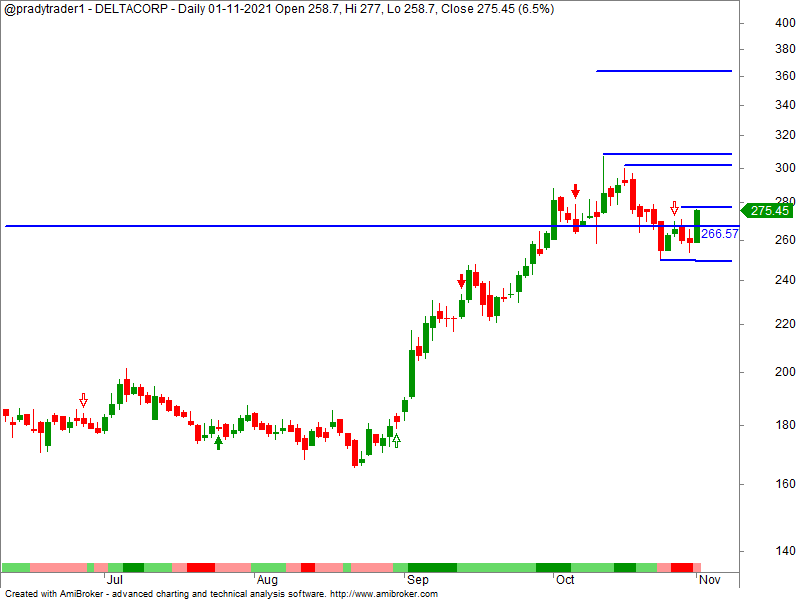
#DELTACORP (D)
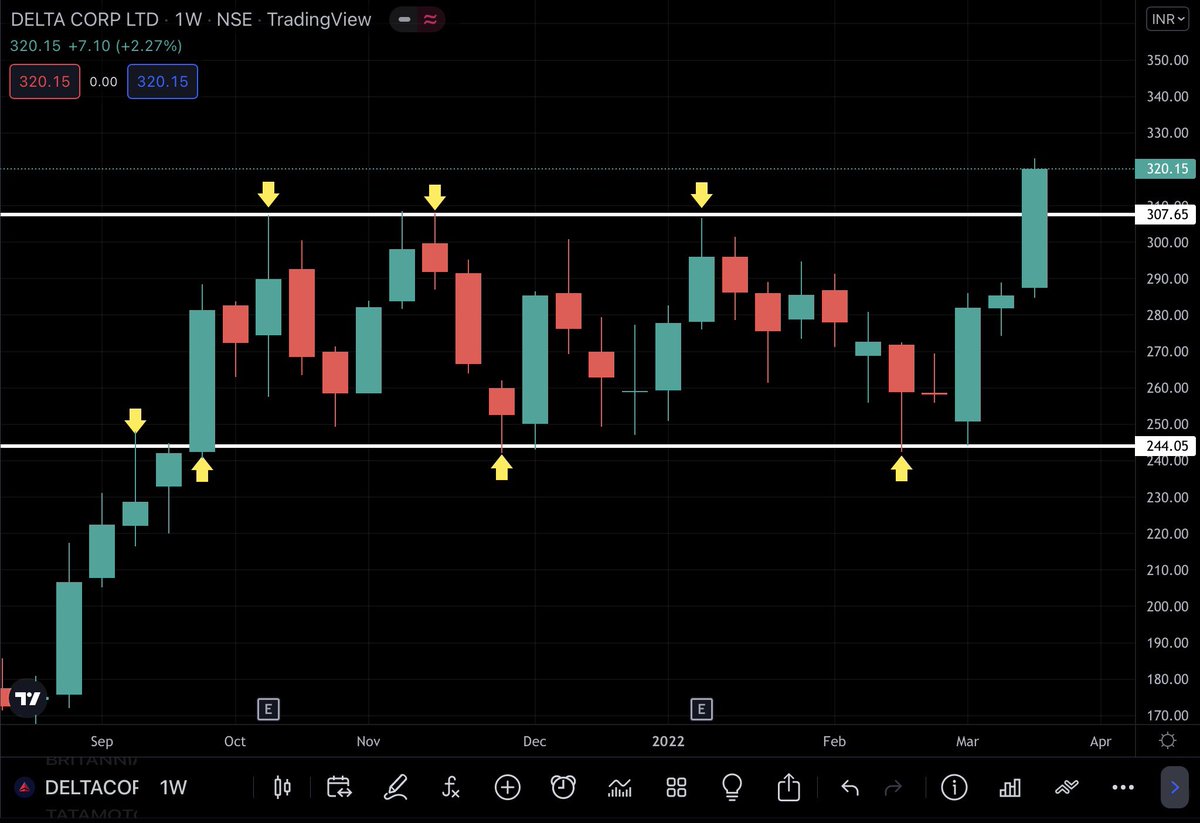
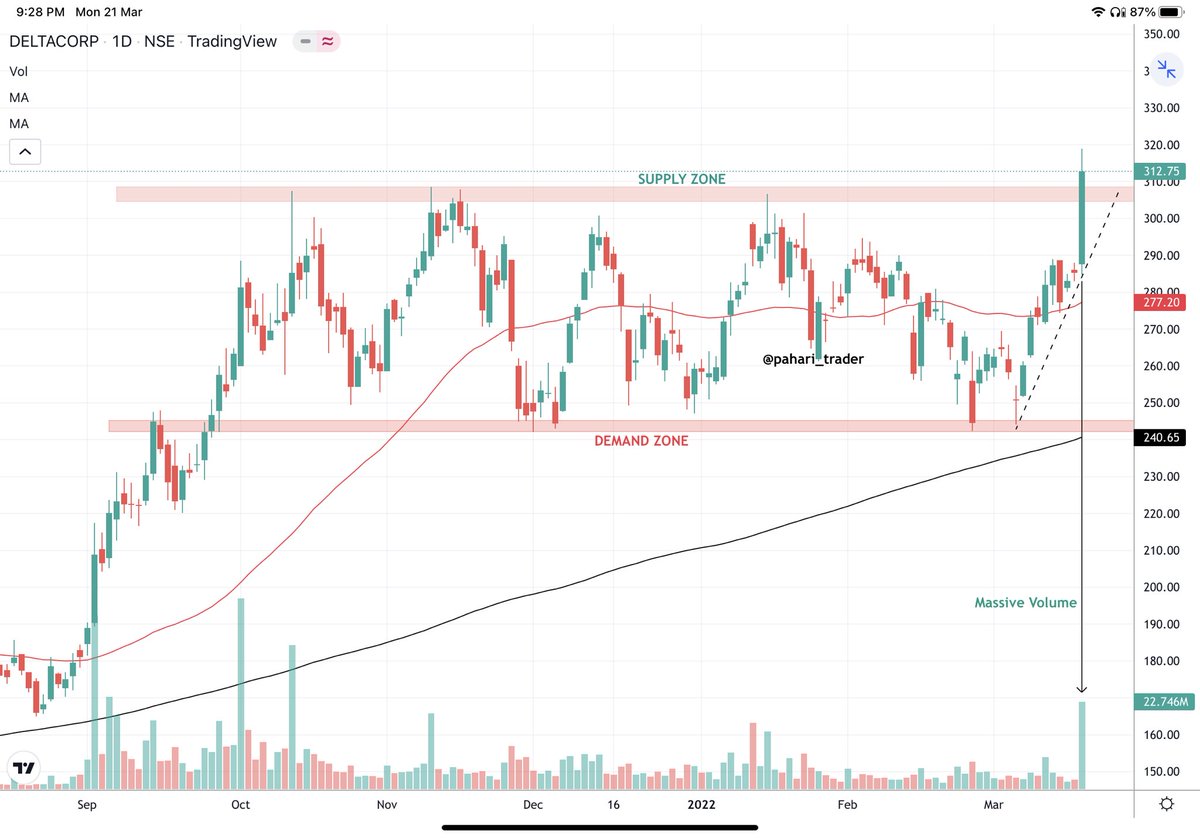
- Darvas Box Breakout
- Massive Accumulation
- Trading 52 week’s high
- Strong bullish momentum
- Buy above 315
- Stoploss 295 (clbs)
- Targets 330/350/375/400+
- TF ≈ 4-6 months
#Investing
More from Himanshu Chauhan
More from Deltacorp
Delta corp 💯💯
153 ✅
188 ✅
209 ✅
Now 225 🔥
Khelo India khelo
271 - 364 intact
153 ✅
188 ✅
209 ✅
Now 225 🔥
Khelo India khelo
271 - 364 intact
delta corp - follow up and updated chart
— Vibhor Varshney (@nakulvibhor) September 2, 2021
started tracking at 153 , then gave again at 188
now 209
supportive trendline is still intact from 1.5 years
making HH-HL
making round bottom in big picture
target 271 - 364
disc - personally holding in folio https://t.co/KhOsxZEoQR pic.twitter.com/h8KFg4WfQk
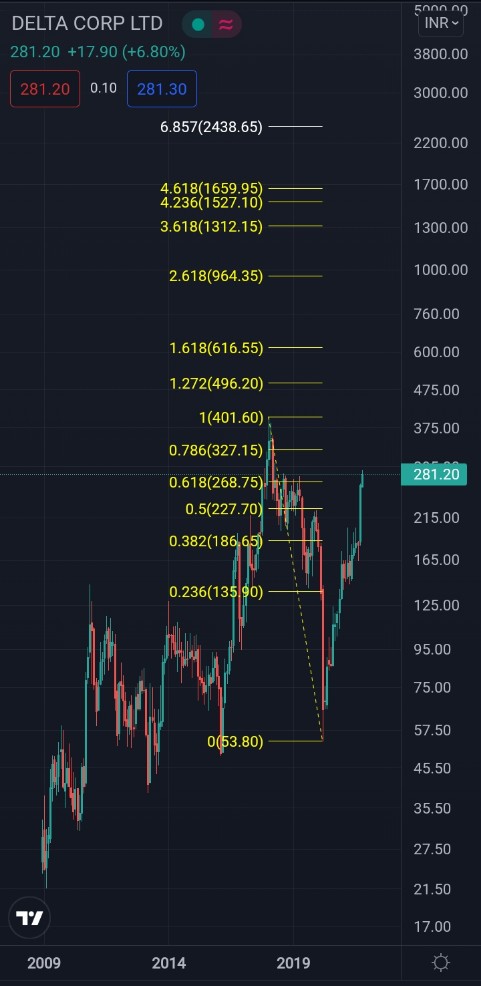
#DELTACORP-287.70
Now above Fibonacci retracement
0.618%(268) and likely move higher towards next Fibonacci retracement level
0.786(327 ) and than ATH cross.
#Probability
Now above Fibonacci retracement
0.618%(268) and likely move higher towards next Fibonacci retracement level
0.786(327 ) and than ATH cross.
#Probability
DELTACORP
— Waves_Perception(Dinesh Patel) Stock Market FARMER (@idineshptl) August 13, 2020
116
Just a perspective pic.twitter.com/Qymzx8VfsR
You May Also Like
@franciscodeasis https://t.co/OuQaBRFPu7
Unfortunately the "This work includes the identification of viral sequences in bat samples, and has resulted in the isolation of three bat SARS-related coronaviruses that are now used as reagents to test therapeutics and vaccines." were BEFORE the
chimeric infectious clone grants were there.https://t.co/DAArwFkz6v is in 2017, Rs4231.
https://t.co/UgXygDjYbW is in 2016, RsSHC014 and RsWIV16.
https://t.co/krO69CsJ94 is in 2013, RsWIV1. notice that this is before the beginning of the project
starting in 2016. Also remember that they told about only 3 isolates/live viruses. RsSHC014 is a live infectious clone that is just as alive as those other "Isolates".
P.D. somehow is able to use funds that he have yet recieved yet, and send results and sequences from late 2019 back in time into 2015,2013 and 2016!
https://t.co/4wC7k1Lh54 Ref 3: Why ALL your pangolin samples were PCR negative? to avoid deep sequencing and accidentally reveal Paguma Larvata and Oryctolagus Cuniculus?
Unfortunately the "This work includes the identification of viral sequences in bat samples, and has resulted in the isolation of three bat SARS-related coronaviruses that are now used as reagents to test therapeutics and vaccines." were BEFORE the
chimeric infectious clone grants were there.https://t.co/DAArwFkz6v is in 2017, Rs4231.
https://t.co/UgXygDjYbW is in 2016, RsSHC014 and RsWIV16.
https://t.co/krO69CsJ94 is in 2013, RsWIV1. notice that this is before the beginning of the project
starting in 2016. Also remember that they told about only 3 isolates/live viruses. RsSHC014 is a live infectious clone that is just as alive as those other "Isolates".
P.D. somehow is able to use funds that he have yet recieved yet, and send results and sequences from late 2019 back in time into 2015,2013 and 2016!
https://t.co/4wC7k1Lh54 Ref 3: Why ALL your pangolin samples were PCR negative? to avoid deep sequencing and accidentally reveal Paguma Larvata and Oryctolagus Cuniculus?
https://t.co/6cRR2B3jBE
Viruses and other pathogens are often studied as stand-alone entities, despite that, in nature, they mostly live in multispecies associations called biofilms—both externally and within the host.
https://t.co/FBfXhUrH5d
Microorganisms in biofilms are enclosed by an extracellular matrix that confers protection and improves survival. Previous studies have shown that viruses can secondarily colonize preexisting biofilms, and viral biofilms have also been described.
...we raise the perspective that CoVs can persistently infect bats due to their association with biofilm structures. This phenomenon potentially provides an optimal environment for nonpathogenic & well-adapted viruses to interact with the host, as well as for viral recombination.
Biofilms can also enhance virion viability in extracellular environments, such as on fomites and in aquatic sediments, allowing viral persistence and dissemination.
Viruses and other pathogens are often studied as stand-alone entities, despite that, in nature, they mostly live in multispecies associations called biofilms—both externally and within the host.
https://t.co/FBfXhUrH5d
Microorganisms in biofilms are enclosed by an extracellular matrix that confers protection and improves survival. Previous studies have shown that viruses can secondarily colonize preexisting biofilms, and viral biofilms have also been described.
...we raise the perspective that CoVs can persistently infect bats due to their association with biofilm structures. This phenomenon potentially provides an optimal environment for nonpathogenic & well-adapted viruses to interact with the host, as well as for viral recombination.
Biofilms can also enhance virion viability in extracellular environments, such as on fomites and in aquatic sediments, allowing viral persistence and dissemination.