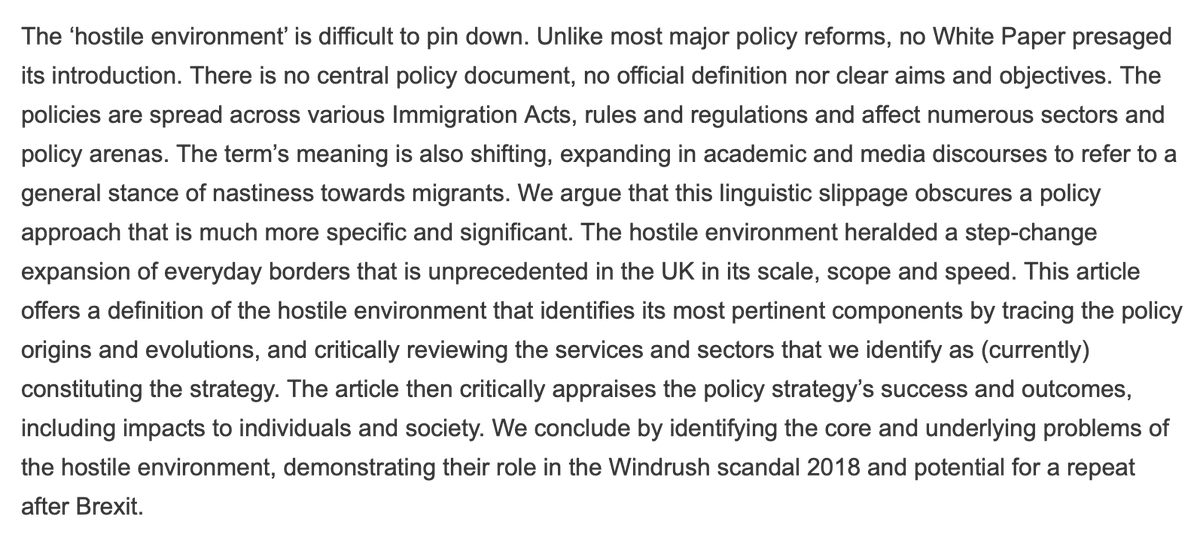
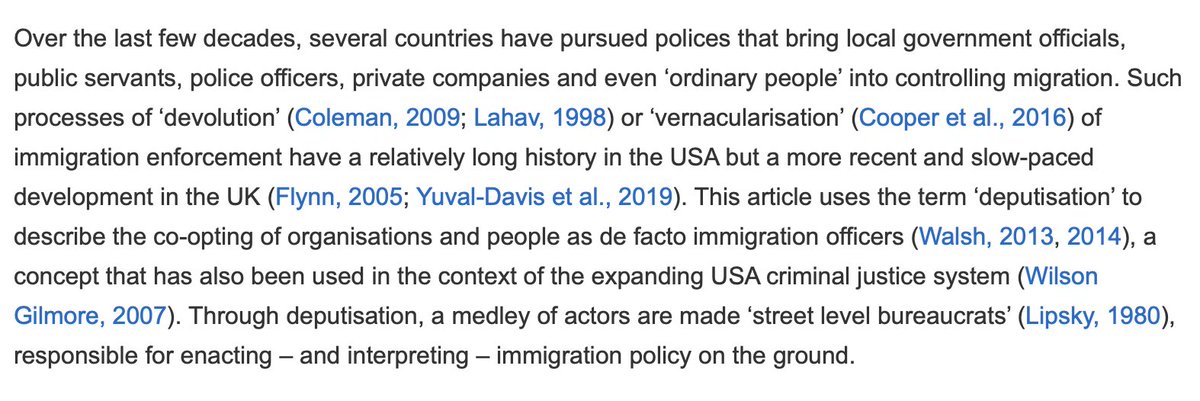
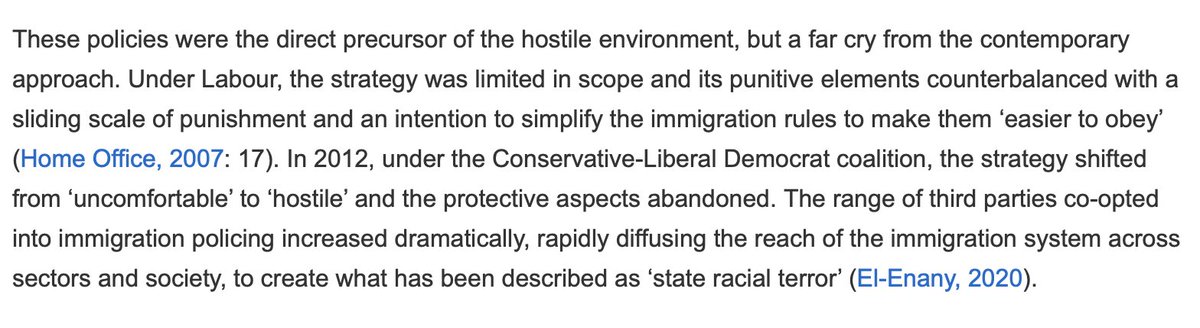
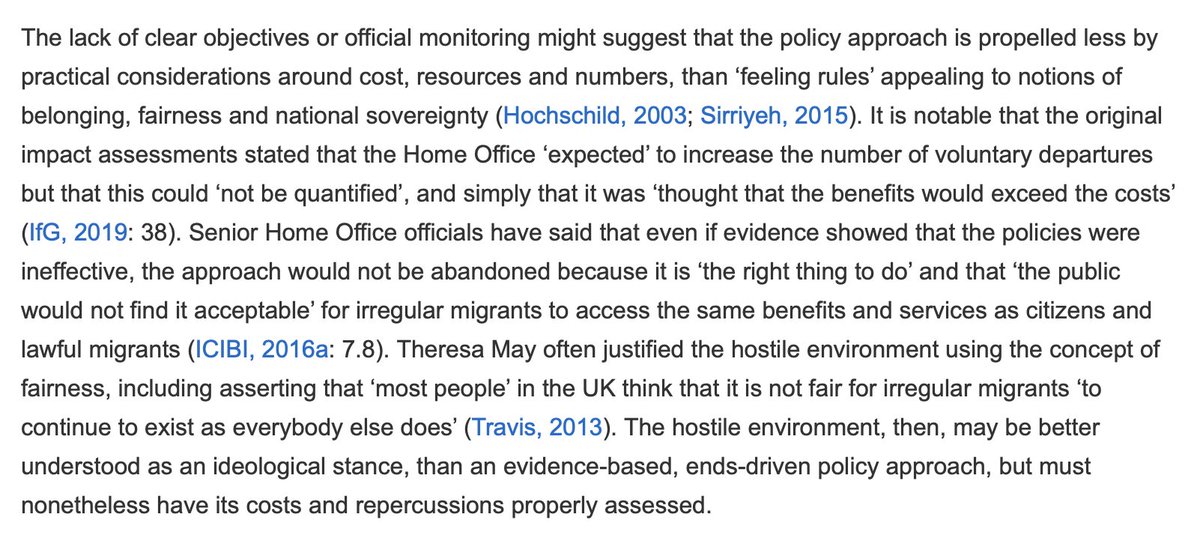
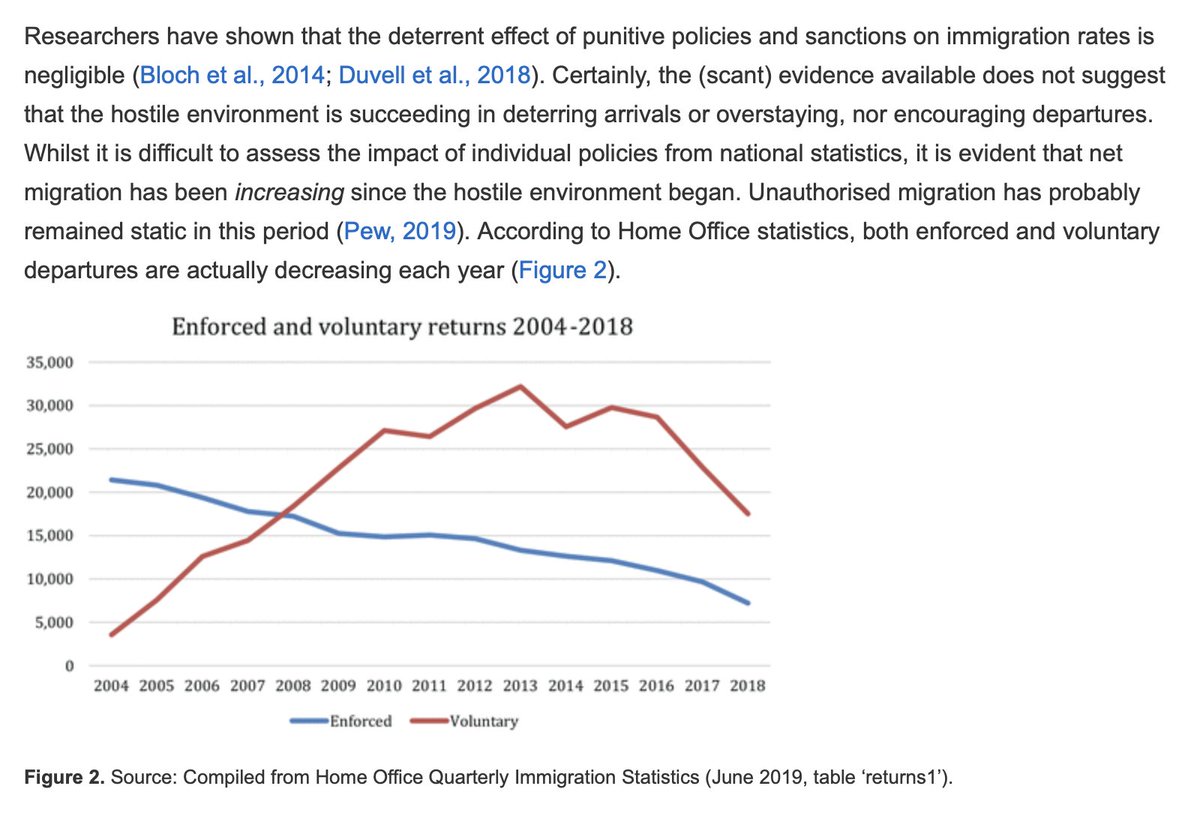
1. Very pleased that my article with @MBEGriffiths about the hostile environment policy has been published in the journal Critical Social Policy, after over four years of work on it. Thread on some of what we say.

2. We look at the origins, extent, operationalisation and impacts of the hostile environment in the labour and housing markets, public services, pricing, healthcare and education.
3. It is a policy over which, by design, the government lost control because it relies on third parties to implement it on the ground.
4. The modern policy has long antecedents but from around 2012 the approach was dramatically and recklessly expanded and any pretence at 'balance' by making immigration compliance easier was abandoned.
5. We argue the hostile environment was never an evidence-driven policy expected to achieve measurable immigration outcomes but rather an ideological policy propelled by a set of moral values.
6. There have been some attempts by civil servants at retrospective rationalisation of the policy but on these terms the policy fails very badly indeed.
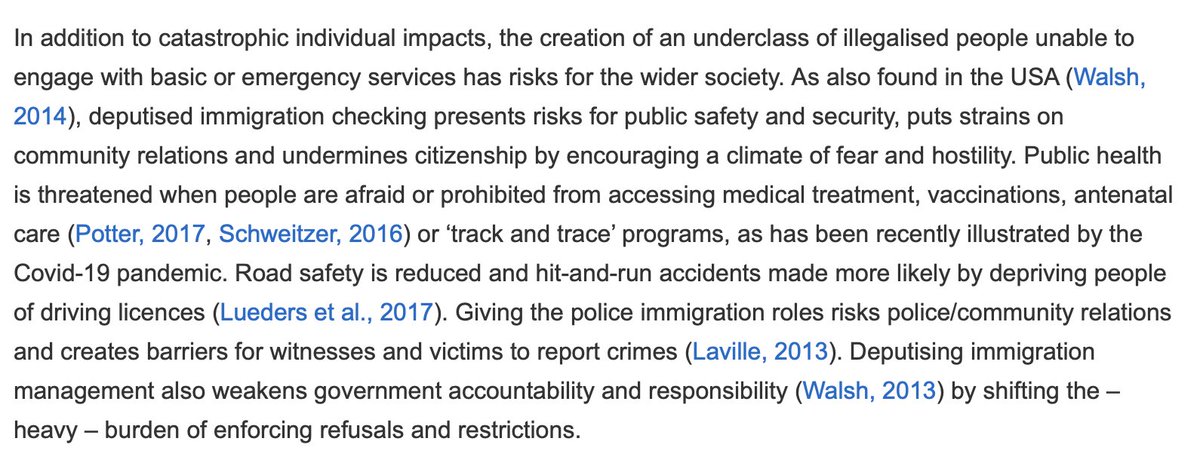
7. Against that the consequences for individuals have been calamitous, as the work of @ameliagentleman showed. Huge wider social damage has also been done.
8. We look at why the policy has been such a disaster: poor data, an inherently discriminatory system of selective checking, failure to understand British immigration history and that undocumented ≠ unlawful, uncontrolled and therefore overzealous application on the ground.
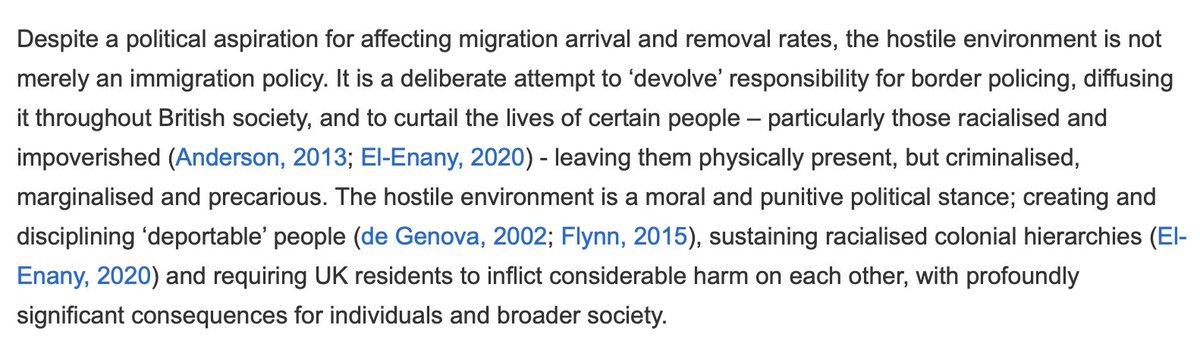
9. Really, the hostile environment is not so much a single policy as an overall approach: the 'devolution' or 'deputisation' of immigration controls. The effect is to leave its (intended and collateral) targets physically present, but criminalised, marginalised and precarious.
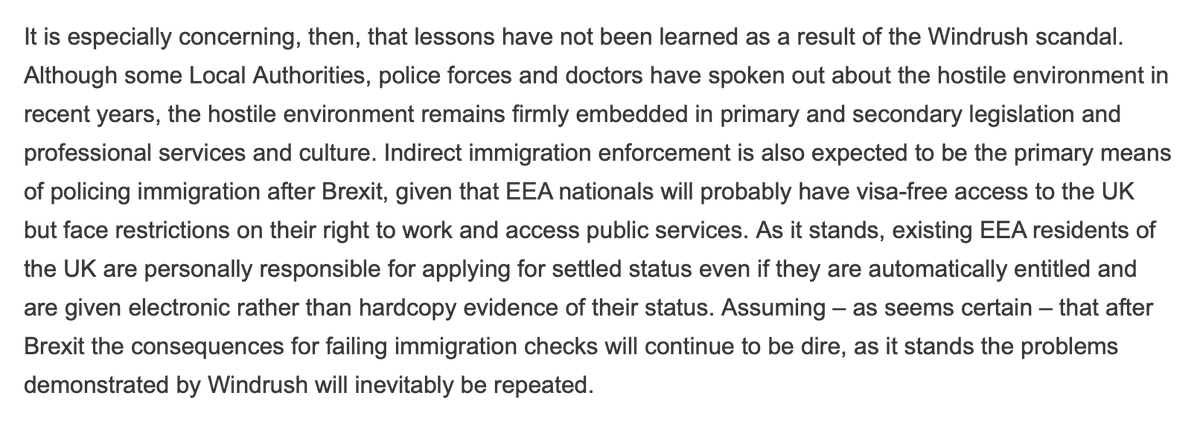
10. There has been some push back by some, but the whole hostile environment approach remains firmly embedded in law and practice, which is likely to have serious impacts on EEA citizens living in the UK after June 2021.
11. Anyway, we started writing this in mid 2016 before @ameliagentleman broke the Windrush story. As you can imagine, it has gone through quite a few versions since then! Article is open access thanks to @unibirmingham.

More from Culture

Best books I read in 2020

1. Atomic Habits by @JamesClear

“If you show up at the gym 5 days in a row—even for 2 minutes—you're casting votes for your new identity. You’re not worried about getting in shape. Youre focused on becoming the type of person who doesn’t miss workouts”


Good Reasons for Bad Feelings

https://t.co/KZDqte19nG

2. “social anxiety is overwhelmingly common. Natural selection shaped us to care enormously what other people think..We constantly monitor how much others value us..Low self-esteem is a signal to try harder to please others”


The True Believer by Eric Hoffer

https://t.co/uZT4kdhzvZ

“Hatred is the most accessible and comprehensive of all unifying agents...Mass movements can rise and spread without belief in a God, but never without a believe in a devil.”


Grandstanding

https://t.co/4Of58AZUj8

"if politics becomes a morality pageant, then the contestants have an incentive to keep problems intact...politics becomes a forum to show off moral qualities...people will be dedicated to activism for its own sake, as a vehicle to preen"


Warriors and Worriers by Joyce Benenson

https://t.co/yLC4eGHEd4

“Across diverse cultures, a man who lives in the house with another man’s children is about 60 times more likely than the biological father to kill those children.”

You May Also Like