These 5 youtube channels will teach you programming more than a CS degree

🧵👇

1. FreeCodeCamp

https://t.co/RQae8ZU2wx

2. Programming with Mosh

https://t.co/NkaUHP5Waa
3. Derek Banas

https://t.co/yIe2G1wskd
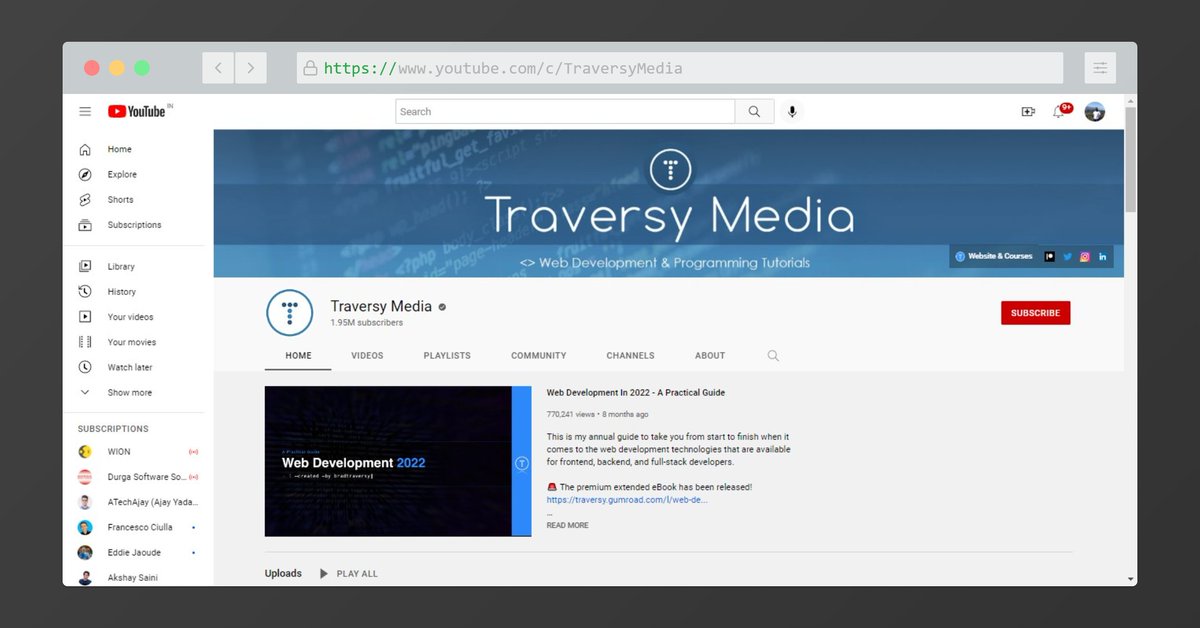
4. Traversy Media

https://t.co/LQgK4nze2g
5. Durga Software Solution

https://t.co/UPfq95gHfi
6. Netninja

https://t.co/I4hk8kbFcI
7. Academind

https://t.co/GYh8fkO5EH
Before you go, do you know?
I've also started writing on LinkedIn.

I share some exclusive content there, which I never share here.

Follow me on Linkedin to stay updated with Backend content:
https://t.co/XgytLk3FWg
Namaste, I'm Vikas!

Every Mon, Wed & Friday - I tweet a thread on Backend Development.

Follow me @vikasrajputin to read all my future threads.

Like and RT the first tweet below to support my work. https://t.co/u6vE7NnsBp
***7 youtube channels
Note:

- This thread is written from a programming perspective only

- Most CS degrees don't make you an employable programmer

- To become that, you should refer to these channels

- I've nothing against CS and don't want anyone to quit their degree after reading this thread.

More from Vikas Rajput

More from Catagory jee

A thread 🧵on Resources-for-preparation-Of-Placements Part -2 (Lecture video links)

**Designing**

- SYSTEM DESIGN

- Gaurav Sen - (
https://t.co/rzNpoBlK3q)

- SudoCode -

- LOW LEVEL DESIGN

- Soumyajit bhattacharya - (https://t.co/PCc8ZQAL8i)

- Sandeep Kaul - (https://t.co/ZH9Jq9Ei3p)

- Crack the System DesigN Interview - (https://t.co/8rhrPZZm1F)

- System Design Interview — Alex Xu -

- Designing Data Intensive Applications - (https://t.co/OhkTqqCQPx)

- System Design Interview - (https://t.co/7QvMtVRGvf)

- System Design - (https://t.co/ytpm3oy0tL)

- Services Engineering - (https://t.co/JPxM5YntWz)

- Engineering Blogs -

**Git and Github**

- Git and GitHub for Poets - (https://t.co/DsXVNVtENy)

**Projects**

- WEB DEVELOPMENT - (https://t.co/w1cEHZFRQz)

- DATA SCIENCE - (https://t.co/SJfFP4U0z0)

- MACHINE LEARNING -
The epic thread 🧵 on the best "free" resources to start coding and go professional.

Basic Programming and Computing Concepts

CS50 by Harvard
Source:
https://t.co/GYXktrSbCw

Prerequisites: None

Probably the best free course for beginners and professionals alike. It goes through the very basics of programming and painlessly shifts to advance topics.

Programming with Python

CS50P by Harvard
Source: https://t.co/vv7YUWWVV8

Prerequisites: CS50 will help but not necessary.

Takes forward the best things of CS50 but in Python. Undoubtedly, the best Python Course you will find on the internet.

Artificial Intelligence (Theory Focused)

CS50's Introduction to Artificial Intelligence with Python by Harvard
Source: https://t.co/ms2c5mxdTC

Prerequisites: CS50P

This is a more theory and concept focused Course that will be your entry point to AI.

AI with Tensorflow

Tensorflow 2.0 Beginner Tutorial by Aladdin Persson
Source: https://t.co/D7hpDOazZA

Prerequisites: CS50P and CS50 AI with Python

The best beginners tutorial on Tensorflow.

You May Also Like

THE MEANING, SIGNIFICANCE AND HISTORY OF SWASTIK

The Swastik is a geometrical figure and an ancient religious icon. Swastik has been Sanatan Dharma’s symbol of auspiciousness – mangalya since time immemorial.


The name swastika comes from Sanskrit (Devanagari: स्वस्तिक, pronounced: swastik) &denotes “conducive to wellbeing or auspicious”.
The word Swastik has a definite etymological origin in Sanskrit. It is derived from the roots su – meaning “well or auspicious” & as meaning “being”.


"सु अस्ति येन तत स्वस्तिकं"
Swastik is de symbol through which everything auspicios occurs

Scholars believe word’s origin in Vedas,known as Swasti mantra;

"🕉स्वस्ति ना इन्द्रो वृधश्रवाहा
स्वस्ति ना पूषा विश्ववेदाहा
स्वस्तिनास्तरक्ष्यो अरिश्तनेमिही
स्वस्तिनो बृहस्पतिर्दधातु"


It translates to," O famed Indra, redeem us. O Pusha, the beholder of all knowledge, redeem us. Redeem us O Garudji, of limitless speed and O Bruhaspati, redeem us".

SWASTIK’s COSMIC ORIGIN

The Swastika represents the living creation in the whole Cosmos.


Hindu astronomers divide the ecliptic circle of cosmos in 27 divisions called
https://t.co/sLeuV1R2eQ this manner a cross forms in 4 directions in the celestial sky. At centre of this cross is Dhruva(Polestar). In a line from Dhruva, the stars known as Saptarishi can be observed.