Bad habits repeat themselves repeatedly, not because you don't want to change, but because you have the wrong system for change.
10 Lessons From (the book you still haven't read) Atomic Habits by James Clear:
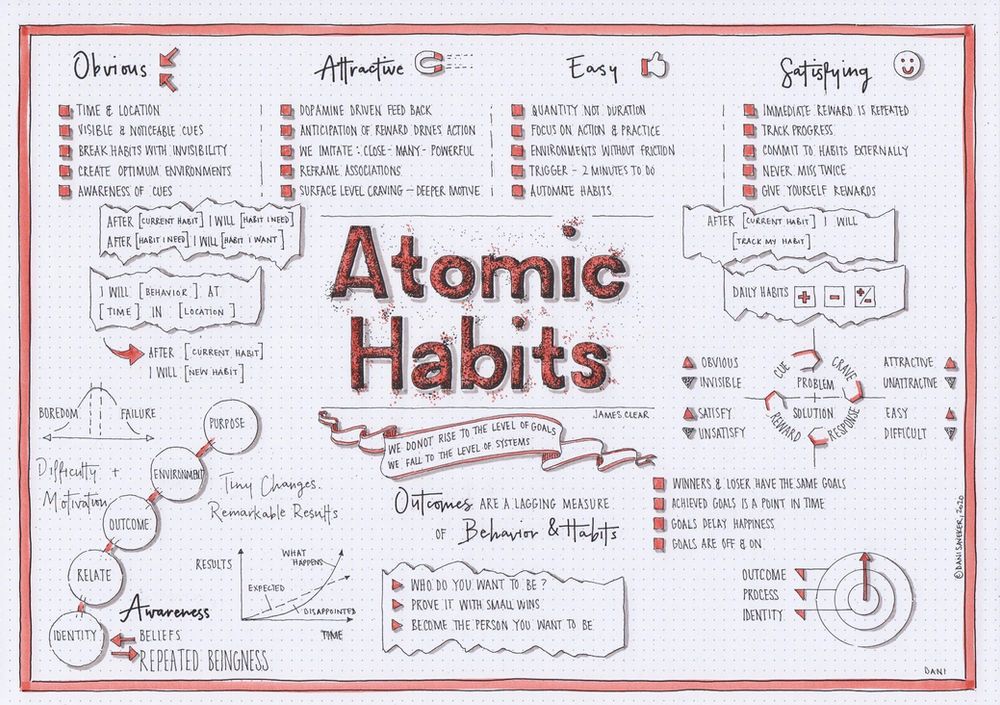
Bad habits repeat themselves repeatedly, not because you don't want to change, but because you have the wrong system for change.
Here are 10 lessons from Atomic Habits by James Clear that can help you do that.
The easier it is to begin your new habit, the more likely you will stick with it.
If you want to start running, for instance, don't make a goal of running 5 miles a day.
Once that becomes easy, add more each time until you're up to your goal.
Cues are habits that trigger other habits.
For example, brushing your teeth is a cue that triggers the habit of flossing.
If you want to form a new habit, find an existing cue that you can use to trigger it.
When you have a craving for something, you're more likely to act on it.
So if you want to form a new habit, find a way to create a craving for it.
For example, if you want to eat healthily, ensure healthy snacks are visible and easily accessible.
The more satisfying your new habit is, the more likely you will stick with it.
If you're trying to eat healthily, make sure you're eating foods you enjoy and filling you up.
Goals give you something to strive for and help keep you motivated.
When setting a goal for your new habit, make sure it's specific, measurable, achievable, relevant, and time-bound (SMART).
If you want to make sure you stick with your new habit, set a deadline for yourself.
For example, if you want to start working out, make a goal of working out three times a week for six weeks.
When you have a plan, you're more likely to follow your habits.
So if you want to make sure you're sticking to your new habit, plan how you will do it.
The first plan you make likely won't work, so adjust it as needed.
Having someone to keep you accountable can be a great way to make sure you're sticking to your habits.
Find someone with a similar goal and check in with each other regularly to see how you're doing.
When you reach your goals, reward yourself!
This will help motivate you to keep going and make it more likely that you'll stick with your habits.
The reward can be big or small; it doesn't matter as long as it's unique.
Tracking your progress is a great way to stay motivated and on track with your habits.
Use a journal or app to track your new habit and how well you're doing.
This will help you see your progress and keep moving forward.
Developing good habits can be hard, but it's worth it.
These 10 lessons from Atomic Habits by James Clear can help you get started.
Plan
Set a goal
Find a cue
Start small
Make it easy
Set a deadline
Create a craving
Make it satisfying
Track your progress
Get an accountability partner
You can do it; just keep going!
If you got value from this, follow me
@aaronjgolub for more content.
You May Also Like

This is a pretty valiant attempt to defend the "Feminist Glaciology" article, which says conventional wisdom is wrong, and this is a solid piece of scholarship. I'll beg to differ, because I think Jeffery, here, is confusing scholarship with "saying things that seem right".
The article is, at heart, deeply weird, even essentialist. Here, for example, is the claim that proposing climate engineering is a "man" thing. Also a "man" thing: attempting to get distance from a topic, approaching it in a disinterested fashion.

Also a "man" thing—physical courage. (I guess, not quite: physical courage "co-constitutes" masculinist glaciology along with nationalism and colonialism.)

There's criticism of a New York Times article that talks about glaciology adventures, which makes a similar point.

At the heart of this chunk is the claim that glaciology excludes women because of a narrative of scientific objectivity and physical adventure. This is a strong claim! It's not enough to say, hey, sure, sounds good. Is it true?
Imagine for a moment the most obscurantist, jargon-filled, po-mo article the politically correct academy might produce. Pure SJW nonsense. Got it? Chances are you're imagining something like the infamous "Feminist Glaciology" article from a few years back.https://t.co/NRaWNREBvR pic.twitter.com/qtSFBYY80S
— Jeffrey Sachs (@JeffreyASachs) October 13, 2018
The article is, at heart, deeply weird, even essentialist. Here, for example, is the claim that proposing climate engineering is a "man" thing. Also a "man" thing: attempting to get distance from a topic, approaching it in a disinterested fashion.
Also a "man" thing—physical courage. (I guess, not quite: physical courage "co-constitutes" masculinist glaciology along with nationalism and colonialism.)
There's criticism of a New York Times article that talks about glaciology adventures, which makes a similar point.
At the heart of this chunk is the claim that glaciology excludes women because of a narrative of scientific objectivity and physical adventure. This is a strong claim! It's not enough to say, hey, sure, sounds good. Is it true?