Much awaited session at Kolkata by Utpal Seth, Rare Enterprises, on "Dimensions of Mistakes in Investing", to be moderated by Varun Goenka.
#MAW

Utpal Sheth starts with a tribute to Rakesh Jhunjhunwala
Utpal Sheth lays out the context for today's session - Mistakes are rarely discussed!

Outcomes don't define mistakes. They are known through a process of deep introspection & multiple iterations. The opportunity cost of not embracing mistakes is very high.
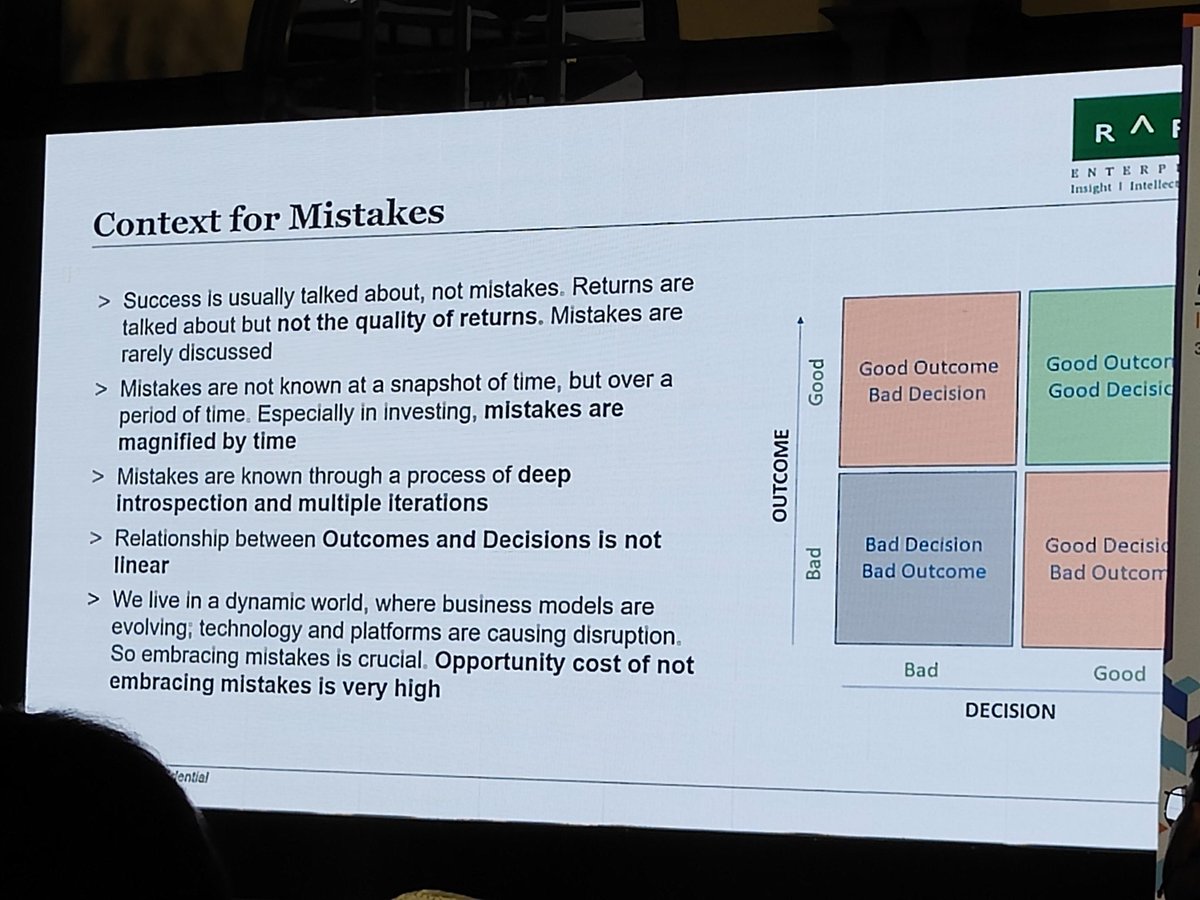
When speaking of mistakes in investing, we often speak of 'Type 2 errors', and at times of type 1 errors. Utpal speaks of Type 1.5 error - not buying / selling with conviction!
Utpal discusses their process with mistakes - and quotes Rakesh Jhunjhunwala - making mistakes isn't a crime, repeating them is. Discusses mistakes at RARE Enterprises with the audience with ease.
One needs to think of portfolio balance very deeply. Sizing the bet depends on the degree of conviction and degree of evidence. Recommended book: "Thinking in Bets"
On thinking about investment mistakes - 3 key steps - identification, attribution and rectification. Attribution of mistakes needs time and thought - one need not wait to attribute mistakes for rectification!
Buying right is tough. The probability of making a good investment is low - due to the chance of making a mistake in any of the 5-8 parameters we use for evaluation. The key is to identify the right jungle (Megatrend) and the right company within that (Gorilla).
Discusses in detail examples of mistakes in buying
Type 1 (didn't buy): Bajaj Finance
Type 1.5 (didn't buy enough/sold partly): CRISIL
Type 2 (bought incorrectly): A2Z Infra Engineering
Important: Parameters in discussion were on their framework - Identifying the Megatrend (see next tweet) they were part of, and whether they were Clear leader, Near leader, and Emerging leader
Important: Megatrend buckets used by Rare Enterprises: Consumption, Globalisation, Financial deepening, Digitalisation, Outsourcing and Formalisation, and Renewable Energy.
Now discusses Mistakes in selling:

Type 1 (Didn't sell right): Bilcare Limited
Type 1.5 (didn't sell enough): Praj Industries
Type 2 (Sold too early): Relaxo Footwear

These hurt much more, and they have had much to learn from these.
Utpal concludes his presentation with quotes from Rakesh Jhunjhunwala and Jeff Bezos, and adds: Embrace your mistake, let mistakes not affect the balance of your mind, and have a risk Management framework to enable peace of mind.
We now head to the Q&A session, moderated by @VGoenka82
Q: Attitude that helped him achieve heights
A: Learning attitude and adaptability. Hopes to have a learning attitude to the last day, and ensure that it's not an 'ivory tower learning' - it's important to implement and execute (hence adaptability and resilience).
Q: How to think about portfolio sizing, given the low joint probability of being right?
A: Buy decisions need not be at one point in time. Gradually build conviction - and continue buying - even if at higher levels. Refers to @mjmauboussin 's Probability adjusted Investing.
Speaks on the importance of the right culture in identifying companies that could create terminal value. You can replace the machinery, the product and all else. You can't buy culture!
Q: How to build the right investment team.
A: one needs to have the right enviornment, empowerment,and right leadership. Complementing skills and behaviours should be present - balance between accelerator and brakes.
Closing remarks from Utpal: Keep learning, keep adapting and keep investing. Don't be afraid of mistakes, protect your state of mind, it's a fulfilling journey. Has had a good time interacting with youngsters here and looks forward to more such at the #MAW conference.

More from All

You May Also Like

कुंडली में 12 भाव होते हैं। कैसे ज्योतिष द्वारा रोग के आंकलन करते समय कुंडली के विभिन्न भावों से गणना करते हैं आज इस पर चर्चा करेंगे।
कुण्डली को कालपुरुष की संज्ञा देकर इसमें शरीर के अंगों को स्थापित कर उनसे रोग, रोगेश, रोग को बढ़ाने घटाने वाले ग्रह


रोग की स्थिति में उत्प्रेरक का कार्य करने वाले ग्रह, आयुर्वेदिक/ऐलोपैथी/होमियोपैथी में से कौन कारगर होगा इसका आँकलन, रक्त विकार, रक्त और आपरेशन की स्थिति, कौन सा आंतरिक या बाहरी अंग प्रभावित होगा इत्यादि गणना करने में कुंडली का प्रयोग किया जाता है।


मेडिकल ज्योतिष में आज के समय में Dr. K. S. Charak का नाम निर्विवाद रूप से प्रथम स्थान रखता है। उनकी लिखी कई पुस्तकें आज इस क्षेत्र में नए ज्योतिषों का मार्गदर्शन कर रही हैं।
प्रथम भाव -
इस भाव से हम व्यक्ति की रोगप्रतिरोधक क्षमता, सिर, मष्तिस्क का विचार करते हैं।


द्वितीय भाव-
दाहिना नेत्र, मुख, वाणी, नाक, गर्दन व गले के ऊपरी भाग का विचार होता है।
तृतीय भाव-
अस्थि, गला,कान, हाथ, कंधे व छाती के आंतरिक अंगों का शुरुआती भाग इत्यादि।

चतुर्थ भाव- छाती व इसके आंतरिक अंग, जातक की मानसिक स्थिति/प्रकृति, स्तन आदि की गणना की जाती है


पंचम भाव-
जातक की बुद्धि व उसकी तीव्रता,पीठ, पसलियां,पेट, हृदय की स्थिति आंकलन में प्रयोग होता है।

षष्ठ भाव-
रोग भाव कहा जाता है। कुंडली मे इसके तत्कालिक भाव स्वामी, कालपुरुष कुंडली के स्वामी, दृष्टि संबंध, रोगेश की स्थिति, रोगेश के नक्षत्र औऱ रोगेश व भाव की डिग्री इत्यादि।
These 10 threads will teach you more than reading 100 books

Five billionaires share their top lessons on startups, life and entrepreneurship (1/10)


10 competitive advantages that will trump talent (2/10)


Some harsh truths you probably don’t want to hear (3/10)


10 significant lies you’re told about the world (4/10)
IMPORTANCE, ADVANTAGES AND CHARACTERISTICS OF BHAGWAT PURAN

It was Ved Vyas who edited the eighteen thousand shlokas of Bhagwat. This book destroys all your sins. It has twelve parts which are like kalpvraksh.

In the first skandh, the importance of Vedvyas


and characters of Pandavas are described by the dialogues between Suutji and Shaunakji. Then there is the story of Parikshit.
Next there is a Brahm Narad dialogue describing the avtaar of Bhagwan. Then the characteristics of Puraan are mentioned.

It also discusses the evolution of universe.(
https://t.co/2aK1AZSC79 )

Next is the portrayal of Vidur and his dialogue with Maitreyji. Then there is a mention of Creation of universe by Brahma and the preachings of Sankhya by Kapil Muni.


In the next section we find the portrayal of Sati, Dhruv, Pruthu, and the story of ancient King, Bahirshi.
In the next section we find the character of King Priyavrat and his sons, different types of loks in this universe, and description of Narak. ( https://t.co/gmDTkLktKS )


In the sixth part we find the portrayal of Ajaamil ( https://t.co/LdVSSNspa2 ), Daksh and the birth of Marudgans( https://t.co/tecNidVckj )

In the seventh section we find the story of Prahlad and the description of Varnashram dharma. This section is based on karma vaasna.