
The less you've expectation from others, the more you would receive respect in the relationships.
More from D.Muthukrishnan
More from Personal growth


Razors are rules that simplify decisions.
THREAD: 20+ powerful razors (to help you cut through life’s noise):
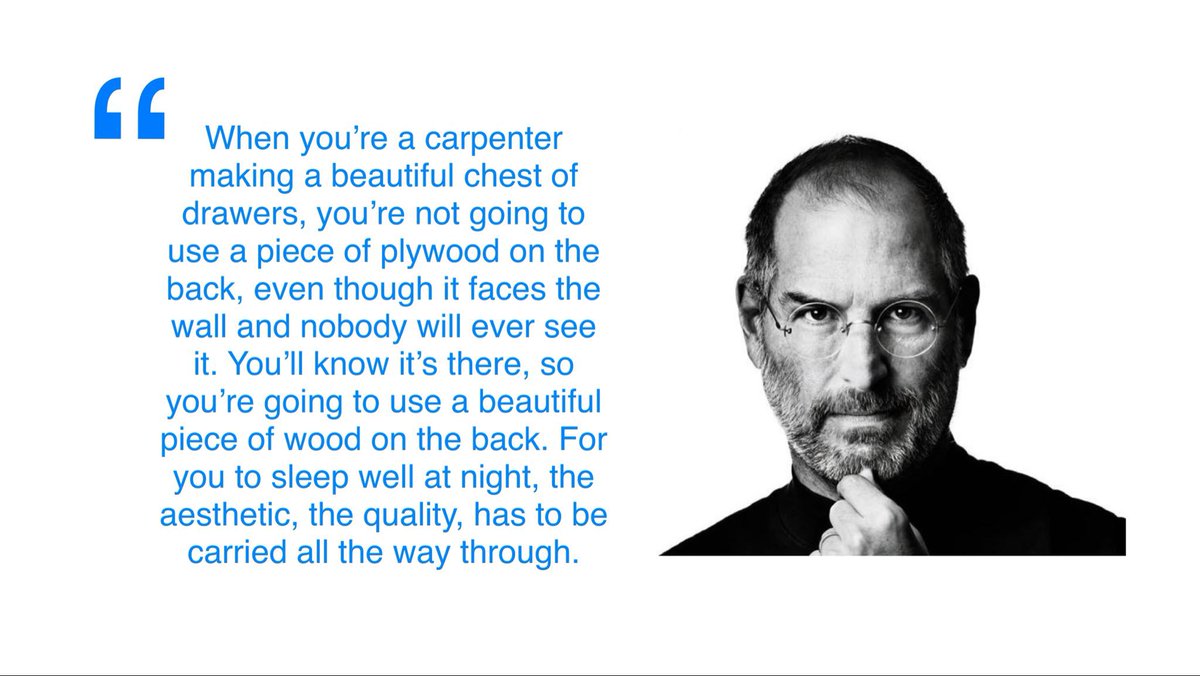
The Steve Jobs Quality Razor
When building, take pride in carrying the quality all the way through.
Would you be proud for your work to be seen from every angle and perspective?
If not, keep working.
The ELI5 Razor
Complexity and jargon are often used to mask a lack of true understanding.
If you can’t explain it to a 5-year-old, you don’t really understand it.
If someone uses a lot of complexity and jargon to explain something to you, they probably don’t understand it.
Munger’s Rule of Opinions
“I never allow myself to have an opinion on anything that I don’t know the other side’s argument better than they do.” - Charlie Munger
Opinions aren’t free. You have to work to earn the right to have them.
The Bezos Regret Minimization Framework
The goal is to minimize the number of regrets in life.
When faced with a difficult decision:
(1) Project yourself into the future
(2) Look back on the decision
(3) Ask "Will I regret not doing this?"
(4) Take action
THREAD: 20+ powerful razors (to help you cut through life’s noise):
The Steve Jobs Quality Razor
When building, take pride in carrying the quality all the way through.
Would you be proud for your work to be seen from every angle and perspective?
If not, keep working.
The ELI5 Razor
Complexity and jargon are often used to mask a lack of true understanding.
If you can’t explain it to a 5-year-old, you don’t really understand it.
If someone uses a lot of complexity and jargon to explain something to you, they probably don’t understand it.
Munger’s Rule of Opinions
“I never allow myself to have an opinion on anything that I don’t know the other side’s argument better than they do.” - Charlie Munger
Opinions aren’t free. You have to work to earn the right to have them.
The Bezos Regret Minimization Framework
The goal is to minimize the number of regrets in life.
When faced with a difficult decision:
(1) Project yourself into the future
(2) Look back on the decision
(3) Ask "Will I regret not doing this?"
(4) Take action
The @JeffBezos Regret Minimization Framework is a simple yet powerful mental model for making important decisions and unlocking growth in your career, startup, business, relationships, or life.
— Sahil Bloom (@SahilBloom) February 24, 2021
A short thread on how it works and how it can change your life... pic.twitter.com/krtr2CarxW


You May Also Like







MDZS is laden with buddhist references. As a South Asian person, and history buff, it is so interesting to see how Buddhism, which originated from India, migrated, flourished & changed in the context of China. Here's some research (🙏🏼 @starkjeon for CN insight + citations)
1. LWJ’s sword Bichen ‘is likely an abbreviation for the term 躲避红尘 (duǒ bì hóng chén), which can be translated as such: 躲避: shunning or hiding away from 红尘 (worldly affairs; which is a buddhist teaching.) (https://t.co/zF65W3roJe) (abbrev. TWX)
2. Sandu (三 毒), Jiang Cheng’s sword, refers to the three poisons (triviṣa) in Buddhism; desire (kāma-taṇhā), delusion (bhava-taṇhā) and hatred (vibhava-taṇhā).
These 3 poisons represent the roots of craving (tanha) and are the cause of Dukkha (suffering, pain) and thus result in rebirth.
Interesting that MXTX used this name for one of the characters who suffers, arguably, the worst of these three emotions.
3. The Qian kun purse “乾坤袋 (qián kūn dài) – can be called “Heaven and Earth” Pouch. In Buddhism, Maitreya (मैत्रेय) owns this to store items. It was believed that there was a mythical space inside the bag that could absorb the world.” (TWX)