Alex1Powell Categories Politics



New video on why the EU\u2019s approach to these Brexit trade talks should not come as a surprise. Whether you approve or not. Featuring @BBCChrisMorris @anandMenon1 & with thanks to colleagues Andrew Walker and Kevin Connolly. pic.twitter.com/ILeJAoSlRo
— Ros Atkins (@BBCRosAtkins) December 10, 2020
2. Firstly, the EU shared rules in the deal they did with Canada, they just did it in a different way.
3. Canada were required to sign up to several car regulations in UNECE.
4. The EU has, at minimum, 48% of the vote on any one of those regulations. With CETA, Canada agreed to share rules where it can be outvoted, and most likely will be.
5. The alignment the EU is proposing for the UK is different. It's based on dynamic alignment which is about approximating rules.



#BidenCheated and nothing can stop what is coming 🤭
https://t.co/kOfHsvT83z

\u201cAs state legislators, we take our responsibility to guard and guarantee our constituents\u2019 right to free and fair elections. I fought to defend this right for three decades\u2026nothing is more sacred in our democracy.\u201d \u2014 \u2066@SenMastriano\u2069 https://t.co/uBg4OGYxqU
— Jenna Ellis (@JennaEllisEsq) November 28, 2020


Or at Parler https://t.co/aEfKd7LHH0 Layers upon layers of old power structures and you could argue that the ones who control Nasdaq is important. They are in control? One and the same company again and again.


January 20, 2017, As The Incoming Duly Elected President Gently Rests His Hand On The Bible And Is Sworn In, The Outgoing President With The Keen Assistance Of Jarrett, Two Former Presidents, CIA, FBI, DOJ, MSM, And The 'Eyes Intelligence Alliance', Conspire To Take Him Down.
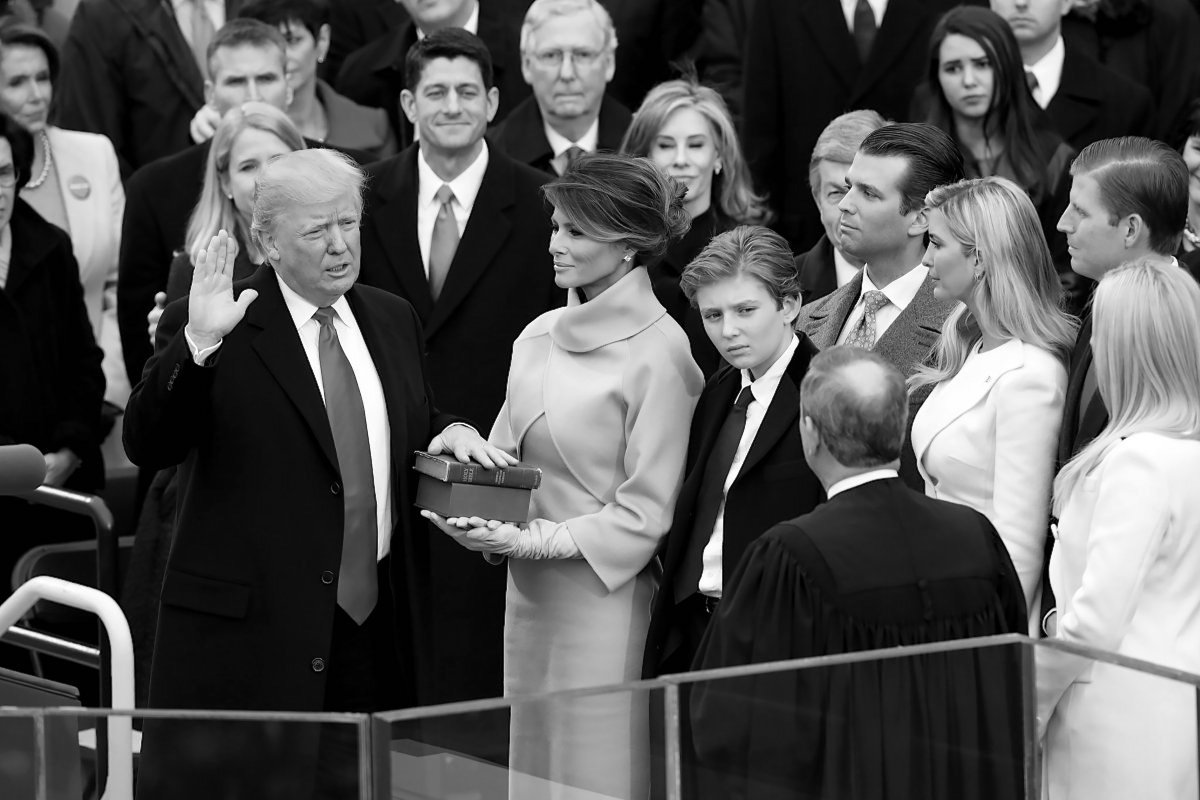
How Did Jarrett, Barry, Hillary, Brennan, Clapper, Comey, And Their Seditious Conspirators Use Tradecraft To Set Up The Entire Spying / Takedown Operation Of First Donald J. Trump, Then President Elect Donald J. Trump, And Ultimately The 45th U.S. President Donald J. Trump?
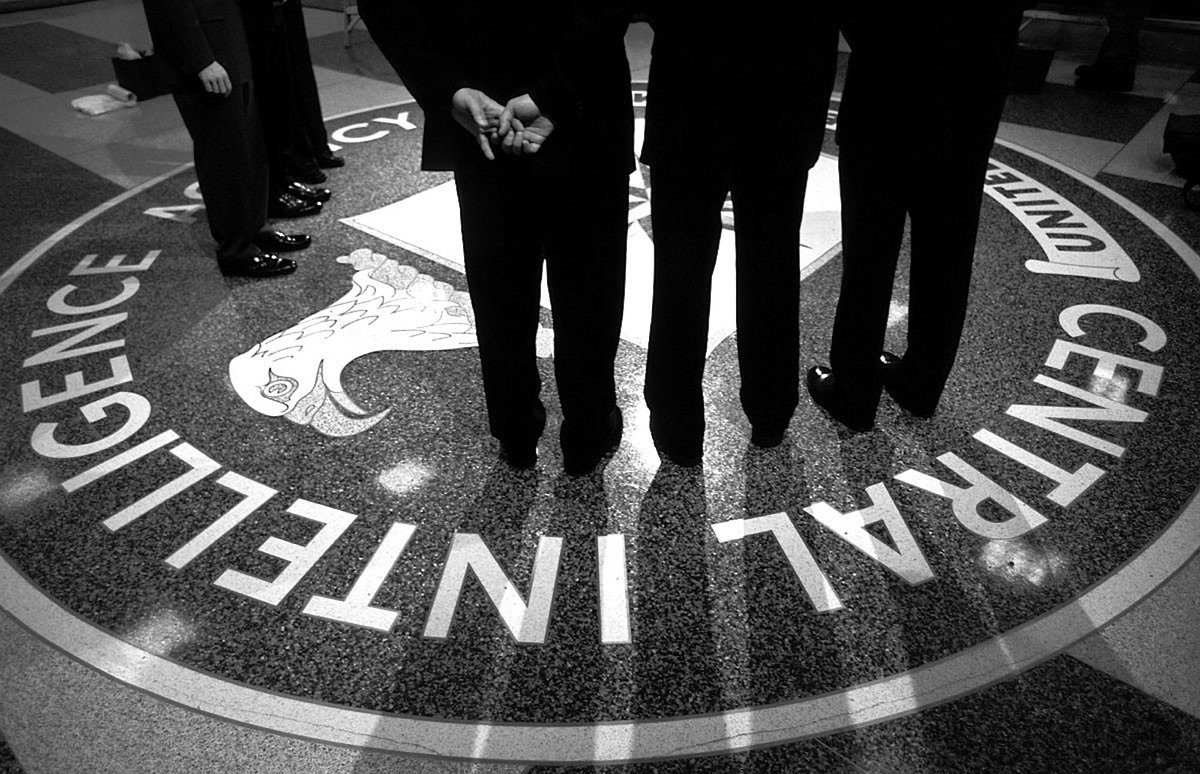
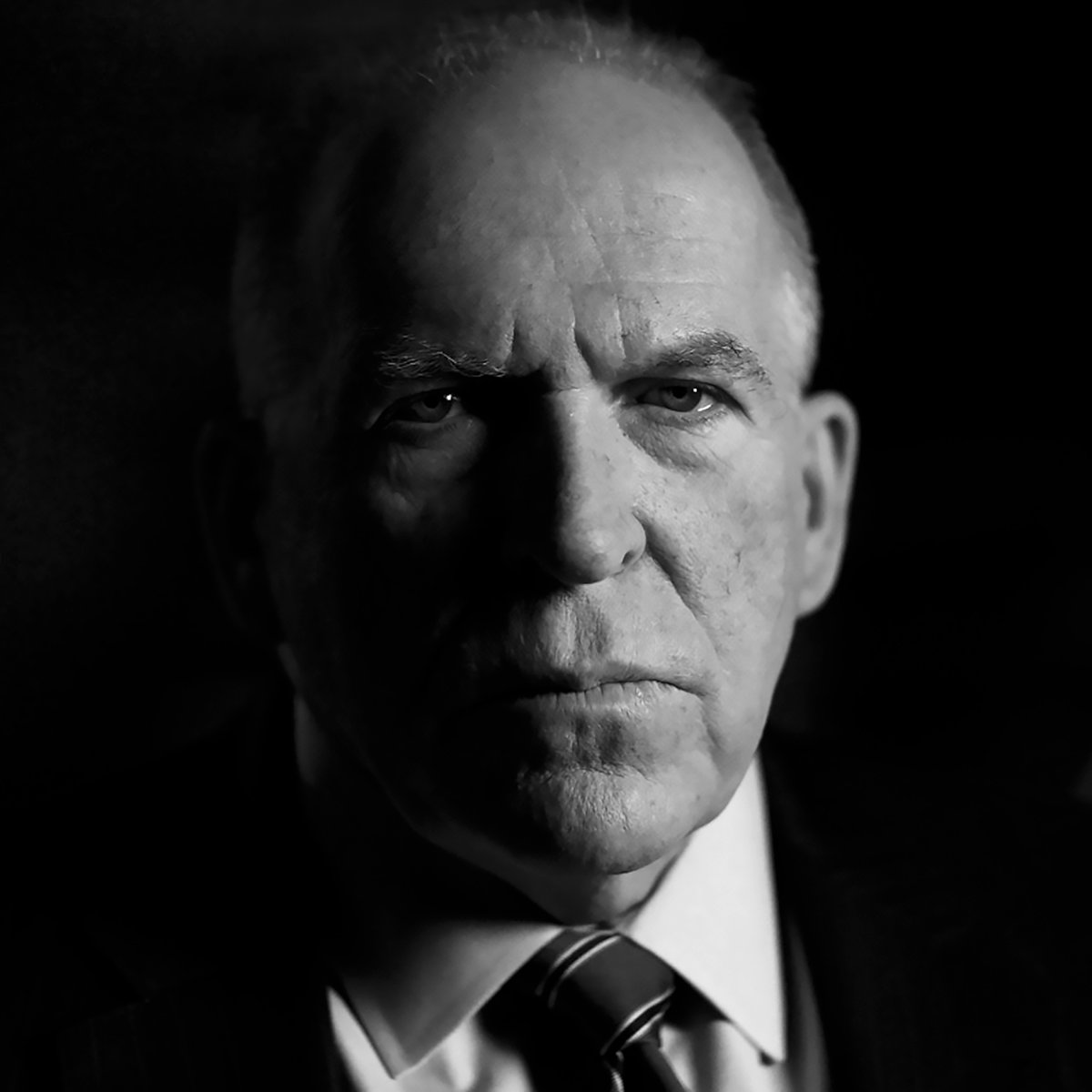
First Off, There Is No Question That John Brennan Oversaw The Entire Operation From Start And Up Until Me Writing This Thread, And Probably Still Updates Valerie And Barry On A Daily Basis.
John Brennan Is Leading The Charge, With No Intention Of Stopping. He Is On A Dangerous And Destructive Mission, Not Intended To Benefit The American People.
After Dr. Brzezinski, I'd Say John Brennan Is One Of The Most Dangerous Men In American History.
https://t.co/wmGyfOCIFL
Zbigniew Brzezinski Was A Cabal 'Conflict Strategist', And One Of The Most Dangerous Men In American History.
— WarNuse (@WarNuse) September 16, 2020
Barry Soetoro Openly Praised Dr. Brzezinski. pic.twitter.com/tjcWYldPiT

2)While China and France have been enhancing their soldiers, the United States has been disabling and killing our soldiers without their consent in violation of the Nuremberg Code. @realDonaldTrump
3)Weaponizing Biotech: How China's Military Is Preparing for a 'New Domain of
4)France is developing bionic soldiers resistant to pain with microchip-enhanced brain power and superior hearing
https://t.co/xlYf22idor @realDonaldTrump
5)Why are our Gulf War veterans dying?
Our veterans were guinea pigs forced to take an unproven, untested drug to assess the effects of bio-warfare agents expected to be used by Saddam Hussein as we invaded Iraq @realDonaldTrump https://t.co/vIgmIXpfAp




1. Sir Oliver Letwin PC FRSA (born 19 May 1956)[1] is a British politician who served as the MP for West Dorset from 1997 to 2019. Letwin was elected as a member of the Conservative Party, but sat as an independent after having the whip removed in September 2019.
2. He served as Shadow Chancellor of the Exchequer under Michael Howard and Shadow Home Secretary under Iain Duncan Smith. He was Chancellor of the Duchy of Lancaster from 2014 to 2016.

3. Archives.
4. 'Vision set for UK to become a world leader in the internet of things - Minister for Government Policy, Oliver Letwin commented: 2014 https://t.co/vGTARHjv8g
"The Internet of Things will be an economic powerhouse for the UK with millions of connections unlocking billions of

"You don't push politicians to do the right thing because you think they will, you do it to show everyone else that they
The debate rages on over whether House progressives should force a floor vote on Medicare for All, with one side arguing that AOC and the rest of "The Squad" were elected to advance progressive policies and the other side arguing that AOC is cool so shut up and leave her alone.
As we discussed yesterday, Americans will not be given Medicare for All despite overwhelming public support because so much power depends on keeping them poor so they don't interfere in the affairs of a nation which serves as the hub of a global
Why They're Denying You Healthcare And Financial Support During A Pandemic
— Caitlin Johnstone \u23f3 (@caitoz) December 20, 2020
"If wealth were more evenly distributed in the most powerful nation on earth, there'd be no ruling class to ensure the domination of the globe-spanning empire."https://t.co/0o5YjLLgQS
The US political system does not exist to serve the interests of Americans, it exists to serve the interests of the empire. No part of that system is there to protect the people from the powerful; it's there to protect the powerful from the people.
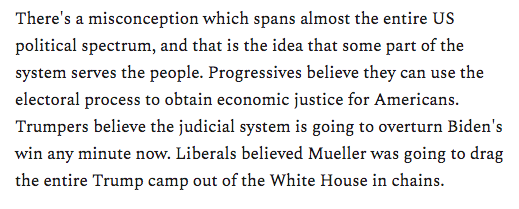
And that's just not the case. There is no part of the US political system which is anything other than innately oppositional to economic justice.


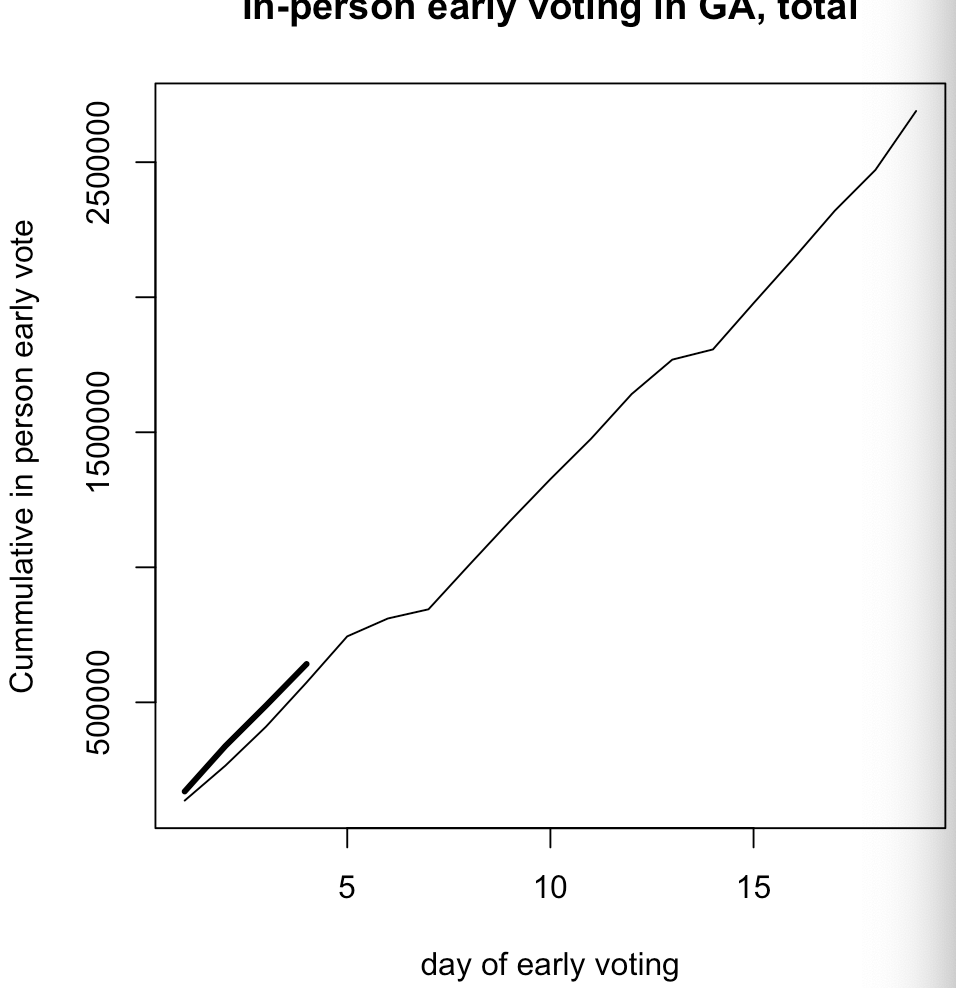
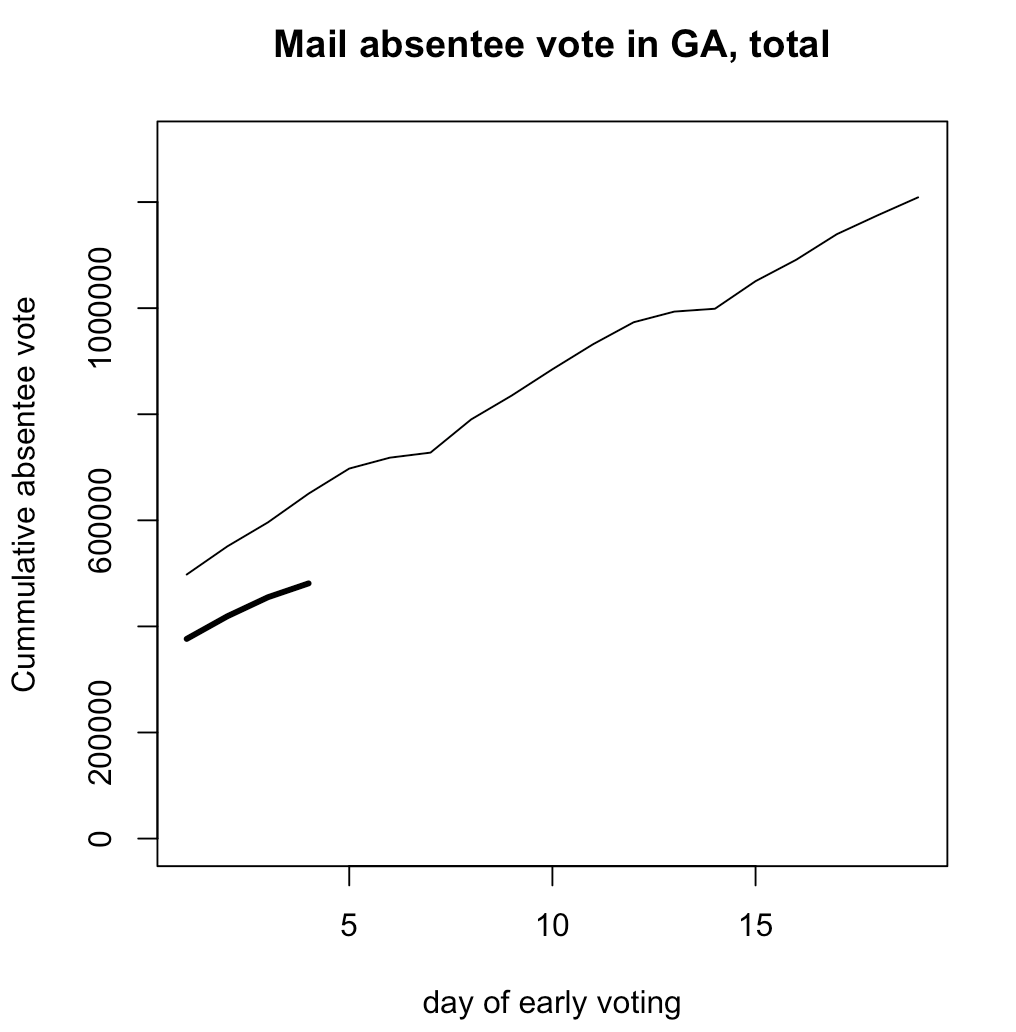
A SINGLE VERIFIED FACT
— David Baker Fight Like A Flynn (@IWasHrren) November 26, 2020
That proves VOTER FRAUD
in GEORGIA, without a doubt.
Trump was ahead. The vote counting was stopped-
BECAUSE A WATER PIPE BURST
Then Biden caught up
The water pipe
DID NOT BURST \U0001f448FACT
The Definitive Case Proving Donald Trump Won https://t.co/ZZZWChwKeP
Takes vote dumps in each state & plots ratios of Biden votes to Trump. Then draws three lines showing that if a data plot is above the line then it is in either the 95th percentile, 99th percentile, or 99.5th percentile. IOW, only one out of every two-hundred points are above it.
The study takes into account that large ballot dumps which heavily favor a candidate make sense, if there are also smaller ones which favor the candidate more. Seems logical. Larger data dumps should be smoother than smaller data dumps.
All states except MI/WI/GA are blue. Notice anything? Notice how the controversial and much needed dumps for Biden that happened in the wee hours of the morning in crucial states are the most unlikely of all data dumps?

Might say these were mail in ballots that were expected to heavily favor Biden. Why don't we see this in other states that weren't absolutely crucial to Biden's victory coming down the stretch? Why are these three states the most extreme? Why not heavy blue areas like NYC or SF?

-lots of paperwork. Filling it in triggers delays.
-trained customs staff. We're short by 50k. That'll cause delays.
- IT systems. Several haven't launched yet. More delays.
This is why there'll be shortages @jbhearn. /1
If you are an EU supporter or a U.K. Remainer then the best thing to do will be to start a rumour, preferably by an expert, that No Deal will lead to food shortages and panic buying. This will ensure it happens and then you can say \u201ctold you so\u201d you silly Brexiteers.
— Professor John Hearn (@jbhearn) December 14, 2020
If you're exporting to EU, in the case of food products (dead or alive) you also need an official veterinarian (that's a thing) working with a certification support officer to deal with the sanitary and phytosanitory checks to generate a European Health Certificate /2
That EHC is then submitted at a border control post and also on the EU import control system. Only then can the truck travel into the EU. /3
Thing is, the importer in the EU will have to input *LOTS* of information into the EU's trade control and expert system (not the same as as the EU import control system) because it's arriving from outside the EU. /4
Alternatively the EU importer can skip all of the admin, fees and taxes triggered by importing from the UK by instead sourcing from a EU based company. That is why brexit will be an economic calamity for the UK; the operational reality is going to trump the economic theory. /5

What Murph's reporting (& opining) on is a survey that showed, in a time of international crisis where Australia has performed relatively well, politicians benefit from a "competence dividend"
\U0001f644 pic.twitter.com/odGMUKzPnT
— Richard Chirgwin (@R_Chirgwin) December 25, 2020
That's neither a surprise, nor something to be sneered at. But it's a one-paragraph story. It's what you'd expect to see.
The journalist's role, you'd think, would be to critically unpick that. Work through what premiers & the PM did to deserve it, or otherwise.
One case that could be made is that the premiers stepped up, acted visibly & decisively on behalf of their respective states, & the PM is largely riding on their coattails.
Murph, though, has been on a weird campaign to position Morrison in particular as a statesman-in-waiting.
Once the federal government authorised Job Seeker/Lover/Keeper, Murph was convinced this was (bound to be) the end of Ideological Warrior Morrison and we'd see the emergence of pragmatic Morrison who could govern reasonably, in ways atypical of the way his party had been trending
LOL
And LOL again.
The early economic interventions were made with a gun to his head. The idea he'd suddenly become a learning learner who learns was something Murph seemed desperate to hold on to, like it was important for her sense that federal politics could work properly.


