Alex1Powell Categories Politics


When you see something like this we need to investigate a little and join the dots.
https://t.co/GIsIzIct4B

This guy always pops up somewhere along the way, so what is the true agenda here? Who are the players?
https://t.co/HOR94sif64

And now we tie George Soros to Lord Malloch Brown and the Privy council. Soros has just made Malloch Brown head of his Open Society foundation.
https://t.co/6ss7Brnzo4

Malloch Brown one of the heads of Smartmatic.
https://t.co/hvjUICnB3S

And of course let's not forget Domonion.
https://t.co/d3DlCLGoYO


Statewide: 2,097,269 (+26,075)
Fulton: 272,057 (+14,360)
Gwinnett: 182,924 (+9,753)
Columbia: 32,920 (+175)
Houston: 32,876 (+126)
Cherokee: 53,860 (+320)
Forsyth: 58,066 (+437)
Coweta: 26,575 (+203)
I'll post the rates tomorrow with the racial breakdown. For now, let's go with the raw totals.
What do we have from today? Well, Democrats probably added about 8K votes to their margin, per @joe__gantt's estimates. That's not as much as they'd have been hoping for, to be blunt.
But let's also remember that the second weekend in the general election was a pro-GOP day. So this is certainly not the worst-case scenario everyone worried about. All of that helps the Democrats. They'd have liked more, but...it's Boxing Day.
In the general election, for example, our estimate was that Biden won the first two days of early voting, three of the four weekend days, and Trump won basically every other day of early voting pic.twitter.com/9JID24eq3I
— Nate Cohn (@Nate_Cohn) December 15, 2020
Tomorrow, it appears as if DeKalb, Columbia, Fulton, and Gwinnett are open. This will likely result in another pro-Democratic day, but almost certainly with more votes cast. How much? I got no idea, but probably around 30K-40K. So Democrats will look to add about 10K to the lead.
We'll enter the last 4 days of early voting with approximately a (roughly) 190K vote lead for Democrats, in all likelihood. That'll leave the GOP with some ground to make up.




To all those RW Hindus & Non-Khalistani Sikhs telling me Sikhs are all patriots & only minorities are khalistanis. Then how come this body that manages Gurudwaras & sikh temples & appoints Jathedar of Akal Takht is supporting Khalistani protests?! https://t.co/3cxn4NPT5n pic.twitter.com/e56K4BEy6t
— Syamkrishnan Kamath (@Dharmi2020) December 7, 2020
Udasis the monastic wing of Sikhism that was started by Guru Nanak's son Sri Chand was expelled from Gurudwaras, their murtis thrown out & declared non sikh along with Nanakpanthis & several other Sikh sects that were close to Hinduism.

If Khalistan terrorism was not anti-Hindu should explain why one after the other each & every sect in Sikhism that is similar to Hinduism was thrown out since Akali movement of 1925? Sehajdharis are latest, in 2016 to be
35,000 Punjabi Hindus were killed by Khalistani terrorists in Punjab. I am yet to hear any demand of justice for them!
— Amit Srivastava (@AmiSri) December 4, 2020
Why were the the 1984 riots always mentioned by leaders across political spectrum, leaders in India & abroad. But have you ever heard anyone talk about those hindus who were killed by
Sir, with due respect data about deaths are not hidden!
— Amit Srivastava (@AmiSri) December 4, 2020
But for Sikhs, the issue is raised at every level - in state & national politics, in public, in judiciary, even at international level. But have you seen anyone even mentioning those unfortunate Hindus? That\u2019s the point!
One of the most ancient sects of Sikhs founded by Guru Nanak's son Sri Chand the Udasis, enjoyed state patronage & support under the sikh Empire of Ranjith Singh. How did they go from there to not even being sikhs in a matter of a few decades?
https://t.co/H7sYSUeBiS


how we found out about Zients' purchase of a surprise medical billing operation. (btw, "long term holdings" wannabe Berkshire Hathaway funds like Cranemere engage in EXTENSIVE due diligence, they knew what they were doing). https://t.co/9bXcWYhg0s (2/x)
How do you write about @revolvingdoorDC criticism of Zients without taking into account Zeints' leading role in NorthStar Anesthesia? (3/x)
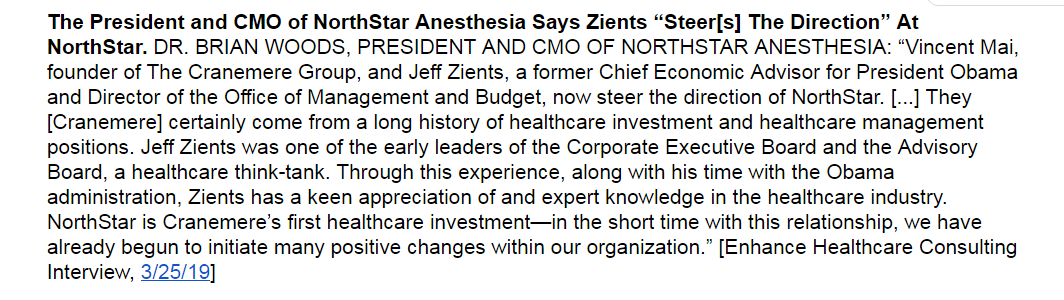
Does @DaHalperin maybe have some thoughts about Zients, the predatory for profit Kaplan college empire, and the Washington Post???? https://t.co/u7UIKAZ2bF (4/x)
What did NorthStar -- that Zients buddies at the Post Editorial Board think is unimportant -- do? During Cranemere's due diligence AND post-purchase, they engaged in surprise medical billing. (5/x)